


We came to US to become Americans not Indian-Americans: Jindal

January 16, 2015

Washington, Jan 16: Asserting that he didn't believe in hyphenated identities, Louisiana Governor Bobby Jindal has said that his parents came to the US from India four decades ago to become Americans and not Indian-Americans.bobby jindal
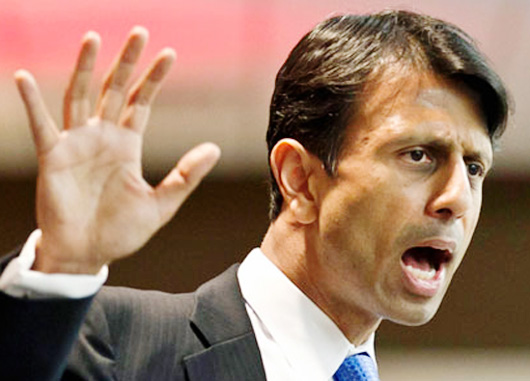
He invoked his ethnic heritage to make a call for immigrant assimilation in the multi-cultural American society and said people who talked about skin pigmentation were the "most dim-witted lot" around.

"My parents came in search of the American Dream, and they caught it. To them, America was not so much a place, it was an idea. My dad and mom told my brother and me that we came to America to be Americans. Not Indian-Americans, simply Americans," Jindal said in a prepared remarks that he is scheduled to deliver next week.

Jindal, the first Indian-American Governor of any American state, is scheduled to address the Henry Jackson Society on Monday in London.

Releasing the prepared remarks of Jindal's speech, his office said the Louisiana Governor will call for immigrant assimilation to strengthen countries and protect freedom.

"If we wanted to be Indians, we would have stayed in India. It's not that they are embarrassed to be from India, they love India. But they came to America because they were looking for greater opportunity and freedom," Jindal said, explaining the reason why he does not like to be called or described as an Indian-American.

"I do not believe in hyphenated Americans. This view gets me into some trouble with the media back home. They like to refer to Indian-Americans, Irish-Americans, African-Americans, Italian-Americans, Mexican-Americans, and all the rest. To be clear – I am not suggesting for one second that people should be shy or embarrassed about their ethnic heritage," he said.

"I am explicitly saying that it is completely reasonable for nations to discriminate between allowing people into their country who want to embrace their culture, or allowing people into their country who want to destroy their culture, or establish a separate culture within," he said.

"It is completely reasonable and even necessary for a sovereign nation to discriminate between people who want to join them and people who want to divide them. And immigration policy should have nothing at all to do with the colour of anyone's skin. I find people who care about skin pigmentation to be the most dim-witted lot around. I want nothing to do with that," he said.

Jindal said his objective in this speech is to speak clearly about what he believes to be America's proper role in international affairs; to speak bluntly about the nature of the threats being faced and the recent tragic events in France; and to suggest what he think is the way forward.

"The first step for America, and for any nation that wants to protect its own freedom and encourage it everywhere is to have a strong economy. When the United States became a major economic power at the end of the 19th century, it had the means to become a major military power and to become a leader in the free world," Jindal said.

The Governor said the first tenet of American foreign policy must always be freedom, and the relentless pursuit of freedom for our people, and for all people, regardless of race, creed, religion, ethnicity, or any other artificial divisions, which humans use to divide one from another.

"America must always be a beacon of freedom throughout the world. I'm not naive enough to suggest that the entire world will ever be free, but I'm also completely opposed to ever giving up on the notion that all people everywhere in the world deserve and desire to be free," he said.

"The next principle is of course security. America must and will pay any price to defend itself and to defend its allies. No two countries are the same, but those countries that value freedom and democracy and civility and decency must band together, and must defend each other," he said.

"Those countries that desire security and harbour no ill- will toward their neighbours must stick together in an increasingly dangerous world. The third principle that is crucial is truth. We must speak the truth, to each other, and to our own countrymen," he said.

"When a country or a movement is behaving badly on the international stage, we must not pretend otherwise. You cannot remedy a problem if you will not name it and define it. One of the most prominent examples in our day is ISIS and all forms of radical Islam. These people have no legitimate claim, they have no justification for their cowardly, barbaric, and inhuman behaviour, and we must not pretend otherwise," Jindal said.

Comments

Add new comment

  • Coastaldigest.com reserves the right to delete or block any comments.
  • Coastaldigset.com is not responsible for its readers’ comments.
  • Comments that are abusive, incendiary or irrelevant are strictly prohibited.
  • Please use a genuine email ID and provide your name to avoid reject.
Agencies
June 6,2020

Seoul, Jun 6: South Korea on Saturday reported 51 new cases of COVID-19, mostly in the densely populated capital region, as authorities scramble to stem transmissions among low-income workers who can't afford to stay home.

The figures announced by South Korea's Centers for Disease Control and Prevention brought national totals to 11,719 workers and 273 deaths.

At least 34 of the new coronavirus cases were linked to door-to-door sellers hired by Richway, a Seoul-based health product provider.

Vice Health Minister Kim Gang-lip said the spread of the virus among Richway sellers was particularly alarming as most of them are in their 60s and 70s. He called for officials to strengthen their efforts to find and examine workplaces vulnerable to infections.

More than 120 infections have also been linked to a massive warehouse operated by Coupang, a local e-commerce giant, which has been accused of failing to properly implement preventive measures and having employees work even when sick.

South Korea was reporting around 500 new cases per day in early March due to a massive outbreak surrounding the southern city of Daegu, before officials managed to stabilize the situation with aggressive tracking and testing.

But the recent resurgence of COVID-19 in the greater capital area, where about half of South Korea's 51 million people live, is now threatening to erase some of the country's hard-won gains. It has also led to second-guessing whether officials were too quick to ease social distancing and reopen schools.

Health authorities and hospital officials on Friday participated in a table-top exercise for sharing hospital capacities between Seoul and nearby cities and ensure swift transports of patients so that a spike of cases in one area doesn't overwhelm its hospital system. 

Comments

Add new comment

  • Coastaldigest.com reserves the right to delete or block any comments.
  • Coastaldigset.com is not responsible for its readers’ comments.
  • Comments that are abusive, incendiary or irrelevant are strictly prohibited.
  • Please use a genuine email ID and provide your name to avoid reject.
News Network
April 15,2020

Wuhan, Apr 15: In the six days after top Chinese officials secretly determined they likely were facing a pandemic from a new coronavirus, the city of Wuhan at the epicenter of the disease hosted a mass banquet for tens of thousands of people; millions began traveling through for Lunar New Year celebrations.

President Xi Jinping warned the public on the seventh day, Janaury 20. But by that time, more than 3,000 people had been infected during almost a week of public silence, according to internal documents obtained by The Associated Press and expert estimates based on retrospective infection data.

That delay from Jan 14 to Jan. 20 was neither the first mistake made by Chinese officials at all levels in confronting the outbreak, nor the longest lag, as governments around the world have dragged their feet for weeks and even months in addressing the virus.

But the delay by the first country to face the new coronavirus came at a critical time — the beginning of the outbreak. China's attempt to walk a line between alerting the public and avoiding panic set the stage for a pandemic that has infected almost 2 million people and taken more than 126,000 lives.

A This is tremendous, a said Zuo-Feng Zhang, an epidemiologist at the University of California, Los Angeles. If they took action six days earlier, there would have been much fewer patients and medical facilities would have been sufficient. We might have avoided the collapse of Wuhan's medical system.

Other experts noted that the Chinese government may have waited on warning the public to stave off hysteria, and that it did act quickly in private during that time.

But the six-day delay by China's leaders in Beijing came on top of almost two weeks during which the national Center for Disease Control did not register any cases from local officials, internal bulletins obtained by the AP confirm. Yet during that time, from Jan 5 to Jan 17, hundreds of patients were appearing in hospitals not just in Wuhan but across the country.

It's uncertain whether it was local officials who failed to report cases or national officials who failed to record them. It's also not clear exactly what officials knew at the time in Wuhan, which only opened back up last week with restrictions after its quarantine.

But what is clear, experts say, is that China's rigid controls on information, bureaucratic hurdles and a reluctance to send bad news up the chain of command muffled early warnings. The punishment of eight doctors for rumor-mongering, broadcast on national television on Jan. 2, sent a chill through the city's hospitals.

Doctors in Wuhan were afraid, said Dali Yang, a professor of Chinese politics at the University of Chicago. It was truly intimidation of an entire profession. Without these internal reports, it took the first case outside China, in Thailand on Jan 13, to galvanize leaders in Beijing into recognising the possible pandemic before them. It was only then that they launched a nationwide plan to find cases distributing CDC-sanctioned test kits, easing the criteria for confirming cases and ordering health officials to screen patients, all without telling the public.

The Chinese government has repeatedly denied suppressing information in the early days, saying it immediately reported the outbreak to the World Health Organization.

Allegations of a cover-up or lack of transparency in China are groundless, said foreign ministry spokesman Zhao Lijian at a Thursday press conference.

The documents show that the head of China's National Health Commission, Ma Xiaowei, laid out a grim assessment of the situation on Jan. 14 in a confidential teleconference with provincial health officials.

A memo states that the teleconference was held to convey instructions on the coronavirus from President Xi Jinping, Premier Li Keqiang and Vice Premier Sun Chunlan, but does not specify what those instructions were.

The epidemic situation is still severe and complex, the most severe challenge since SARS in 2003, and is likely to develop into a major public health event, the memo cites Ma as saying.

The National Health Commission is the top medical agency in the country. In a faxed statement, the Commission said it had organised the teleconference because of the case reported in Thailand and the possibility of the virus spreading during New Year travel. It added that China had published information on the outbreak in an open, transparent, responsible and timely manner," in accordance with important instructions repeatedly issued by President Xi.

The documents come from an anonymous source in the medical field who did not want to be named for fear of retribution. The AP confirmed the contents with two other sources in public health familiar with the teleconference. Some of the memo's contents also appeared in a public notice about the teleconference, stripped of key details and published in February.

Under a section titled sober understanding of the situation, the memo said that clustered cases suggest that human-to-human transmission is possible. It singled out the case in Thailand, saying that the situation had changed significantly because of the possible spread of the virus abroad.

With the coming of the Spring Festival, many people will be traveling, and the risk of transmission and spread is high, the memo continued.

Comments

Add new comment

  • Coastaldigest.com reserves the right to delete or block any comments.
  • Coastaldigset.com is not responsible for its readers’ comments.
  • Comments that are abusive, incendiary or irrelevant are strictly prohibited.
  • Please use a genuine email ID and provide your name to avoid reject.
News Network
June 6,2020

Washington, Jun 6: US President Donald Trump has said that countries like India and China would have much more coronavirus cases than America, the worst-hit country in the world, if they conduct more tests.

Trump, in his remarks at Puritan Medical Products in Maine, said that the US has carried out 20 million tests.

Compared to the US, Germany is at four million and much talked about South Korea is about three million tests, he said on Friday.

According to Johns Hopkins Coronavirus Resource Center, the US has reported nearly 1.9 million cases and over 1,09,000 deaths, making America the worst affected country, while the total number of coronavirus cases in India and China stand at 2,36,184 and 84,177 respectively.

India has so far conducted over 4 million coronavirus tests, according to the health ministry.

Commenting on the COVID-19 tests in the US, Trump said: "We will be well over 20 million tests. Remember this, when you test more, you have more cases.

"I say to my people every time we test; you find cases because we do more testing. If we have more cases, if we wanted to do testing in China or in India or other places, I promise you there would be more cases... you are doing a fantastic job in getting out the swabs".

Puritan is one of the only manufacturers in the world producing the high-quality medical swabs that are crucial for rapid testing.

"And every swab you make at Puritan is proudly stamped with the beautiful phrase made in the USA."

"Thanks to the testing capacity that you are making possible, our country is reopening and our economy is recovering like nobody would've thought possible," he said.

Referring to the latest monthly employment numbers, Trump said that the economy is now back on track.

"We absolutely shattered expectations, and this is the largest monthly jobs increase in American history, think of that; that's a long time.

"I think it's more than double or about double of what our highest was before so this is the largest monthly job increase in American history. And we're going to have a phenomenal next year. We're going to have a tremendous couple of months prior to the election on November 3 very, very important date," the president said.

Seeking re-election for his second consecutive term, Trump is pitted against Democratic presidential nominee Joe Biden in November 3 presidential elections. Most of the opinion polls shows that Biden is several points ahead of Trump.

"It's going to be a very important election because the only thing that can screw it up is if you get the wrong president and they raise your taxes, and they open up your borders so that everybody pours into our country," Trump said.

Reiterating that he has built a strong economy in the last three years, Trump vowed to bring the economy back on track, which has been badly hit by the coronavirus pandemic.

Describing the fight against coronavirus as the greatest national and industrial mobilisation since the World War II, Trump said that his administration has marshaled the full power of the US government and US industry to defeat the invisible enemy.

"It is indeed an enemy. It came from China, should have been stopped in China. They didn't do that," he alleged.

The administration, he said, has delivered over 1.5 billion pieces of personal protective equipment to doctors and nurses on the front lines. "We slashed the red tape to speed up the development of vaccines. And vaccines are coming along incredibly well, wait till you see, and therapeutics. And we partnered at private sector leaders such as Puritan to build the largest and most advanced testing capacity on the face of the earth, like this one," he said.

The Puritan factory in Maine, he said, quickly ramped up the production to produce nearly 20 million foam tipped swabs each month.

"Then in April, my administration invoked the Defence Production Act to help you scale up even more. Under a USD 75 million public-private partnership, Puritan will soon double production to 40 million swabs per month," Trump added.

Comments

Add new comment

  • Coastaldigest.com reserves the right to delete or block any comments.
  • Coastaldigset.com is not responsible for its readers’ comments.
  • Comments that are abusive, incendiary or irrelevant are strictly prohibited.
  • Please use a genuine email ID and provide your name to avoid reject.