


We came to US to become Americans not Indian-Americans: Jindal

January 16, 2015

Washington, Jan 16: Asserting that he didn't believe in hyphenated identities, Louisiana Governor Bobby Jindal has said that his parents came to the US from India four decades ago to become Americans and not Indian-Americans.bobby jindal
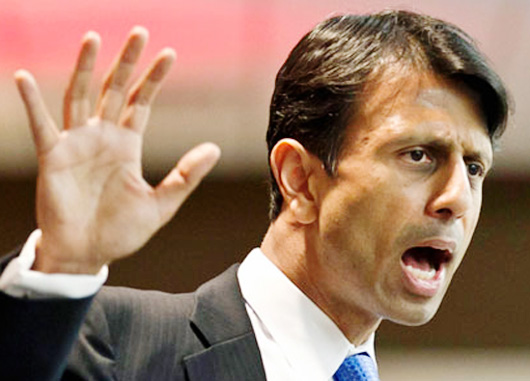
He invoked his ethnic heritage to make a call for immigrant assimilation in the multi-cultural American society and said people who talked about skin pigmentation were the "most dim-witted lot" around.

"My parents came in search of the American Dream, and they caught it. To them, America was not so much a place, it was an idea. My dad and mom told my brother and me that we came to America to be Americans. Not Indian-Americans, simply Americans," Jindal said in a prepared remarks that he is scheduled to deliver next week.

Jindal, the first Indian-American Governor of any American state, is scheduled to address the Henry Jackson Society on Monday in London.

Releasing the prepared remarks of Jindal's speech, his office said the Louisiana Governor will call for immigrant assimilation to strengthen countries and protect freedom.

"If we wanted to be Indians, we would have stayed in India. It's not that they are embarrassed to be from India, they love India. But they came to America because they were looking for greater opportunity and freedom," Jindal said, explaining the reason why he does not like to be called or described as an Indian-American.

"I do not believe in hyphenated Americans. This view gets me into some trouble with the media back home. They like to refer to Indian-Americans, Irish-Americans, African-Americans, Italian-Americans, Mexican-Americans, and all the rest. To be clear – I am not suggesting for one second that people should be shy or embarrassed about their ethnic heritage," he said.

"I am explicitly saying that it is completely reasonable for nations to discriminate between allowing people into their country who want to embrace their culture, or allowing people into their country who want to destroy their culture, or establish a separate culture within," he said.

"It is completely reasonable and even necessary for a sovereign nation to discriminate between people who want to join them and people who want to divide them. And immigration policy should have nothing at all to do with the colour of anyone's skin. I find people who care about skin pigmentation to be the most dim-witted lot around. I want nothing to do with that," he said.

Jindal said his objective in this speech is to speak clearly about what he believes to be America's proper role in international affairs; to speak bluntly about the nature of the threats being faced and the recent tragic events in France; and to suggest what he think is the way forward.

"The first step for America, and for any nation that wants to protect its own freedom and encourage it everywhere is to have a strong economy. When the United States became a major economic power at the end of the 19th century, it had the means to become a major military power and to become a leader in the free world," Jindal said.

The Governor said the first tenet of American foreign policy must always be freedom, and the relentless pursuit of freedom for our people, and for all people, regardless of race, creed, religion, ethnicity, or any other artificial divisions, which humans use to divide one from another.

"America must always be a beacon of freedom throughout the world. I'm not naive enough to suggest that the entire world will ever be free, but I'm also completely opposed to ever giving up on the notion that all people everywhere in the world deserve and desire to be free," he said.

"The next principle is of course security. America must and will pay any price to defend itself and to defend its allies. No two countries are the same, but those countries that value freedom and democracy and civility and decency must band together, and must defend each other," he said.

"Those countries that desire security and harbour no ill- will toward their neighbours must stick together in an increasingly dangerous world. The third principle that is crucial is truth. We must speak the truth, to each other, and to our own countrymen," he said.

"When a country or a movement is behaving badly on the international stage, we must not pretend otherwise. You cannot remedy a problem if you will not name it and define it. One of the most prominent examples in our day is ISIS and all forms of radical Islam. These people have no legitimate claim, they have no justification for their cowardly, barbaric, and inhuman behaviour, and we must not pretend otherwise," Jindal said.

Comments

Add new comment

  • Coastaldigest.com reserves the right to delete or block any comments.
  • Coastaldigset.com is not responsible for its readers’ comments.
  • Comments that are abusive, incendiary or irrelevant are strictly prohibited.
  • Please use a genuine email ID and provide your name to avoid reject.
News Network
May 21,2020

Canberra, May 21: Australian Prime Minister Scott Morrison and his Indian counterpart, Narendra Modi, are looking forward to deepening the countries' strategic relationship, with both sides expected to sign a range of pacts from defence to trade in strategic sectors amid heightened tensions with China over Beijing's response to coronavirus pandemic.

During a virtual summit, scheduled to take place on June 4, both leaders are expected to ramp up efforts to diversify Australia's export markets and find trusted suppliers of vital products and components, a local newspaper, The Australian reported on Tuesday.

The new agreements will focus on reliable supply chains in key strategic sectors, including medical goods, technology and critical minerals, amid heightened tensions with China over Beijing's response to coronavirus pandemic.

The leaders will seal a new defence agreement allowing reciprocal access to bases and co-operation on military technology projects, while a new education partnership will be on the table to help overcome Australian university reliance on Chinese students.

The talks in terms of strategic convergence, now have greater significance as COVID-19 exacerbates the strategic contest between the US and China, and forces like-minded countries to seek out reliable partners.

Australian farmers could also benefit, with talks underway on expanding agricultural exports to India, including barley, as China throws up new trade barriers, media reports stated.

The virtual summit follows the cancellation of Morrison's planned state visit to India in January due to the bushfires.

Morrison said last year, ahead of his planned visit, that India was "a natural partner for Australia", referring to the countries' "shared values" -- a point of differentiation with China.

Former Department of Foreign Affairs and Trade secretary Peter Varghese, who wrote a landmark report on the bilateral relationship in 2018, was quoted by the newspaper as saying that India would be even more important to Australia in the post-COVID world. "If one of the lessons from COVID is that countries need to spread their risk, then finding new markets or building up existing markets is a crucial part of that," he added.

Varghese noted that India, a member of the Quadrilateral Security Dialogue along with Australia, Japan and the US, was a vital strategic partner to Australia in helping "constrain China's ambitions to be the predominant power".

"That shared objective between Australia and India of not wanting to see the region dominated by China is a key component of building up our geopolitical relationship," he told The Australian.

The summit also follows recent talks between Australian Foreign Minister Marise Payne and Indian counterpart Subrahmanyam Jaishankar on the pandemic response and Australia's call for an independent inquiry, which was overwhelmingly backed at the World Health Assembly on Tuesday.

Australia wants to support India to develop a domestic critical minerals processing industry, which would provide Western nations with an alternative to sourcing the materials from China.

Meanwhile, India has strong expertise as a manufacturer of drugs and medical equipment, while Australia is a centre of biomedical research, opening the possibility for closer co-operation in the key sector, the media reported further.

Comments

Add new comment

  • Coastaldigest.com reserves the right to delete or block any comments.
  • Coastaldigset.com is not responsible for its readers’ comments.
  • Comments that are abusive, incendiary or irrelevant are strictly prohibited.
  • Please use a genuine email ID and provide your name to avoid reject.
News Network
July 17,2020

Jul 17: US President Donald Trump has said that he wants to do everything possible to keep peace for the people of India and China, according to his spokesperson

Over the past several weeks, the Trump administration has come out in support of India against China.

“He (Trump) said I love the people of India and I love the people of China and I want to do everything possible to keep the peace for the people,” White House Press Secretary Kayleigh McEnany told reporters at a news conference here on Thursday.

She was responding to a question on Trump’s message to India, which recently had a standoff with China in eastern Ladakh along the Line of Actual Control.

Earlier in the day, White House Economic Advisor Larry Kudlow described India as a great ally, saying President Trump is a great friend of Prime Minister Narendra Modi.

On Wednesday, Secretary of State Mike Pompeo said that India has been a great partner of the US.

“India has been a great partner… They are an important partner of ours. I have a great relationship with my foreign minister counterpart. We talked frequently about a broad range of issues. We talked about the conflict they had along the border with China. We've talked about the risk that emanates from the Chinese telecommunication infrastructure there,” Pompeo told reporters in response to a question.

Travelling in Europe, US National Security Advisor Robert O’Brien told reporters that China has been very aggressive with India.

O’Brien said that India is a democracy and is a great friend of the United States. Prime Minister “Modi and President Trump have a super relationship,” he said.

“In fact, it was the last foreign trip that I took with the president before the COVID-19 crisis hit, was to India, and we had a great reception of the Indian people there. We have a lot in common with them, we speak English, we're democracies. We've got a growing, very strong relationship with India,” O’Brien said.

Welcoming the White House statement, Al Mason, co-chair of the Trump Victory Indian American Finance Committee, said that unlike his predecessor, President Trump has come out openly in support of India.

“Most of the Indian-Americans have observed that every earlier president - be it a Democrat or Republican, like Clinton or Bush Senior or Bush Jr or Obama have been very scared to side with India openly, for fear of hurting China.

“Only President Trump has had the courage to say that… I love India, America respects India… US stands with India - and that also, to over one billion Indians in India at the Namaste Trump rally held in India… and that too… near India’s neighbour China,” Mason said in a statement.

“And he is consistent in his love for India and Indian-Americans,” he added.

Comments

Add new comment

  • Coastaldigest.com reserves the right to delete or block any comments.
  • Coastaldigset.com is not responsible for its readers’ comments.
  • Comments that are abusive, incendiary or irrelevant are strictly prohibited.
  • Please use a genuine email ID and provide your name to avoid reject.
News Network
April 12,2020

Apr 12: Pope Francis called on Sunday for an "immediate" ceasefire in global conflict and urged European nations to show "solidarity" in the face of a coronavirus pandemic that has claimed more than 109,000 lives worldwide.

"May Christ our peace enlighten all who have responsibility in conflicts, that they may have the courage to support the appeal for an immediate global ceasefire in all corners of the world," the pope said in a livestreamed Easter message.

Francis added that it was time for Europe, which he described as his "beloved continent", to "rise again, thanks to a concrete spirit of solidarity" similar to that shown after World War II.

Christians around the world are marking a solitary Easter, forced to celebrate the most joyful day in the Christian calendar largely alone amid the sorrowful reminders of the devastation wrought by the coronavirus pandemic

Comments

Add new comment

  • Coastaldigest.com reserves the right to delete or block any comments.
  • Coastaldigset.com is not responsible for its readers’ comments.
  • Comments that are abusive, incendiary or irrelevant are strictly prohibited.
  • Please use a genuine email ID and provide your name to avoid reject.