



WhatsApp co-founder Jan Koum to quit in loss of privacy advocate at Facebook

Agencies
May 1, 2018

San Francisco, May 1: The co-founder of WhatsApp, a messaging service owned by Facebook Inc with more than 1 billion daily users, said on Monday he was leaving the company, in a loss of one of the strongest advocates for privacy inside Facebook.

Jan Koum`s plan to exit comes after clashing with the parent company over WhatApp`s strategy and Facebook`s attempts to use its personal data and weaken its encryption, the Washington Post earlier reported, citing people familiar with the internal discussions.

"It`s been almost a decade since Brian and I started WhatsApp, and it`s been an amazing journey with some of the best people," Koum, WhatsApp`s chief executive, said in a post on his Facebook page referring to co-founder Brian Acton.

"But it is time for me to move on." He did not give a date for his departure and could not immediately be reached for comment.

Acton left the messaging service company in September to start a foundation, after spending eight years with WhatsApp.

Facebook Chief Executive Mark Zuckerberg commented on Koum`s post, saying he was grateful for what Koum taught him about encryption "and its ability to take power from centralized systems and put it back in people`s hands. Those values will always be at the heart of WhatsApp."

Facebook has battled European regulators over a plan to use WhatsApp user data, including phone numbers, to develop products and target ads. The plan is suspended, but WhatsApp said last week it still wanted to move forward eventually.

Stanford alumnus Acton and Ukrainian immigrant Koum co-founded WhatsApp in 2009. Facebook bought WhatsApp in 2014 for $19 billion in cash and stock.

WhatsApp, a pun on the phrase "What`s up?," grew in popularity in part because its encrypted messages are stored on users` smartphones and not on company servers, making the service more private.

Concerns about Facebook`s handling of personal information have grown since the social network`s admission in March that the data of millions of users was wrongly harvested by political consultancy Cambridge Analytica.

Facebook has taken steps to generate revenue from WhatsApp, which unlike Facebook does not have advertising.

WhatsApp`s management has fiercely opposed advertising, saying in 2012 that they did not want to be "just another ad clearinghouse" where the engineering team "spends their day tuning data mining."

Instead, WhatsApp charged a $1 annual subscription. It dropped that in 2016, moving towards a plan to charge businesses for specialised accounts.

Comments

Add new comment

  • Coastaldigest.com reserves the right to delete or block any comments.
  • Coastaldigset.com is not responsible for its readers’ comments.
  • Comments that are abusive, incendiary or irrelevant are strictly prohibited.
  • Please use a genuine email ID and provide your name to avoid reject.
News Network
August 8,2020

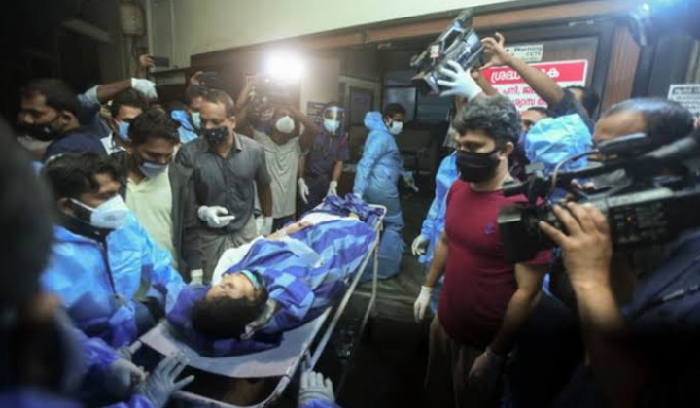
Kozhikode, Aug 8: A family of five, returning to their hometown at Koducalli in Kozhikode from Dubai, were aboard the fateful Air India Express flight that crash-landed at the Kozhikode airport claiming at least 18 lives on Friday.

Saifudheen, 40, is a businessman in Dubai. During the vacation when schools were closed here, his wife Fasalunnisa travelled, along with their children Muhammad Shahil, Fathima Sana and Aysha Shanza, to meet her husband.

On Friday, they were all travelling in the Air India aircraft to Kozhikode.

All five have received injuries and have been admitted to Baby Memorial Hospital Kozhikode except Sana, who is admitted to Al Shifa Hospital at Perinthalmanna in Malappuram.

"Saifudheen is my uncle. He and his family members were returning from Dubai when this unfortunate incident occurred. We were informed about the mishap at 8 pm. Now the family members have been shifted to Baby Memorial Hospital and everyone is fine now," Muhammad Salih, nephew of Saifudheen said.

The death toll in the flight crash landing incident at Kozhikode International Airport in Kerala rose to 18, including two pilots, Civil Aviation Minister Hardeep Singh Puri said on Saturday.

The minister said that he will visit the Kozhikode airport to take stock of the situation.

Two special relief flights have been arranged from Delhi and one from Mumbai for rendering humanitarian assistance to all the passengers and the family members.

Aircraft Accident Investigation Bureau (AAIB), Directorate General of Civil Aviation (DGCA) and Flight Safety Departments have reached to investigate the incident, the Air India Express stated.

Comments

Add new comment

  • Coastaldigest.com reserves the right to delete or block any comments.
  • Coastaldigset.com is not responsible for its readers’ comments.
  • Comments that are abusive, incendiary or irrelevant are strictly prohibited.
  • Please use a genuine email ID and provide your name to avoid reject.
News Network
May 6,2020

Washington, May 6: At a time when the coronavirus pandemic has squeezed them, multi-national companies in America are laying off workers while paying cash dividends to their shareholders. Thus making the workers bear the brunt of the sacrifices while the shareholders continue to collect.

The Washington Post said in one of its reports that five big American companies have paid a combined USD 700 million to shareholders while cutting jobs, closing plants and leaving thousands of their workers filing for unemployment benefits.

Since the pandemic was declared an emergency, Caterpillar has suspended operations at two plants and a foundry, Levi Strauss has closed stores, and toolmaker Stanley Black & Decker has been planning layoffs and furloughs.

Steelcase, an office furniture manufacturer, and World Wrestling Entertainment have also shed employees.

Executives of those companies told the Post that the layoffs support the long-term health of their companies, and often the executives are giving up a piece of their salaries. Furloughed workers can apply for unemployment benefits.

But distributing millions of dollars to shareholders while leaving many workers without a paycheck is unfair, critics argue, and belies the repeated statements from executives about their concern for employees' welfare during the coronavirus crisis.

Caterpillar, for example, announced a USD 500 million distribution to shareholders April 8, about two weeks after indicating that operations at some plants would stop. The company however declined to divulge how many workers are affected.

"We are taking a variety of actions globally, but we aren't going to discuss the number of impacted people," spokeswoman of the company, Kate Kenny, said in a reply to an email by the Post.

This spate of dividends is also likely to revive long-standing debates about economic rewards.

"There are no hard-and-fast rules about this," said Amy Borrus, deputy director of the Council of Institutional Investors, a group that argues for shareholder rights and represents pension funds and other long-term investors.

Many large US companies choose to issue a regular, quarterly dividend to shareholders, often increasing it, and they boast about these payments because they help keep the share price higher than it might otherwise be. Those companies might be reluctant to announce that they are cutting or suspending their dividend during a crisis, Borrus was further quoted as saying.

But "companies have to be mindful of the optics of paying dividends if they're laying off thousands of workers," she added.

On March 26, Caterpillar had announced that because of the pandemic, it was "temporarily suspending operations at certain facilities." Two plants, in East Peoria, Ill., and Lafayette, Ind., were coming to a halt, as well as a foundry in Mapleton, Ill., according to news reports.

"We are taking a variety of actions at our global facilities to reduce production due to weaker customer demand, potential supply constraints and the spread of the covid-19 pandemic and related government actions," Kenny said via email.

"These actions include temporary facility shutdowns, indefinite or temporary layoffs," she added.

Similarly, Levi Strauss announced April 7 that the company would stop paying store workers, and about 4,000 are now on furlough. On the same day, the company announced that it was returning USD 32 million to shareholders.

"As this human and economic tragedy unfolds globally over the coming months, we are taking swift and decisive action that will ensure we remain a winner in our industry," Chip Bergh, president and chief executive of the company, also told the Post.

Stanley Black & Decker announced on April 2 that it was planning furloughs and layoffs because of the pandemic. Two weeks later, it issued a dividend to shareholders of about USD 106 million.

The notion that a company's primary purpose is to serve shareholders gained prominence in the 1980s but has come under attack in recent years, even from business executives, the newspaper reported.

Corporate decisions to suspend dividends and buybacks are complex, however, and it is difficult to know whether these suspensions of dividend and buyback programs were motivated by a desire to conserve cash in anticipation of bad times, and how much they are prompted by a sense of obligation to employees.

Over recent decades, the mandate to "maximize shareholder value" has become orthodoxy, for many, and it is often unclear what motivates companies to pare dividends or buybacks for shareholders, said William Lazonick, an emeritus economics professor at the University of Massachusetts at Lowell, who has been one of the leading critics of companies that distribute cash to shareholders through stock buybacks and dividends rather than reinvesting the profits into employees, innovation and production.

Comments

Add new comment

  • Coastaldigest.com reserves the right to delete or block any comments.
  • Coastaldigset.com is not responsible for its readers’ comments.
  • Comments that are abusive, incendiary or irrelevant are strictly prohibited.
  • Please use a genuine email ID and provide your name to avoid reject.
News Network
January 1,2020

Jammu, Jan 1: As many as 160 terrorists were killed in Jammu and Kashmir this year, while 250 terrorists, including 102 of Pakistani origin, were active in the Valley, Director General of Police (DGP) Dilbag Singh said on Tuesday, noting that terror incidents and the number of local youths turning towards terrorism have decreased.

"250 terrorists have been active in Jammu and Kashmir. There is a decrease in number of active terrorists as compared to last year," Mr Singh said at the annual press conference at police headquarters in Jammu.

The DGP said that there is 30 per cent fall in terrorist incidents, less civilian killings and 36 per cent decrease in law and order incidents as compared to 2018.

"218 such (local) youths joined militant outfits in 2018 but only 139 joined in 2019," he said. Out of these new recruits only 89 have survived.

"The rest have been eliminated as their shelf life is between 24 hours to 2-3 months after joining militancy. There are hardly few old terrorists surviving, which include Jehangir Saroori and Riyaz Nayikoo", he said.

There have been only 481 law and order incidents this year as compared to 625 last year, he said.

There were 80 per cent successful anti-terror operations in which 160 terrorists, including foreigners, have been killed during the year.

Mr Singh said 102 terrorists have been arrested and 10 terrorists surrendered during the year.

He said that 102 Pakistan origin terrorists are still operating in Kashmir.

"Eleven valiant police personnel from Jammu and Kashmir besides 72 from other other security forces have been martyred," he said.

There was no collateral damage during anti-terror operation as people fully cooperated. "There was zero law and order problem this year (during anti terror operations)," he added.

The DGP said that "there has been a high degree of incidents of infiltration attempts from across the border this year and also ceasefire violations. But security forces have successfully foiled these attempted as 130 infiltrators have entered in 2019 as compared to 143 last year".

He said Jammu and Kashmir Police has set an example by handling the law and order situation in the most "exemplary" way following the abrogation of Article 370 provisions.

It was the biggest challenge faced by the force in 2019, but "we handled the most critical phase in the best way" and there was no civilian casualty during the period, he said.

Dismissing claims of minors being arrested by police in Kashmir, he said that it is being used as propaganda by some people and asserted that the J-K police has acted within the limits of law.

"We are open to scrutiny. The issue reached the Supreme Court which referred it to Jammu and Kashmir high court. The matter was inquired by the HC committee. The SC said that there is no misuse of law by law enforcement agency. J-K police has acted within the limits of law," he said.

Replying to queries on restoration of internet, the DGP said it is under consideration. "I think J-K is moving towards such a situation (on law and order front). Very soon you will hear positive announcement," Mr Singh said.

He said that though some people will try to misuse internet, "in the past, we took care of them and we will take care of such people in the future too".

Internet services in all government-run hospitals and SMS to all mobile phones will be restored from December 31 midnight in the Kashmir Valley, Jammu and Kashmir official spokesman Rohit Kansal said on Tuesday.

On December 10, some short message service (SMS) were enabled on mobile phones in order to facilitate students, scholarship applicants, traders and others. It has now been decided to fully restore the service throughout Kashmir from midnight of December 31, Kansal said.

Mobile Internet services were restored in Kargil district of Ladakh on Friday after remaining suspended for 145 days in the wake of the Centre abrogating provisions of Article 370 of the Constitution, officials said.

Internet services were suspended on August 4, a day before the Centre announced abrogation of Article 370 and division of the state into the union territories of Jammu and Kashmir, and Ladakh.

Comments

Add new comment

  • Coastaldigest.com reserves the right to delete or block any comments.
  • Coastaldigset.com is not responsible for its readers’ comments.
  • Comments that are abusive, incendiary or irrelevant are strictly prohibited.
  • Please use a genuine email ID and provide your name to avoid reject.