



White House bars CNN, NYT, LA Times, BuzzFeed from press briefing

February 25, 2017

Washington, Feb 25: The White House excluded several major US news organisations, including some it has criticised, from an off-camera briefing held by the White House press secretary on Friday.
press

Reporters for CNN, The New York Times, Politico, The Los Angeles Times and BuzzFeed were not allowed into the session in the office of press secretary Sean Spicer.

Spicer's off-camera briefing, or “gaggle,” replaced the usual televised daily news briefing in the White House briefing room. He did not say why those particular news organisations were excluded, a decision which drew strong protests.

Reuters was included in the session, along with about 10 other news organisations, including Bloomberg and CBS.

President Donald Trump has regularly attacked the media and at a gathering of conservative activists on Friday he criticized news organisations that he said provide “fake news”, calling them the “enemy” of the American people.

Spicer said his team decided to have a gaggle in his office on Friday instead of a full briefing in the larger White House briefing room and argued that “we don't need to do everything on camera every day.”

Reporters at the Associated Press and Time magazine walked out of the briefing when hearing that others had been barred from the session.

Off-camera gaggles are not unusual. The White House often invites handpicked outlets in for briefings, typically for specific topics. But briefings and gaggles in the White House are usually open to all outlets and they are free to ask anything.

A pool reporter from Hearst Newspapers was included in the gaggle on Friday and gave full details to the entire press corps. Media outlets allowed into the gaggle also shared their audio with others.

Protests

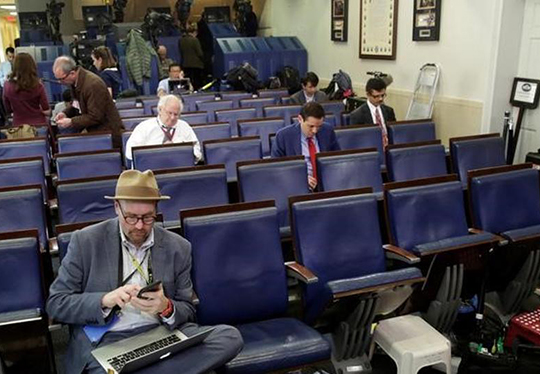
Journalists leave after several major news organizations including CNN, The New York Times and Politico were excluded from an off camera "gaggle" meeting with White House Press Secretary Sean Spicer in his office that was held in place of the regular daily press briefing at the White House in Washington, U.S., February 24, 2017. (Reuters)
Spicer's decision drew a sharp response from some of the media outlets that were excluded.

“Nothing like this has ever happened at the White House in our long history of covering multiple administrations of different parties,” Dean Baquet, executive editor of The New York Times, said in a statement.

“We strongly protest the exclusion of The New York Times and the other news organizations. Free media access to a transparent government is obviously of crucial national interest.”

The White House Correspondents Association, or WHCA, also protested.

“The WHCA board is protesting strongly against how today's gaggle is being handled by the White House,” said Jeff Mason, president of the association and a Reuters reporter.

During the election campaign last year, Trump's team banned a few news organisations, including The Washington Post and BuzzFeed, from covering his campaign rallies for a period of time to protest their coverage.

CNN posted a Twitter message on Friday afternoon saying: “This is an unacceptable development by the Trump White House. Apparently this is how they retaliate when you report facts they don't like. We'll keep reporting regardless.”

Ben Smith, editor-in-chief of BuzzFeed News, said in a statement: “While we strongly object to the White House's apparent attempt to punish news outlets whose coverage it does not like, we won't let these latest antics distract us from continuing to cover this administration fairly and aggressively.”

On Friday, Spicer said the White House plans to fight against what it says is unfair coverage.

“I think we're going to aggressively push back,” he said. “We're just not going to sit back and let false narratives, false stories, inaccurate facts get out there.”

Comments

Add new comment

  • Coastaldigest.com reserves the right to delete or block any comments.
  • Coastaldigset.com is not responsible for its readers’ comments.
  • Comments that are abusive, incendiary or irrelevant are strictly prohibited.
  • Please use a genuine email ID and provide your name to avoid reject.
News Network
January 12,2020

Washington, Jan 12: US president Donald Trump said Saturday the United States was monitoring Iranian demonstrations closely, warning against any new “massacre” as protests broke out after Tehran admitted to shooting down a passenger plane.

Iran said earlier it unintentionally downed a Ukrainian jetliner outside Tehran, killing all 176 people aboard, in an abrupt about-turn after initially saying that it had crashed due to mechanical failure. The firing came shortly after Iran launched missiles at bases in Iraq housing American forces.

President Hassan Rouhani said a military probe into the tragedy had found that “missiles fired due to human error” brought down the Boeing 737, calling it an “unforgivable mistake.”

Trump told Iranians -- in tweets in both English and Farsi -- that he stands by them and is monitoring the demonstrations.

“To the brave, long-suffering people of Iran: I've stood with you since the beginning of my Presidency, and my Administration will continue to stand with you,” he tweeted.

“There can not be another massacre of peaceful protesters, nor an internet shutdown. The world is watching,” he added, apparently referring to an Iranian crackdown on street protests that broke out in November.

“We are following your protests closely, and are inspired by your courage," he said.

The new demonstrations follow an Iranian crackdown on street protests that broke out in November. Amnesty International has said it left more than 300 people dead. Internet access was reportedly cut off in multiple Iranian provinces ahead of memorials planned a month after the protests.

On Saturday evening, police dispersed students who had converged on Amir Kabir University in Tehran to pay tribute to the victims, after some among the hundreds gathered shouted "destructive" slogans, Fars news agency said.

State television reported that students shouted "anti-regime" chants, while the news agency Fars reported that posters of Soleimani had been torn down.

Comments

Add new comment

  • Coastaldigest.com reserves the right to delete or block any comments.
  • Coastaldigset.com is not responsible for its readers’ comments.
  • Comments that are abusive, incendiary or irrelevant are strictly prohibited.
  • Please use a genuine email ID and provide your name to avoid reject.
News Network
April 26,2020

Apr 26: The remarkable story of an airman who overcame prejudice to become one of only a handful of Indian fighter pilots in the First World War has emerged in newly-released archive files by the UK's Commonwealth War Graves Commission (CWGC).

Lieutenant Shri Krishna Chanda Welinkar is one of the thousands of moving stories from the war preserved in family correspondence and being brought alive as part of a digitisation project.

The never-before-published files contain thousands of letters, pictures and other papers sent between the Commission and the next of the kin of First World War dead.

Among them is the story of Welinkar, who hailed from Bombay in colonial India. After much hardship and discrimination, he eventually became a pilot and went missing while on patrol over the skies above the Western Front in June 1918.

His family had to wait nearly three years before they finally knew for certain that he had died, and his grave was located.

“For everyone who died in the First World War, there was inevitably a partner, parent or child back home who had questions. The heartbreaking letters in CWGC's archive give us an insight into what it was like for those families trying to come to terms with their loss,” said Andrew Fetherston, chief archivist for CWGC.

“They are stories that show desperate searches for closure, former enemies uniting and, on many occasions, the sad realisation that a missing loved one would always remain so. We are pleased to be able to make this invaluable piece of World War history accessible to a new generation and help deepen our understanding of how the First World War impacted those who were left behind,” he said.

Welinkar was one of the 1.3 million Indians who answered the call to fight for the British Empire. Nearly 74,000 never saw their homeland again and are remembered today in cemeteries and memorials throughout the world, including France, Belgium, the Middle East and Africa.

Welinkar was a well-educated man studying at Cambridge University. He trained to become an aviator in Middlesex and wished to join the Royal Flying Corps, later known as the Royal Air Force.

Upon attempting to enlist, Welinkar encountered the same prejudices as his other fellow Indian airmen and was encouraged to become an air mechanic instead.

He was eventually given a commission in the Royal Flying Corps as an Officer. In 1918, he was posted to France and patrolled the skies above the Western Front.

In June 1918, Lieutenant Welinkar embarked on what would be his final patrol; he did not return and was reported missing. His fate remained unknown for many months afterwards.

The newly-released e-files chronicle the remarkable discovery of Welinkar and his final resting place long after the war had ended. Colonel Barton, who knew Welinkar, acted on behalf of his mother and helped find her missing son. They spoke to former enemies and honed their search to the grave of an unidentified man, buried by the Germans as “Oberleutnant S.C. Wumkar” in a grave in Rouvroy, Belgium.

The body was later moved and reinterred in Hangard Communal Cemetery Extension but it wasn't until the vital clue, found in the original German burial records in February 1921, that it was confirmed beyond doubt this grave was of Welinkar's.

In May 1921, Colonel Barton, on behalf of Welinkar's mother, requested that a Commission headstone be placed on the grave with the following personal inscription: “To the Honoured Memory of One of the Empire's Bravest Sons”.

This records – known as Enquiry Files – are part of a collection of nearly 3,000 files which have never been made available to the public before. Nearly half have been digitised so far, alongside a previously unreleased collection of more than 16,000 photographs held in negatives in the Commission's archive.

The files, internally referred to simply as E-Files, contain correspondence between the CWGC and the next of kin of the war dead. They often contain letters, typed memos between Commission staff and on occasion photos, maps and diagrams.

CWGC only holds an enquiry file for a small proportion of the 1.7 million people it commemorates from the Commonwealth. Today it is only possible to release those surviving records from the First World War because correspondence with families of Second World War casualties often involves people still alive today and cannot be made public for many years, due to the UK's data protection rules.

To date, more than 1,300 of the surviving 3,000 First World War enquiry files have been digitised.

The CWGC commemorates the 1.7 million Commonwealth servicemen and women who died during the two World Wars. It also holds and updates an extensive and accessible records archive, while operating over 23,000 locations in more than 150 countries and territories.

Comments

Add new comment

  • Coastaldigest.com reserves the right to delete or block any comments.
  • Coastaldigset.com is not responsible for its readers’ comments.
  • Comments that are abusive, incendiary or irrelevant are strictly prohibited.
  • Please use a genuine email ID and provide your name to avoid reject.
News Network
May 19,2020

Washington, May 19: As the scientists across the world are struggling to develop a vaccine for combating coronavirus, US drugmaker Moderna announced on Monday (local time) that the phase I trial of its Covid-19 vaccine has shown positive early results.

The company is hopeful that it's vaccine could be available to the public as early as January next year. Several firms across the world are in the race to develop a vaccine for the deadly virus which has claimed over 3 lakh lives worldwide.

CNN citing Dr. Tal Zaks, Moderna's chief medical officer reported that "if future studies go well, the company's vaccine could be available to the public as early as January".

"This is absolutely good news and news that we think many have been waiting for for quite some time," Zaks was quoted as saying.

Moderna, based in Cambridge, Massachusetts announced that the vaccine developed neutralising antibodies to the virus at levels reaching or exceeding the levels seen in people who have naturally recovered from Covid-19, reported CNN.

These will be followed by phase 2 trials and phase 3 trials, which Moderna plans to start in July.

President Donald Trump had on Friday said that that the United States will be able to deliver a few hundred million doses of COVID-19 vaccine, under 'Operation Warp Speed', by the end of this year.

"I have very recently seen early data from a clinical trial with a coronavirus vaccine and this data made me feel even more confident that we'll be able to deliver a few hundred million doses of vaccine by the end of 2020 and we will do the best we can," Trump had said at a press conference at the White House on Friday.

Comments

Add new comment

  • Coastaldigest.com reserves the right to delete or block any comments.
  • Coastaldigset.com is not responsible for its readers’ comments.
  • Comments that are abusive, incendiary or irrelevant are strictly prohibited.
  • Please use a genuine email ID and provide your name to avoid reject.