



White House invites Modi to visit U.S.

May 17, 2014

Washington, May 17: U.S. President Barack Obama effectively reversed a nine-year U.S. visa ban when he congratulated Gujarat Chief Minister Narendra Modi on his party's “historic” victory in the Indian general election, and then invited Mr. Modi to visit the U.S. at a “mutually agreeable time to further strengthen our bilateral relationship.”
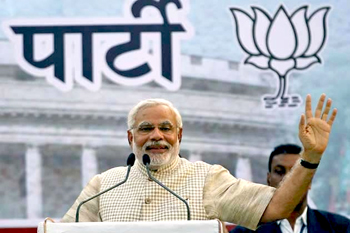
White_House_invites_ModiAdditionally, the White House said on Friday, “We look forward to working with [the new Indian government] once formed to advance our partnership.”

U.S. Secretary of State John Kerry chose micro-blogging site Twitter to say to Mr. Modi, “Congrats to @narendramodi and BJP. Look forward to working w/you/growing shared prosperity/security w/world's largest democracy.”

The State Department elaborated on Mr. Kerry's statement saying that it congratulated Mr. Modi and the BJP on its victory in winning a majority of seats in India's historic national election, “which saw more voters cast their ballots freely and fairly than in any election in human history.”

State Department officials said that they understood that the next steps were for the Indian Election Commission to officially inform the President of the certified election results, and for him to appoint a Prime Minister.

The U.S. has, since 2005, denied Mr. Modi an entry visa on the grounds that he has been linked to curtailments of religious freedom in the context of the 2002 Gujarat riots.

However, on Friday, the White House Press Secretary Jay Carney said during a media briefing “The Prime Minister of India will be welcomed to the U.S.,” and added that once the government was formed, the U.S. looked forward to working “closely with the Prime Minister and the Cabinet to advance our strong, bilateral relationship based on shared democratic values.”

The State Department echoed the White House view that “The Prime Minister of India will be welcomed to the U.S. [and] as Head of Government, Mr. Modi would be eligible for an A-1 visa.”

Some groups in the U.S. drew attention to the visa and Gujarat riots issue on Friday, and the Coalition Against Genocide (CAG), an umbrella group focusing on justice and accountability for the pogrom said that it “pledged to continue its struggle with renewed fervour in the wake of the election results in India.”

CAG Spokesperson Raja Swamy underscored Mr. Modi's alleged links to the RSS cautioning that “During this election campaign, RSS leaders have been openly raking up contentious issues, posing a threat to communal harmony and increasing the prospect of violence against minorities.”

Reactions to the BJP's stronger-than-anticipated victory in the elections were nevertheless broadly positive.

New York Democratic Congressman and Co-Chair of the Congressional Caucus on India and Indian-Americans, said, in a statement “From Kerala to Jaipur, from Mumbai to Kolkata, the power of democracy was on display throughout the country. I applaud India's commitment to the democratic process and wish the Indian people and government the very best.”

Sanjay Puri, Chairman of the U.S. India Political Action Committee similarly said, “On behalf of the Indian-American community and friends of India in the U.S., USINPAC extends its warm congratulations to Narendra Modi for leading the BJP to a spectacular victory in these historic elections in India.”

Emphasising that Indian-Americans were “heartened to note that the BJP will have single party majority in the Parliament,” he added, “The Indian Diasporas and friends of India in the U.S. … cheer and send our best of wishes to the people of India, and the leadership of Mr. Modi.”

The Confederation of Indian Industry, which has spearheaded numerous efforts to boost India's profile as an investor in the U.S. economy and a destination for U.S. investments, welcomed the election results with an eye on the prospects for accelerating future economic growth.

Chandrajit Banerjee, CII Director-General, said, “With a decisive mandate, the new government could take the tough decisions that are urgently needed to revive economic growth. The first priority is to get the cleared projects operational. This is the quickest way to revive investment demand.”

He also urged the new government, once formed, to sharpen the focus on “issues arising out of the land acquisition act and the new companies act,” and passing a “strong reform package… to generate the 150 million new jobs that India needs over the next ten years.”

Comments

Add new comment

  • Coastaldigest.com reserves the right to delete or block any comments.
  • Coastaldigset.com is not responsible for its readers’ comments.
  • Comments that are abusive, incendiary or irrelevant are strictly prohibited.
  • Please use a genuine email ID and provide your name to avoid reject.
News Network
January 22,2020

Davos, Jan 22: President Donald Trump has said that the US is watching the developments between India and Pakistan over Kashmir "very closely" and repeated his offer to "help" resolve the longstanding dispute between the two neighbours as he met Prime Minister Imran Khan on the sidelines of the World Economic Forum here in the Swiss ski resort.

Addressing the media with the Pakistan Prime Minister prior to their private meeting on Tuesday, President Trump asserted that trade and borders were both critical points for discussion, while Khan said that for him, Afghanistan was the top priority.

Trump told Khan, whom he referred to as "my friend", that he would speak to Prime Minister Narendra Modi about the ongoing Kashmir issue. The US president is expected to visit India in the coming weeks, marking his first visit after taking up his post in the White House.

"What's going on between Pakistan and India … if we can help, we certainly will be willing to. We have been watching it very closely and it's an honour to be here with my friend," he said.

"The Pakistan-India conflict is a very big issue for us in Pakistan and we expect the US to always play its part in deescalating the tensions, because no other country can," Khan said.

President Trump has repeatedly offered to mediate following India's August 5 decision to revoke the special status to Jammu and Kashmir and bifurcate the state into two Union Territories, evoking strong reaction from Pakistan which has been trying to internationalise the Kashmir issue.

New Delhi has defended the move, saying Jammu and Kashmir is an integral part of India and the issue was strictly internal to the country, and the special status provisions only gave rise to terrorism in Jammu and Kashmir.

"The country took the decision of abrogation of Article 370, which had only given separatism and terrorism to that state," Prime Minister Narendra Modi said at a function in October last year.

This is the third meeting between Trump and Khan since Pakistan premier assumed office in 2018 and it came against the backdrop of Pakistan Foreign Minister Shah Mehmood Qureshi's recent trip to the US, amid reports that the US and Afghan Taliban were close to striking a peace deal.

"There are issues we want to talk about. The main issue is Afghanistan because it concerns the US and Pakistan. Fortunately, we are on the same page. Both of us are interested in peace there and an orderly transition in Afghanistan with talks with Taliban and the government," Khan said.

When a reporter asked Trump if he would visit Pakistan considering he was already set to visit India, the US president said he was meeting the Pakistan premier in Davos.

"Well, we're visiting right now. So we don't really have to. I wanted to say that from a relationship standpoint, we got a great relationship. From the standpoint our two countries, we're getting along very well. I would say we've never been closer with Pakistan the way we're right now. And this is a big statement," Trump said.

Khan left for Switzerland to attend the World Economic Forum and meet the world leaders, including President Trump, on the sidelines of the annual event which kicked off at the ski resort town of Davos on Tuesday.

The four-day summit marks the 50th anniversary of the forum.

A total of 53 heads of State are on the guest list. Nearly 3,000 participants from 118 countries are expected to attend the event during which political leaders, business executives, heads of international organisations and civil society representatives are set to deliberate on contemporary economic, geopolitical, social and environmental issues.

Comments

Add new comment

  • Coastaldigest.com reserves the right to delete or block any comments.
  • Coastaldigset.com is not responsible for its readers’ comments.
  • Comments that are abusive, incendiary or irrelevant are strictly prohibited.
  • Please use a genuine email ID and provide your name to avoid reject.
News Network
March 4,2020

Tokyo, Mar 4: Takeda Pharmaceutical Co said on Wednesday it was developing a drug to treat COVID-19, the flu-like illness that has struck more than 90,000 people worldwide and killed over 3,000.

The Japanese drugmaker is working on a plasma-derived therapy to treat high-risk individuals infected with the new coronavirus and will share its plans with members of the U.S. Congress on Wednesday, it said in a statement.

Takeda is also studying whether its currently marketed and pipeline products may be effective treatments for infected patients.

"We will do all that we can to address the novel coronavirus threat...(and) are hopeful that we can expand the treatment options," Rajeev Venkayya, president of Takeda's vaccine business, said in the statement.

Takeda said it was in talks with various health and regulatory agencies and healthcare partners in the United States, Asia and Europe to move forward its research into the drug.

Its research requires access to the blood of people who have recovered from the respiratory disease or who have been vaccinated, once a vaccine is developed, Takeda said.

Comments

Add new comment

  • Coastaldigest.com reserves the right to delete or block any comments.
  • Coastaldigset.com is not responsible for its readers’ comments.
  • Comments that are abusive, incendiary or irrelevant are strictly prohibited.
  • Please use a genuine email ID and provide your name to avoid reject.
News Network
April 2,2020

United Nations, Apr 2: The global economy could shrink by up to one per cent in 2020 due to the coronavirus pandemic, a reversal from the previous forecast of 2.5 per cent growth, the UN has said, warning that it may contract even further if restrictions on the economic activities are extended without adequate fiscal responses.

The analysis by the UN Department of Economic and Social Affairs (DESA) said the COVID-19 pandemic is disrupting global supply chains and international trade. With nearly 100 countries closing national borders during the past month, the movement of people and tourism flows have come to a screeching halt.

"Millions of workers in these countries are facing the bleak prospect of losing their jobs. Governments are considering and rolling out large stimulus packages to avert a sharp downturn of their economies which could potentially plunge the global economy into a deep recession. In the worst-case scenario, the world economy could contract by 0.9 per cent in 2020," the DESA said, adding that the world economy had contracted by 1.7 per cent during the global financial crisis in 2009.

It added that the contraction could be even higher if governments fail to provide income support and help boost consumer spending.

The analysis noted that before the outbreak of the COVID-19, world output was expected to expand at a modest pace of 2.5 per cent in 2020, as reported in the World Economic Situation and Prospects 2020.

Taking into account rapidly changing economic conditions, the UN DESA's World Economic Forecasting Model has estimated best and worst-case scenarios for global growth in 2020.

In the best-case scenario with moderate declines in private consumption, investment and exports and offsetting increases in government spending in the G-7 countries and China global growth would fall to 1.2 per cent in 2020.

"In the worst-case scenario, the global output would contract by 0.9 per cent instead of growing by 2.5 per cent in 2020," it said, adding that the scenario is based on demand-side shocks of different magnitudes to China, Japan, South Korea, the US and the EU, as well as an oil price decline of 50 per cent against our baseline of USD 61 per barrel.

The severity of the economic impact will largely depend on two factors - the duration of restrictions on the movement of people and economic activities in major economies; and the actual size and efficacy of fiscal responses to the crisis.

A well-designed fiscal stimulus package, prioritising health spending to contain the spread of the virus and providing income support to households most affected by the pandemic would help to minimise the likelihood of a deep economic recession, it said.

According to the forecast, lockdowns in Europe and North America are hitting the service sector hard, particularly industries that involve physical interactions such as retail trade, leisure and hospitality, recreation and transportation services. Collectively, such industries account for more than a quarter of all jobs in these economies.

The DESA said as businesses lose revenue, unemployment is likely to increase sharply, transforming a supply-side shock to a wider demand-side shock for the economy.

Against this backdrop, the UN-DESA is joining a chorus of voices across the UN system calling for well-designed fiscal stimulus packages which prioritize health spending and support households most affected by the pandemic.

Urgent and bold policy measures are needed, not only to contain the pandemic and save lives, but also to protect the most vulnerable in our societies from economic ruin and to sustain economic growth and financial stability, Under-Secretary-General for Economic and Social Affairs Liu Zhenmin said.

The analysis also warns that the adverse effects of prolonged economic restrictions in developed economies will soon spill over to developing countries via trade and investment channels.

A sharp decline in consumer spending in the European Union and the United States will reduce imports of consumer goods from developing countries.

Developing countries, particularly those dependent on tourism and commodity exports, face heightened economic risks. Global manufacturing production could contract significantly, and the plummeting number of travellers is likely to hurt the tourism sector in small island developing States, which employs millions of low-skilled workers, it said.

Meanwhile, the decline in commodity-related revenues and a reversal of capital flows are increasing the likelihood of debt distress for many nations. Governments may be forced to curtail public expenditure at a time when they need to ramp up spending to contain the pandemic and support consumption and investment.

UN Chief Economist and Assistant Secretary-General for Economic Development Elliot Harris said the collective goal must be a resilient recovery which puts the planet back on a sustainable track. We must not lose sight how it is affecting the most vulnerable population and what that means for sustainable development, he said.

The alarms raised by UN-DESA echo another report, released on March 31, in which UN experts issued a broad appeal for a large-scale, coordinated, comprehensive multilateral response amounting to at least 10 per cent of global gross domestic product (GDP).

According to estimates by the Johns Hopkins University, confirmed coronavirus cases across the world now stand at over 932,600 and over 42,000 deaths.

Comments

Add new comment

  • Coastaldigest.com reserves the right to delete or block any comments.
  • Coastaldigset.com is not responsible for its readers’ comments.
  • Comments that are abusive, incendiary or irrelevant are strictly prohibited.
  • Please use a genuine email ID and provide your name to avoid reject.