



Why Tarun Tejpal’s case became greater crime for media than Muzaffarnagar mass-rape?

[email protected] (SAEED NAQVI)
December 6, 2013

Muzaffarnagar1

State election results have taken Tarun Tejpal off prime time shows and the front pages. This is something of a relief.

On Nov 7-8, past midnight, after extensive partying at what was billed to be a THINK fest at a five star hotel in Goa, the feisty proprietor editor of Tehelka magazine followed one of his junior reporters, a friend of his daughter's, and allegedly did things to her which under a revised law is tantamount to rape. Strangely, something similar happened the subsequent day too.

In such stories, a routine triangle emerges. There was, for instance, Tarun's wife and family in a state of trauma. In the young lady's case there is apparently a boyfriend in the bargain. The truth of any human story will always be conditioned by these extraneous factors.

No sooner had the story leaked than it was banner headlines, recycled mornings, afternoons, nights on prime time shows. That was not all. It remained the staple for TV discussions week after week, as if the world had come to a standstill, riveted on Tarun Tejpal.

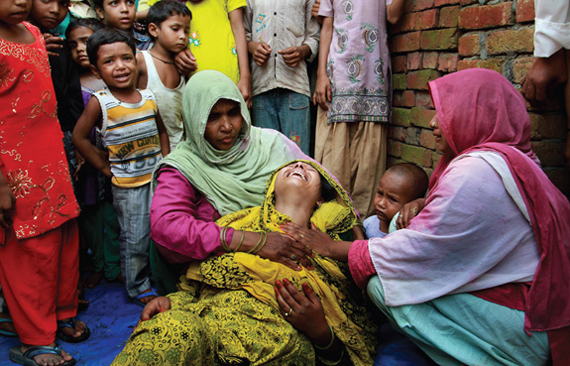
By a coincidence, I had just returned from Muzaffarnagar, barely two hours drive from New Delhi, where Muslim victims from recent communal violence were preparing for a bitter winter in makeshift camps. Among the refugees were scores of women, raped in front of their parents and children and who are still waiting for the wheels of justice to move at all. In Tarun's case there is that uncertainty as to what really happened. Here is rape with as many witnesses as can fill a court of law.

Efforts to administer justice in the case of an alleged rape in the lift of a five star Goa hotel, contrasted sharply with gross inaction in Muzaffarnagar. The star struck media was taking no interest.

These victims of rape and ethnic cleansing were confronting yet another challenge. The regional party in power in Lucknow, the Samajwadi party, were keen that these victims must somehow disappear because their continued presence in camps reflects on the government's inability to prevent the pogram.

There was another dilemma. If the state intervened on behalf of the Muslims, the government will lose Hindu support. Should it end up doing nothing for the uprooted Muslims, the party faces the certainty of that vote bank drifting away.

So what should "Maulana" Mulayam Singh Yadav do on the eve of key national elections? He has a brainwave. He will require the few thousand Muslims still in the camp to accept a lumpsum of Rs.5 lakhs, equivalent of $8,000, by way of compensation for having been dislocated.

So far so good. But they will be entitled to this lumpsum only on one condition: they sign an affidavit that they will not ever return to their homes under any circumstance.

Why is the government of Mulayam Singh going to such extraordinary lengths to prevent this timid vote bank from returning to their villages? Because he cannot guarantee them their security.

Why such helplessness on the part of the nation's most populous state? Because the conflict in the region is between Jats and Muslims and the police force is overwhelmingly Jat.

If that is the case why not transfer a Jat force to a non Jat area and the other way around? Hush!! Don't even whisper this. Jats will get angry.

To sweeten the deal for the victims, Mulayam has roped in Maulana Arshad Madani, national president of Jamiat-Ulama-i-Hind. Maulana says the "victims should take the money and build a home elsewhere". But why should they abandon the property they have left behind in the villages from where they have been driven out. "That property is theirs" says the Maulana. "No one can take it away from them." So, Mulayam Singh has placed the fate of the Muzaffarnagar riot victims in the care of the Deoband seminary.

With all of this swimming in my head upon my return from Muzaffarnagar, I had difficulty placing all the brouhaha about the Goa episode in proper perspective.

I messaged Tarun: A media so focused on rape, should be directed to Muzaffarnagar.

It turns out that Maulana Arshad Madani's nephew, Maulana Mahmood Madani was also at the Goa THINK fest dominating the nation's news. The clergy, it turns out, has got it covered at all ends.

Comments

Add new comment

  • Coastaldigest.com reserves the right to delete or block any comments.
  • Coastaldigset.com is not responsible for its readers’ comments.
  • Comments that are abusive, incendiary or irrelevant are strictly prohibited.
  • Please use a genuine email ID and provide your name to avoid reject.
Ram Puniyani
January 26,2020

During last couple of decades we have been witnessing the coming up of various statues in different parts of the country. There is diverse political logic and different set of political tendencies for erecting these statues. When Mayawati was UP CM, she got multiple of her own statues made, in addition to many statues of major dalit icons, irrespective of the criticism against that act. As per her strategy it was a symbol of identity of dalit assertion. The biggest statue to come up was that of Sardar Vallabh Bhai Patel, a lifelong Congressman, whom RSS combine is trying to appropriate. This statue of Unity was ‘Made in China’. The clever trick was that the same forces were behind this statue, which was banned by Patel in the aftermath of Gandhi murder. Interestingly while currently BJP is blaming Congress for Partition of India, ironically it was Sardar Patel who was in the committee which gave final stamp of approval for the partition of India.

There is also a talk in UP, where the Ram temple campaign yielded rich electoral dividends for BJP, to have tallest statue of Lord Ram in Ayodhya. In a state where children are dying in hospitals due to lack of Oxygen cylinders, a huge budgetary allocation will be required for such project. While on statues one should also remember that in Maharashtra a tall statue of Chatrapati Shivaji Maharaj is underway in Arabian Sea, near Mumbai. Only few voices of protest against it came up, e.g. that of renowned journalist, now, MP, Kumar Ketkar, whose house was vandalised for his opposing the move on the grounds that same massive amount can be utilized for welfare-development activities in the state.

On the back of this comes a comparatively low budget 114 feet tall statue of Jesus Christ in Karnataka, in Kappala hills Harobele village, where Christian pilgrims have been thronging from last several centuries. The land for this has been donated by Congress leader Shivaprasad and his brother, a Congress MP. It is planned to be carved out from a single rock. The plan of this statue is being opposed by those who have been behind most of the statue projects so far. Hindu Jagran Vedike, VHP, RSS are up in arms saying that they will not let this come up. There are various arguments cited for this opposition. It is being said that this was a place of worship of Lord Munnieshwara (a form of Lord Shiva).

More than this it is being argued that Shivakumar is trying to please his Italian boss in the party. Also that this will bring back the period of slavery of foreign rule, the colonial rule of British. As such this opposition is more in tune with the ideology of RSS combine, which has been for a statue here and a statue there. Their politics regards Christianity as a ‘foreign religion’! It is true that in Citizenship Amendment Act, they have not excluded Christianity while other religion, which they regard as ‘Foreign’ i.e. Islam. Here they are using a different logic, that the countries from where persecuted minorities are coming, are Muslim countries, Pakistan, Afghanistan and Bangla Desh.

In India the major targeting by RSS combine has been against Muslims, but Christians are also not spared. Starting in the decade of 1980, an intense propaganda has been going on that Christian Missionaries are converting. As RSS affiliate Vanvasi Kalyan Ashram became active in Adivasi areas, the likes of Swami Aseemanand, Swami Laxmanand and followers of Aasaram bapu spread out in Tribal areas. They started their programs to popularise Shabri and Hanuman, with congregations like Shabri Kumbh being regularly organized in these areas. The aim was to Hinduize the people in those areas.

The first major anti Christian violence came up in the ghastly form of burning alive of Pastor Graham Steward Stains along with his two minor sons Timothy and Philip. RSS affiliate Bajrang Dal's Dara Siingh aka Rajendra Pal was behind this and he is serving the life term for that. At the same time Wadhva Commission was appointed to investigate this crime which shook the country and President K.R. Narayan termed it as the one belonging to the inventory of the black deeds of human history.

The Wadhva commission report pointed out that there was no statistical significant change in the region where the pastor was working. Similarly the national figures tell us that the Christian population, if at all, has marginally declined in last five decades as per the census figures. They stand like this, percentage of Christians in population, 1971-2.60, 1981- 2.44, 1991-2.34, 2001-2.30 and 2011-2.30. There are arguments that some people are converting to Christianity but are not revealing their religion. This may be true in case of miniscule percentage of dalits, who may not reveal there conversion, as they stand to loose reservation provisions if they convert.

The anti Christian violence is scattered and is below the radar most of the places. There was massive valence in Kandhamal, Orissa, when on the pretext that Christians have murdered Swami Laxmananand, a massive violence was unleashed in 2008. On regular basis prayer meetings of Christians are attacked on the pretext that these are attempts at conversion. While there is a huge demand for the schools and colleges run by Christian groups, in Adivasis areas and remote areas the work of Swamis is on.

Now the trend is to dump Christian traditions. Since Ramnath Kovind became President, the usual practice of Carol Singers visiting Rashtrapati Bhavan has been stopped. In the army retreat so far ‘Abide with me’ by Scottish poet, Henri Francis Lyte, a Christian song, a favourite of Gandhi, has been dropped. The Christian minorities have perceived the threat in various forms. Currently they are as much part of the protests against CAA, NPR and NRIC as any other community.

While statues and identity issues cannot have primacy over the social development issues, it cannot be selective. To oppose Jesus Christ statue while spending fortunes for other statues is a part of the agenda of RSS combine, which is unfolding itself in various forms. opposition to Jesus Christ statue being yet another step in the direction.

Comments

Add new comment

  • Coastaldigest.com reserves the right to delete or block any comments.
  • Coastaldigset.com is not responsible for its readers’ comments.
  • Comments that are abusive, incendiary or irrelevant are strictly prohibited.
  • Please use a genuine email ID and provide your name to avoid reject.
Ram Puniyani
February 10,2020

Noam Chomsky is one of the leading peace workers in the world. In the wake of America’s attack on Vietnam, he brought out his classic formulation, ‘manufacturing consent’. The phrase explains the state manipulating public opinion to have the public approve of it policies—in this case, the attack of the American state on Vietnam, which was then struggling to free itself from French colonial rule.

In India, we are witness to manufactured hate against religious minorities. This hatred serves to enhance polarisation in society, which undermines India’s democracy and Constitution and promotes support for a Hindu nation. Hate is being manufactured through multiple mechanisms. For example, it manifests in violence against religious minorities. Some recent ghastly expressions of this manufactured hate was the massive communal violence witnessed in Mumbai (1992-93), Gujarat (2002), Kandhamal (2008) and Muzaffarnagar (2013). Its other manifestation was in the form of lynching of those accused of having killed a cow or consumed beef. A parallel phenomenon is the brutal flogging, often to death, of Dalits who deal with animal carcasses or leather.

Yet another form of this was seen when Shambhulal Regar, indoctrinated by the propaganda of Hindu nationalists, burned alive Afrazul Khan and shot the video of the heinous act. For his brutality, he was praised by many. Regar was incited into the act by the propaganda around love jihad. Lately, we have the same phenomenon of manufactured hate taking on even more dastardly proportions as youth related to Hindu nationalist organisations have been caught using pistols, while police authorities look on.

Anurag Thakur, a BJP minster in the central government recently incited a crowd in Delhi to complete his chant of what should happen to ‘traitors of the country...” with a “they should be shot”. Just two days later, a youth brought a pistol to the site of a protest at Jamia Millia Islamia university and shouted “take Azaadi!” and fired it. One bullet hit a student of Jamia. This happened on 30 January, the day Nathuram Godse had shot Mahatma Gandhi in 1948. A few days later, another youth fired near the site of protests against the CAA and NRC at Shaheen Bagh. Soon after, he said that in India, “only Hindus will rule”.

What is very obvious is that the shootings by those associated with Hindu nationalist organisations are the culmination of a long campaign of spreading hate against religious minorities in India in general and against Muslims in particular. The present phase is the outcome of a long and sustained hate campaign, the beginning of which lies in nationalism in the name of religion; Muslim nationalism and Hindu nationalism. This sectarian nationalism picked up the communal view of history and the communal historiography which the British introduced in order to pursue their ‘divide and rule’ policy.

In India what became part of “social common sense” was that Muslim kings had destroyed Hindu temples, that Islam was spread by force, and that it is a foreign religion, and so on. Campaigns, such as the one for a temple dedicated to the Hindu god Rama to be built at the site where the Babri masjid once stood, further deepened the idea of a Muslim as a “temple-destroyer”. Aurangzeb, Tipu Sultan and other Muslim kings were tarnished as the ones who spread Islam by force in the subcontinent. The tragic Partition, which was primarily due to British policies, and was well-supported by communal streams also, was entirely attributed to Muslims. The Kashmir conflict, which is the outcome of regional, ethnic and other historical issues, coupled with the American policy of supporting Pakistan’s ambitions of regional hegemony, (which also fostered the birth of Al-Qaeda), was also attributed to the Muslims.

With recurring incidents of communal violence, these falsehoods went on going deeper into the social thinking. Violence itself led to ghettoisation of Muslims and further broke inter-community social bonds. On the one hand, a ghettoised community is cut off from others and on the other hand the victims come to be presented as culprits. The percolation of this hate through word-of-mouth propaganda, media and re-writing of school curricula, had a strong impact on social attitudes towards the minorities.

In the last couple of decades, the process of manufacturing hate has been intensified by the social media platforms which are being cleverly used by the communal forces. Swati Chaturvedi’s book, I Am a Troll: Inside the Secret World of the BJP’s Digital Army, tells us how the BJP used social media to spread hate. Whatapp University became the source of understanding for large sections of society and hate for the ‘Other’, went up by leaps and bounds. To add on to this process, the phenomenon of fake news was shrewdly deployed to intensify divisiveness.

Currently, the Shaheen Bagh movement is a big uniting force for the country; but it is being demonised as a gathering of ‘anti-nationals’. Another BJP leader has said that these protesters will indulge in crimes like rape. This has intensified the prevalent hate.

While there is a general dominance of hate, the likes of Shambhulal Regar and the Jamia shooter do get taken in by the incitement and act out the violence that is constantly hinted at. The deeper issue involved is the prevalence of hate, misconceptions and biases, which have become the part of social thinking.

These misconceptions are undoing the amity between different religious communities which was built during the freedom movement. They are undoing the fraternity which emerged with the process of India as a nation in the making. The processes which brought these communities together broadly drew from Gandhi, Bhagat Singh and Ambedkar. It is these values which need to be rooted again in the society. The communal forces have resorted to false propaganda against the minorities, and that needs to be undone with sincerity.

Combating those foundational misconceptions which create hatred is a massive task which needs to be taken up by the social organisations and political parties which have faith in the Indian Constitution and values of freedom movement. It needs to be done right away as a priority issue in with a focus on cultivating Indian fraternity yet again.

Comments

Add new comment

  • Coastaldigest.com reserves the right to delete or block any comments.
  • Coastaldigset.com is not responsible for its readers’ comments.
  • Comments that are abusive, incendiary or irrelevant are strictly prohibited.
  • Please use a genuine email ID and provide your name to avoid reject.
Ram Puniyani
June 29,2020

In Minneapolis, US an African American, George Floyd lost his life as the white policeman, Derek Chauvin, caught hold of him and put his knee on his neck. This is a technique developed by Israel police. For nine long minutes the knee of the while policeman was on the neck of George, who kept shouting, I can’t breathe.

Following this gruesome murder America erupted with protests, ‘Black lives matter’. The protestors were not just African Americans but also a large section of whites. Within US one police Chief apologized for the act of this. In a touching gesture of apology the police force came on its knees. This had reverberations in different parts of the World.

The act was the outcome of the remnants of the racial hatred against blacks by the whites. It is the hatred and the perceptions which are the roots of such acts of violence. What was also touching that the state of democracy in US is so deep that even the police apologized, the nation, whites and blacks, stood up as a sensitive collective against this violence.

US is not the only country where the brutal acts of violence torment the marginalized sections of society. In India there is a list of dalits, minorities and adivasis who are regularly subjected to such acts. But the reaction is very different. We have witnessed the case of Tabrez Ansari, who was tied to the pole by the mob and beaten ruthlessly. When he was taken to police station, police took enough time to take him to hospital and Tabrez died.

Mohsin Sheikh, a Pune techie was murdered by Hindu Rashtra Sena mob, the day Modi came to power in 2014. Afrazul was killed by Shambhulal Regar, videotaped the act released on social media. Regar believed that Muslims are indulging in love Jihad, so deserve such a fate. Mohammad Akhlaq is one among many names who were mob lynched on the issue of beef cow. The list can fill pages after pages.

Recently a young dalit boy was shot dead for the crime of entering a temple. In Una four dalits were stripped above waste and beaten mercilessly. Commenting on this act the Union Minister Ramvilas Paswan commented that it is a minor incident. Again the list of atrocities against dalits is long enough. The question is what Paswan is saying is the typical response to such gruesome murders and tortures. In US loss of one black life, created the democratic and humane response. In India there is a general silence in response to these atrocities. Some times after a good lapse of time, the Prime Minister will utter, ‘Mother Bharati has lost a son’. Most of the time victim is blamed. Some social groups raise their voice in some fora but by and large the deafening silence from the country is the norm.

India is regarded as the largest democracy. Democracy is the rule of law, and the ground on which the injustices are opposed. In America though the present President is insensitive person, but its institutions and processes of democratic articulations are strong. The institutions have deepened their roots and though prejudices may be guiding the actions of some of the officers like the killer of George, there are also police officers who can tell their President to shut up if he has nothing meaningful to say on the issue. The prejudices against Blacks may be prevalent and deep in character, still there are large average sections of society, who on the principles of ‘Black lives matter’. There are large sections of vocal population who can protest the violation of basic norms of democracy and humanism.

In India by contrast there are multiple reasons as to why the lives of Tabrez Ansari, Mohammad Akhlaq, Una dalit victims and their likes don’t matter. Though we claim that we are a democracy, insensitivity to injustices is on the rise. The strong propaganda against the people from margins has become so vicious during last few decades that any violence against them has become sort of a new normal. The large populace, though disturbed by such brutalities, is also fed the strong dose of biases against the victims. The communal forces have a great command over effective section of media and large section of social media, which generates Hate against these disadvantaged groups, thereby the response is muted, if at all.

As such also the process of deepening of our democracy has been weak. Democracy is a dynamic process; it’s not a fixed entity. Decades ago workers and dalits could protest for their rights. Now even if peasants make strong protests, dominant media presents it as blocking of traffic! How the roots of democracy are eroded and are visible in the form where the criticism of the ruling dispensation is labelled as anti National..

Our institutions have been eroded over a period of time, and these institutions coming to the rescue of the marginalized sections have been now become unthinkable. The outreach of communal, divisive ideology, the ideology which looks down on minorities, dalits and Adivasis has risen by leaps and bounds.

The democracy in India is gradually being turned in to a hollow shell, the rule of law being converted in to rule of an ideology, which does not have faith in Indian Constitution, which looks down upon pluralism and diversity of this country, which is more concerned for the privileges of the upper caste, rich and affluent. The crux of the matter is the weak nature of democracy, which was on way to become strong, but from decades of 1980s, as emotive issues took over, the strength of democracy started dwindling, and that’s when the murders of the types of George Floyd, become passé. One does complement the deeper roots of American democracy and its ability to protect the democratic institutions, which is not the case in India, where protests of the type, which were witnessed after George Floyd’s murder may be unthinkable, at least in the present times. 

Comments

Add new comment

  • Coastaldigest.com reserves the right to delete or block any comments.
  • Coastaldigset.com is not responsible for its readers’ comments.
  • Comments that are abusive, incendiary or irrelevant are strictly prohibited.
  • Please use a genuine email ID and provide your name to avoid reject.