


WikiLeaks 'reveals' President Obama's personal emails

October 22, 2016

Washington, Oct 22: WikiLeaks has revealed US President Barack Obama's private email address by publishing hacked emails, in another potentially embarrassing document dump targeting the Democrats, a media report said.
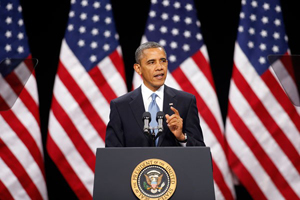
obama"WikiLeaks reveals first batch of US President Barack Obama emails sent via secret address," WikiLeaks, the Julian Assange-founded open secrets site, tweeted on Thursday — implying that even more of Obama's private communications would be released.

According to the New York Post, the site published seven messages involving an email address purported to be that of the commander-in-chief: [email protected].

One exchange was dated the evening of November 4, 2008 — Election Day. John Podesta, co-chair of Obama's transition team, urges Obama not to accept an invitation to a G-20 meeting in November 15 on the global financial crisis should outgoing President George W. Bush invite him that night after Obama is officially elected.

Podesta attached a memo the transition team prepared weighing the pros and cons of going to the summit.

"On the chance that President Bush would raise this with you tonight, I wanted you to be aware that it is the unanimous recommendation for your advisors that you NOT attend," Podesta said.

When the G20 convened in Washington, Obama was absent.

An email message sent on Thursday to Obama's alleged address didn't bounce back immediately — signalling it could still be a working account.

The White House declined to comment. The US intelligence authorities believe Russia orchestrated the widespread cyber attacks into Democratic Party-related emails.

The Obama messages were among some 23,000 emails stolen from Podesta, who now serves as Democratic presidential nominee Hillary Clinton's campaign chairman, the New York Post reported.

The alleged Obama emails were from 2008 when the young Illinois senator was about to win his historic White House bid and was assembling a transition team. The emails largely address staffing a transition economic team and adding diversity to a future Obama administration.

Comments

Add new comment

  • Coastaldigest.com reserves the right to delete or block any comments.
  • Coastaldigset.com is not responsible for its readers’ comments.
  • Comments that are abusive, incendiary or irrelevant are strictly prohibited.
  • Please use a genuine email ID and provide your name to avoid reject.
News Network
February 16,2020

Munich, Feb 16: Iran's foreign minister said Saturday that US President Donald Trump is receiving bad advice if he believes an American "maximum pressure" campaign against his country will cause the government in Tehran to collapse.

Foreign Minister Mohammad Javad Zarif told a group of top defense officials and diplomats at the Munich Security Conference that the information provided to the president has dissuaded Trump from accepting offers from other leaders to mediate between Washington and Tehran.

"President Trump has been convinced that we are about to collapse so he doesn't want to talk to a collapsing regime," Zarif said.

To support his argument, the Iranian minister cited Trump's decision to pull out unilaterally in 2018 from Iran's nuclear deal with the US and other world powers. Trump said the landmark 2015 accord didn't address Iran's ballistic missile program or regional activities and needed to be renegotiated.

Since then, the Trump administration's re-imposition of US sanctions in a campaign of so-called "maximum pressure" have taken a severe toll on the Iranian economy and sent Iran's currency plunging.

"I believe President Trump, unfortunately, does not have good advisers," Zarif said. "He's been wanting for Iran to collapse since he withdrew from the nuclear deal." Zarif also said the killing of Iranian Gen. Qassem Soleimani in a US drone strike in Iraq on January 3 was a miscalculation by Washington that has galvanized support for Iran instead of increasing pressure on the regime.

The Iran nuclear deal, known as the Joint Comprehensive Plan of Action or JCPOA, promised Iran economic incentives in exchange for curbs on its nuclear program. It was intended to prevent Tehran from developing a nuclear bomb, which Iran insists it does not want to do.

Since the US withdrawal, the deal's other signatories - Germany, France, Britain, Russia and China - have unsuccessfully struggled to come up with ways to offset the effects of the new American sanctions.

Washington has pressured the other countries - so far without success - to abandon the deal entirely US Secretary of State Mike Pompeo said at the Munich Security Conference earlier Saturday that while there may be disagreements on what to do with the JCPOA, "when I talk to my counterparts here in Europe, everybody gets it."

"Everyone understands that these are folks who continue to build out their nuclear program," Pompeo said. "So there's a common understanding about the threat; we have tactical differences on how to proceed."

In recent months, Iran has steadily violated the limitations the deal placed on the amount of enriched uranium and heavy water it can stockpile, the number and type of centrifuges it can operate, and the purity of the uranium it enriches.

Iranian officials insist the moves are intended only to put pressure on the countries that remain part of the deal to provide economic help to Iran and that all the measures taken are fully reversible.

Zarif rejected Trump's suggestion of negotiating a new deal, saying the one negotiated during the Obama administration was the only vehicle for talks on Iran's nuclear program.

"There is no point in talking over something you already talked about. You don't buy a horse twice," he said.

"It's not about opening talks with the United States. It's about bringing the United States to the negotiating table that's already there," Zarif said.

Comments

Add new comment

  • Coastaldigest.com reserves the right to delete or block any comments.
  • Coastaldigset.com is not responsible for its readers’ comments.
  • Comments that are abusive, incendiary or irrelevant are strictly prohibited.
  • Please use a genuine email ID and provide your name to avoid reject.
News Network
June 12,2020

Jun 12: The global number of COVID-19 cases has increased to over 7.5 million, while the death toll was nearing 421,000, according to the Johns Hopkins University.

As of Friday morning, the overall number of cases stood at 7,500,777, while the deaths increased to 420,993, the University's Center for Systems Science and Engineering (CSSE) revealed in its latest update.

The US continues with the world's highest number of confirmed cases and deaths at 2,022,488 and 113,803, respectively, according to the CSSE.

In terms of cases, Brazil comes in the second place with 802,828 infections.

This was followed by Russia (501,800), the UK (292,860), India (286,605), Spain (242,707), Italy (236,142), Peru (214,788), France (192,493), Germany (186,691), Iran (180,156), Turkey (174,023), Chile (154,092), Mexico (133,974), Pakistan (125,933) and Saudi Arabia (116,021), the CSSE figures showed.

Regarding fatalities, the UK continues in the second position after the US with 41,364 COVID-19 deaths, which also accounts for the highest number of fatalities in Europe.

The other countries with over 10,000 deaths are Brazil (40,919), Italy (34,167), France (29,349), Spain (27,136) and Mexico (15,944).

Comments

Add new comment

  • Coastaldigest.com reserves the right to delete or block any comments.
  • Coastaldigset.com is not responsible for its readers’ comments.
  • Comments that are abusive, incendiary or irrelevant are strictly prohibited.
  • Please use a genuine email ID and provide your name to avoid reject.
News Network
January 20,2020

Langkawi, Jan 20: Malaysia will not take retaliatory trade action against India over its boycott of palm oil purchases amid a political row between the two countries, Prime Minister Mahathir Mohamad said on Monday.

India, the world’s largest edible oil buyer, this month effectively halted imports from its largest supplier and the world’s second-biggest producer in response to comments from Mahathir attacking India’s domestic policies.

“We are too small to take retaliatory action,” Mahathir told reporters in Langkawi, a resort island off the western coast of Malaysia. “We have to find ways and means to overcome that,” he added.

The 94-year-old premier of Muslim-majority Malaysia has criticised New Delhi’s new religion-based citizenship law and also accused India of invading the disputed region of Kashmir.

Mahathir again criticised India’s citizenship law on Monday, saying he believed it was “grossly unfair”.

India has been Malaysia’s largest palm oil market for the past five years, presenting the Southeast Asian country with a major challenge in finding new buyers for its palm oil.

Benchmark Malaysian palm futures fell nearly 10% last week, their biggest weekly decline in more than 11 years.

New Delhi is also unhappy with Malaysia’s refusal to revoke permanent resident status for controversial Indian Islamic preacher Zakir Naik, who has lived in Malaysia for about three years and faces charges of money laundering and hate speech in India.

Mahathir said even if the Indian government guarantees a fair trial, Naik faces the real threat of vigilante action and that Malaysia will only relocate the preacher if it can find a third country where he would be safe.

“If we can find a place for him, we will send him out.”

Comments

Add new comment

  • Coastaldigest.com reserves the right to delete or block any comments.
  • Coastaldigset.com is not responsible for its readers’ comments.
  • Comments that are abusive, incendiary or irrelevant are strictly prohibited.
  • Please use a genuine email ID and provide your name to avoid reject.
