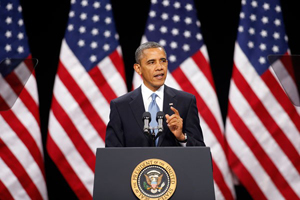
WikiLeaks 'reveals' President Obama's personal emails

October 22, 2016

Washington, Oct 22: WikiLeaks has revealed US President Barack Obama's private email address by publishing hacked emails, in another potentially embarrassing document dump targeting the Democrats, a media report said.

obama"WikiLeaks reveals first batch of US President Barack Obama emails sent via secret address," WikiLeaks, the Julian Assange-founded open secrets site, tweeted on Thursday — implying that even more of Obama's private communications would be released.

According to the New York Post, the site published seven messages involving an email address purported to be that of the commander-in-chief: [email protected].

One exchange was dated the evening of November 4, 2008 — Election Day. John Podesta, co-chair of Obama's transition team, urges Obama not to accept an invitation to a G-20 meeting in November 15 on the global financial crisis should outgoing President George W. Bush invite him that night after Obama is officially elected.

Podesta attached a memo the transition team prepared weighing the pros and cons of going to the summit.

"On the chance that President Bush would raise this with you tonight, I wanted you to be aware that it is the unanimous recommendation for your advisors that you NOT attend," Podesta said.

When the G20 convened in Washington, Obama was absent.

An email message sent on Thursday to Obama's alleged address didn't bounce back immediately — signalling it could still be a working account.

The White House declined to comment. The US intelligence authorities believe Russia orchestrated the widespread cyber attacks into Democratic Party-related emails.

The Obama messages were among some 23,000 emails stolen from Podesta, who now serves as Democratic presidential nominee Hillary Clinton's campaign chairman, the New York Post reported.

The alleged Obama emails were from 2008 when the young Illinois senator was about to win his historic White House bid and was assembling a transition team. The emails largely address staffing a transition economic team and adding diversity to a future Obama administration.

Comments

Add new comment

  • Coastaldigest.com reserves the right to delete or block any comments.
  • Coastaldigset.com is not responsible for its readers’ comments.
  • Comments that are abusive, incendiary or irrelevant are strictly prohibited.
  • Please use a genuine email ID and provide your name to avoid reject.
News Network
January 6,2020

Sydney, Jan 6: Reserve troops fanned out across fire-ravaged regions in three Australian states on Monday after a horror weekend, as the government pledged $1.4 billion over two years to help recover from the devastating months-long crisis.

Catastrophic bushfires have turned swathes of land into smouldering, blackened hellscapes and destroyed an area about the size of the island of Ireland, according to official figures, with authorities warning the disaster still has weeks or months to run.

Prime Minister Scott Morrison, whose government has been criticised for its slow response to the emergency, pledged Australian $2 billion ($1.4 billion) of taxpayer money for a national recovery fund.

"It's a long road ahead and we will be with these communities every step of the way as they rebuild," Morrison said.

Firefighters joined by fresh teams from the US and Canada were taking advantage of rainy and cooler conditions to tackle out-of-control blazes ahead of rising temperatures forecast later this week.

In the biggest-ever call up of reserves, military teams were deployed across eastern Australia to help emergency services assess the damage, restore power and deliver supplies of food, water and fuel to cut-off communities.

For the first time in Australian history the government also deployed its medical assistance team, normally sent to other nations to lend support in the aftermath of their disasters to help evacuees.

"There is no room for complacency, especially as we have over 130 fires burning across (New South Wales) state still," Premier of New South Wales state Gladys Berejiklian said on Monday.

New normal

Almost five million hectares (50,000 square kilometres) have been razed across New South Wales and more than 1.2 million hectares in Victoria since late September, officials said.

That took the total amount of land burnt close to eight million hectares, around the size of the island of Ireland or South Carolina.

Twenty-four people have lost their lives so far, with over 1,800 homes damaged.

Two people are missing in New South Wales, the nation's most populous state.

In Victoria, Premier Daniel Andrews established a bushfire recovery agency to help devastated towns. It will be a permanent body, he said, as intense fires will become commonplace.

"We should just be honest about the fact that we're going to see more and more fires, more and more damage as each fire season comes... this is the new normal," Andrews told reporters.

The chair of the newly established Victoria state's bushfire appeal fund, Pat McNamara, added that this year's summer bushfire season was a "creeping disaster".

"We're still not even into what we would regard as the peak of the fire season," McNamara told national broadcaster ABC.

In the usually picturesque southeastern town of Eden, Holly Spence said she spent more than 12 hours defending her family's farm on Saturday, less than a week after saving it on New Year's Eve.

"We don't want to go through this for a third time," the 28-year-old told AFP.

Fiona Kennelly, 50, who evacuated with 24 members of her extended family to a motel outside Eden, said she was relieved the easing conditions allowed them to get some respite from the crisis.

"It's good to see daylight at the right time again," she told AFP, adding that the skies had been turning pitch-black in the afternoons.

Public anger

The impact of the bushfires has spread beyond affected communities, with heavy smoke engulfing the country's second-largest city Melbourne and the national capital Canberra.

Some government departments were shut in Canberra as the city's air quality was once-again ranked the world's poorest, according to independent online air-quality index monitor Air Visual.

The disaster has sparked growing public anger with Morrison. Rallies are planned on Friday to call on his government to step up efforts to tackle climate change, which experts say have helped fuel the fires.

In Los Angeles, Hollywood superstar Russell Crowe said he was back home fighting the fires and that the disaster was "climate change-based".

"We need to act on science, move our global workforce to renewable energy and respect our planet for the unique and amazing place it is. That way, we all have a future," he said in a message read out by Jennifer Aniston.

Australian actress Cate Blanchett praised the volunteer firefighters battling the blazes, adding: "When one country faces a climate disaster, we all face a climate disaster. We're in it together."


Comments

Add new comment

  • Coastaldigest.com reserves the right to delete or block any comments.
  • Coastaldigset.com is not responsible for its readers’ comments.
  • Comments that are abusive, incendiary or irrelevant are strictly prohibited.
  • Please use a genuine email ID and provide your name to avoid reject.
News Network
June 30,2020

Six months since the new coronavirus outbreak, the pandemic is still far from over, the World Health Organization said Monday, warning that "the worst is yet to come".

Reaching the half-year milestone just as the death toll surpassed 500,000 and the number of confirmed infections topped 10 million, the WHO said it was a moment to recommit to the fight to save lives.

"Six months ago, none of us could have imagined how our world -- and our lives -- would be thrown into turmoil by this new virus," WHO chief Tedros Adhanom Ghebreyesus told a virtual briefing.

"We all want this to be over. We all want to get on with our lives. But the hard reality is this is not even close to being over.

"Although many countries have made some progress, globally the pandemic is actually speeding up.

"We're all in this together, and we're all in this for the long haul.

"We will need even greater stores of resilience, patience, humility and generosity in the months ahead.

"We have already lost so much -- but we cannot lose hope."

Tedros also said that the pandemic had brought out the best and worst humanity, citing acts of kindness and solidarity, but also misinformation and the politicisation of the virus.

In an atmosphere of global political division and fractures on a national level, "the worst is yet to come. I'm sorry to say that," he said.

"With this kind of environment and condition, we fear the worst."

Comments

Add new comment

  • Coastaldigest.com reserves the right to delete or block any comments.
  • Coastaldigset.com is not responsible for its readers’ comments.
  • Comments that are abusive, incendiary or irrelevant are strictly prohibited.
  • Please use a genuine email ID and provide your name to avoid reject.
News Network
April 21,2020

New York, Apr 21: Oil prices plunged below zero on Monday as demand for energy collapses amid the coronavirus pandemic and traders don't want to get stuck owning crude with nowhere to store it.

Stocks were also slipping on Wall Street in afternoon trading, with the S&P 500 down 0.9%, but the market's most dramatic action was by far in oil, where benchmark U.S. crude for May delivery plummeted to negative $3.70 per barrel, as of 2:15 pm. Eastern time.

Much of the drop into negative territory was chalked up to technical reasons — the May delivery contract is close to expiring so it was seeing less trading volume, which can exacerbate swings. But prices for deliveries even further into the future, which were seeing larger trading volumes, also plunged.

Demand for oil has collapsed so much due to the coronavirus pandemic that facilities for storing crude are nearly full.

Tanks could hit their limits within three weeks, according to Chris Midgley, head of analytics at S&P Global Platts.

Benchmark U.S. crude oil for June delivery, which shows a more ”normal” price, fell 14.8% to $21.32 per barrel, as factories and automobiles around the world remain idled. Big oil producers have announced cutbacks in production in hopes of better balancing supplies with demand, but many analysts say it's not enough.

“Basically, bears are out for blood,” analyst Naeem Aslam of Avatrade said in a report. “The steep fall in the price is because of the lack of sufficient demand and lack of storage place given the fact that the production cut has failed to address the supply glut.”

Halliburton swung between gains and sharp losses, even though it reported stronger results for the first three months of 2020 than analysts expected. The oilfield engineering company said that the pandemic has created so much turmoil in the industry that it “cannot reasonably estimate” how long the hit will last. It expects a further decline in revenue and profitability for the rest of 2020, particularly in North America.

Brent crude, the international standard, was down $1.78 to $26.30 per barrel. .

In the stock market, the mild drops ate into some of the big gains made since late March, driven lately by investors looking ahead to parts of the economy possibly reopening as infections level off in hard-hit areas.

Pessimists have called the rally overdone, pointing to the severe economic pain sweeping the world and continued uncertainty about how long it will last.

The Dow Jones Industrial Average was down 364 points, or 1.5%, to 23,887. The Nasdaq was down 0.1%..

More gains from companies that are winners in the new stay-at-home economy helped limit the market's losses Amazon rose 1.4%, and Netflix jumped 3.8% as people shut in at home buy staples and look to fill their time. Clorox likewise rose toward a new record and was up 1% as households and businesses that remain open look to stay clean.

In Tokyo the Nikkei 225 fell 1.1% after Japan reported that its exports fell nearly 12% in March from a year earlier as the pandemic hammered demand in its two biggest markets, the U.S. and China.

The Hang Seng index in Hong Kong lost 0.2%, and South Korea's Kospi fell 0.8%.

European markets were modestly higher The German DAX was up 0.5%, the French CAC 40 was up 0.7% and the FTSE 100 in London gained 0.7%.

In a sign of continued caution in the market, Treasury yields remained extremely low. The yield on the 10-year Treasury slipped to 0.64% from 0.65% late Friday. It started the year near 1.90%. Bond yields drop when their prices rise, and investors tend to buy Treasurys when they're worried about the economy.

Stocks have been on a generally upward swing recently, and the S&P 500 just closed out its first back-to-back weekly gain since the market began selling off in February. Promises of massive aid for the economy and markets by the Federal Reserve and U.S. government ignited the rally, which sent the S&P 500 up as much as 28.5% since a low on March 23.

More recently, countries around the world have tentatively eased up on business-shutdown restrictions put in place to slow the spread of the virus.

But health experts warn the pandemic is far from over and new flareups could ignite if governments rush to allow ”normal” life to return prematurely.

The S&P 500 remains about 15% below its record high in February as millions more U.S. workers file for unemployment every week amid the shutdowns.

Many analysts also warn that a significant part of the recent recovery in stocks is due to the expectation among some investors that the economy will rebound sharply once economic quarantines are lifted. They're essentially predicting that a line chart of the economy will ultimately resemble the letter “V,” with a wild ride down but then a quick pivot to a vigorous recovery.

That may be to optimistic. “We caution that a U-shaped recovery is also quite likely,” where the economy bottoms out and stays at that low level for a while before recovering, strategists at Barclays warned in a recent report.

Without strong testing programs for COVID-19, businesses likely won't feel comfortable bringing back their full workforces for a while.

”With risk assets now overbought, the chance for a correction has increased,” Morgan Stanley strategists wrote in a report.

Comments

Add new comment

  • Coastaldigest.com reserves the right to delete or block any comments.
  • Coastaldigset.com is not responsible for its readers’ comments.
  • Comments that are abusive, incendiary or irrelevant are strictly prohibited.
  • Please use a genuine email ID and provide your name to avoid reject.