



Will note ban decide UP polls?

[email protected] (Geeta Pandey)
February 17, 2017

Feb 17: In November last year, Prime Minister Narendra Modi stunned the country by announcing that Rs 500 and Rs 1,000 notes were as good as garbage. Despite his insistence that the ban was meant to curb black money and put terrorists out of business, many analysts said it was motivated by politics rather than economics, and done with an eye on the Uttar Pradesh (UP) elections.note
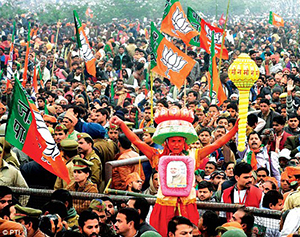
Since the rise of the regional Samajwadi Party (SP) and Bahujan Samaj Party (BSP) in the late 1990s, national parties — the Congress and the BJP — have been often relegated to third and fourth positions in the state. This time around, the Congress has joined the governing SP as a junior partner in an alliance, and the BJP is making an all out effort to win back the state.

In the past few days, I've travelled through several districts in the state to ask people if the currency ban or “notebandi” (Hindi for stopping of notes) here - is an election issue.

The “notebandi” has without doubt touched every life, in the big cities, smaller towns and tiny villages, and everyone talks about the problems they've faced. But will it impact the way people vote? In the main market in Barabanki town, not far from the state capital, Lucknow, the trading community is seething at the “BJP's betrayal”.

Traders have traditionally supported the BJP, and in the past they have also contributed generously to party funds. But this time, they tell me they will not vote for the party. “Notebandi is the biggest issue here,” says Santosh Kumar Gupta, who along with his brothers, runs the family hardware store. “The public has been really hassled. The government set limits on withdrawals and even those little amounts were unavailable because banks had no money.”

Gupta points out that in his address to the nation, the prime minister said the government had been planning for it for six months and that people would face minor problems.

“But there were lots of problems. Isn't he ashamed of lying?” he asks angrily. “Police used sticks to beat up people waiting in queues to withdraw their own hard-earned money. All small manufacturing units in Barabanki shut down for weeks. Thousands became unemployed.”

“There's a labour market a few metres from our shop and every morning, nearly 500 daily wage labourers from the nearby villages would gather to look for work, but for the first time, we saw there were no takers for them.” His brother Manoj Kumar Jaiswal adds: “Traders are very angry with Modi. He first said it was done to curb black money.

Then he said it was done to promote digital economy. “You can use credit cards and (popular mobile wallet) Paytm in cities like Delhi and Mumbai, not in Barabanki. People here are illiterate, many don't have bank accounts or credit cards.” The Gupta family has 10 voters and not one will opt for the BJP.

In Gosaiganj, on the outskirts of Lucknow, I stop to talk to people gathered at a tea stall. Raja Ram Rawat, a 60-year-old widower, lives with his two sons and four grandchildren. The small plot of land he owns is not sufficient to support the family and his sons work as daily wagers to supplement the family income. “Since November 8, they've not been able to find work even for one day,” he says. I ask him how they are managing. “Earlier if we bought two kilograms of vegetables, now we buy only one. That's how we are managing.”

A farmer in the group, Kallu Prasad, compares the ban to “poison” for his community - it came just as the rice crop had been harvested and the sowing season had begun for wheat, mustard and potatoes. “Normally we sell a kilo of rice for Rs 14, but this time we had to sell it for Rs 8 or Rs 9. We couldn't buy seeds and pesticides in time. Farmers who grew vegetables were the worst affected. Since people had no money to buy vegetables, they had to just throw them away.”

In the holy city of Varanasi, walking through the narrow lanes of Lallapura area, where homes sit cheek by jowl, one cannot escape the noise of the looms. Here, every home is a tiny factory where weavers work in semi-darkened rooms, using coloured silk threads to create beautiful patterns. Varanasi is famous for its hand woven silk and cotton saris and nearly a million people make their living from this cottage industry here.

“It was like we were hit by a bolt of lightning,” says factory owner Sardar Mohd Hasim, describing the moment of Modi's announcement. Hasim, who represents 30,000 weavers, says initially “about 90% of the industry” was affected since all their transactions happen in cash.

Looms still shut
“We had no cash to buy raw materials, we had no cash to pay wages to the workers. Nearly three months later, all my 24 looms are still shut. Most of my weavers are doing other jobs to earn a living.”

Varanasi has eight assembly constituencies, and Hasim insists that BJP will not win even one. “Why would anyone now vote for Modi?” he asks. One of his former workers, 40-year-old Mangru Prajapati, who is now back to work in Hasim's brother's loom, agrees. He's the sole breadwinner for his family of eight.

Rajan Behal, trader and leader of the organisation that represents traders, weavers and sellers, calls it a “major disaster”. The ban, he says, couldn't have come at a worse time - November to February is the wedding season when sales peak, but this year it's been a wipe-out. A long-time BJP supporter, Behal refuses to say who he will vote for but predicts that Modi “will not win enough seats to be able to form a government in the state”.

It's an assessment challenged by senior BJP leader in the state Vijay Pathak, who pegs the party's chances of winning at “101%”. He says that there were difficulties in the implementation of the currency ban, but insists that they have been able to convince the voters that it was done in the nation's interest. “We started our campaign with the aim to win more than 265 of the 403 seats. Now we believe we will cross 300.”

That, he says, is because people have faith in “the man who's taking the decisions” - the prime minister. On this count, he's right - Modi's personal stock remains high, especially with the youth. In Kukha Rampur village in Tiloi constituency in Amethi district, 21-year-old Tanu Maurya says she will vote for Modi because he is “doing good work” and that the note ban was “a good decision even if it caused some hardships in the short term”.

Since his sweep of the 2014 general election, Modi has not had much luck in state elections and he's desperate to reverse that losing trend. A victory in the politically key state of Uttar Pradesh would be a huge shot in the arm for Modi and his party.

But will the rupee ban help him or hurt his chances? When the votes are counted on March 11, we will know whether it was a masterstroke or a miscalculation.

Comments

Add new comment

  • Coastaldigest.com reserves the right to delete or block any comments.
  • Coastaldigset.com is not responsible for its readers’ comments.
  • Comments that are abusive, incendiary or irrelevant are strictly prohibited.
  • Please use a genuine email ID and provide your name to avoid reject.
Agencies
April 17,2020

New Delhi, Apr 17: The Indian Railways turned 167 years old on Thursday and for the first time ever, its trains did not carry any passengers on its birthday and instead stood idle in the yards waiting for the nationwide lockdown to end.

On this day 167 years ago, the wheels of the first passenger train in the country from Mumbai to Thane started rolling.

In 1974, Indians experienced life without trains for the first time. In May 1974 during the strike of the railways that lasted for around three weeks, drivers, station masters, guards, track staff and many others went on 'chakka jam' demanding fixed working hours for train drivers and an across-the-board pay hike.

"I can recall those times vividly. I remember that our leader George Fernandes had almost secured a deal with the then railway minister, but it fell through when it was taken to the then Prime Minister Indira Gandhi," All India Railwaymens Federation General Secretary Shiv Gopal Mishra, who was an apprentice in the railways at that time, told PTI.

"Fernandes was arrested in Lucknow. The workers went through a lot at that time. But those were days that angry workers had refused to give in and took great risks to get their demands met," he said.

However, just like this time, four decades ago too freight trains carrying essential supplies were run and the unions agreed to let some passenger trains run on the trunk routes like the Kalka Mail from Howrah to Delhi.

"Never ever in its history, there has been such a long interruption of services. Not during the World Wars, not during the 1974 railway strike, or any other national calamity or natural disaster," a railway spokesperson said.

The first Indian Railways passenger train was flagged off on April 16, 1853, from Mumbai to nearby Thane.

On Thursday, the Railway Ministry wished the railways a happy birthday on Twitter - "Today, 167 years ago with the zeal of 'never to stop' the wheels of the first passenger train from Mumbai to Thane started rolling. For the first time, passenger services are stopped for your safety. Stay indoors & make the nation victorious," it said.

Railway has suspended all passenger services since March 25 till May 3 due to the coronavirus outbreak. Around 15,523 trains run by the railways have been affected including 9,000 passenger trains and 3,000 mail express services which are run daily. It caters to over 20 million passengers every day.

According to the Union health ministry, the death toll due to coronavirus rose to 414 and the number of cases to 12,380 in the country on Thursday.

Comments

Add new comment

  • Coastaldigest.com reserves the right to delete or block any comments.
  • Coastaldigset.com is not responsible for its readers’ comments.
  • Comments that are abusive, incendiary or irrelevant are strictly prohibited.
  • Please use a genuine email ID and provide your name to avoid reject.
Agencies
January 3,2020

Giving each and every app access to personal information stored on Android smartphones such as your contacts, call history, SMS and photos may put you in trouble as bad actors can easily use these access to spy on you, send spam messages and make calls anywhere at your expense or even sign you up for a premium "service", researchers from cybersecurity firm Kaspersky have warned.

But one can restrict access to such information as Android lets you configure app permissions. 

Giving an app any of these permissions generally means that from now on it can obtain information of this type and upload it to the Cloud without asking your explicit consent for whatever it intends to do with your data.

Therefore, security researchers recommend one should think twice before granting permissions to apps, especially if they are not needed for the app to work. 

For example, most games have no need to access your contacts or camera, messengers do not really need to know your location, and some trendy filter for the camera can probably survive without your call history, Kaspersky said. 

While decision to give permission is yours, the fewer access you hand out, the more intact your data will be.

Here's what you should know to protect your data.

SMS: An app with permission to send and receive SMS, MMS, and WAP (Wireless Application Protocol) push messages, as well as view messages in the smartphone memory will be able to read all of your SMS correspondence, including messages with one-time codes for online banking and confirming transactions.

Using this permission, the app can also send spam messages in your name (and at your expense) to all your friends. Or sign you up for a premium "service." You can see and conrol which apps have these rights by going to the settings of your phone.

Calendar: With permission to view, delete, modify, and add events in the calendar, prying eyes can find out what you have done and what you are doing today and in the future. Spyware loves this permission.

Camera: Permission to access the camera is necessary for the app to take photos and record video. But apps with this permission can take a photo or record a video at any moment and without warning. Attackers armed with embarrassing images and other dirt on you can make life a misery, according to Kaspersky.

Contacts: With permission to read, change, and add contacts in your address book, and access the list of accounts registered in the smartphone, an app can send your entire address book to its server. Even legitimate services have been found to abuse this permission, never mind scammers and spammers, for whom it is a windfall.

This permission also grants access to the list of app accounts on the device, including Google, Facebook, and many other services.

Phone: Giving access to your phone means permission to view and modify call history, obtain your phone number, cellular network data, and the status of outgoing calls, add voicemail, access IP telephony services, view numbers being called with the ability to end the call or redirect it to another number and call any number.

This permission basically lets the app do anything it likes with voice communication. It can find out who you called and when or prevent you from making calls (to a particular number or in general) by constantly terminating calls. 

It can eavesdrop on your conversations or, of course, make calls anywhere at your expense, including to pay-through-the-nose numbers, Kaspersky warned.

Comments

Add new comment

  • Coastaldigest.com reserves the right to delete or block any comments.
  • Coastaldigset.com is not responsible for its readers’ comments.
  • Comments that are abusive, incendiary or irrelevant are strictly prohibited.
  • Please use a genuine email ID and provide your name to avoid reject.
Agencies
July 13,2020

New Delhi, Jul 13: The Telecom Regulatory Authority of India (TRAI) has blocked Bharti Airtel's Platinum and Vodafone Idea's RedX premium plans that offer faster data speeds and priority services to customers as both the plans were violating net neutrality norms.

The telecom watchdog has asked Bharti Airtel to explain within seven days how such a similar plan being launched does not violate the rules of net neutrality.

Vodafone Idea's RedX plan has been in the market since November 2019. They made some modifications in May 2020 and the Bharti Airtel was soon going to launch a similar plan.

According to TRAI, the higher speed for premium customers discriminate against others and violates net neutrality.

Responding to TRAI's move, Airtel spokesperson said: "We are passionate about delivering the best network and service experience to all our customers. This is why we have a relentless obsession to eliminate faults and have been consistently recognised by international agencies as the best network in terms of speed, latency and video experience."

"At the same time, we want to keep raising the bar for our post-paid customers in terms of service and responsiveness. This is an ongoing effort at our end," the spokesperson said.

Comments

Add new comment

  • Coastaldigest.com reserves the right to delete or block any comments.
  • Coastaldigset.com is not responsible for its readers’ comments.
  • Comments that are abusive, incendiary or irrelevant are strictly prohibited.
  • Please use a genuine email ID and provide your name to avoid reject.