


Will note ban decide UP polls?

[email protected] (Geeta Pandey)
February 17, 2017

Feb 17: In November last year, Prime Minister Narendra Modi stunned the country by announcing that Rs 500 and Rs 1,000 notes were as good as garbage. Despite his insistence that the ban was meant to curb black money and put terrorists out of business, many analysts said it was motivated by politics rather than economics, and done with an eye on the Uttar Pradesh (UP) elections.note
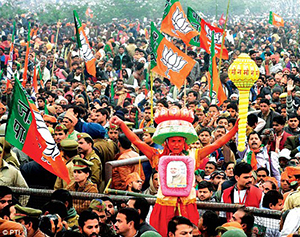
Since the rise of the regional Samajwadi Party (SP) and Bahujan Samaj Party (BSP) in the late 1990s, national parties — the Congress and the BJP — have been often relegated to third and fourth positions in the state. This time around, the Congress has joined the governing SP as a junior partner in an alliance, and the BJP is making an all out effort to win back the state.

In the past few days, I've travelled through several districts in the state to ask people if the currency ban or “notebandi” (Hindi for stopping of notes) here - is an election issue.

The “notebandi” has without doubt touched every life, in the big cities, smaller towns and tiny villages, and everyone talks about the problems they've faced. But will it impact the way people vote? In the main market in Barabanki town, not far from the state capital, Lucknow, the trading community is seething at the “BJP's betrayal”.

Traders have traditionally supported the BJP, and in the past they have also contributed generously to party funds. But this time, they tell me they will not vote for the party. “Notebandi is the biggest issue here,” says Santosh Kumar Gupta, who along with his brothers, runs the family hardware store. “The public has been really hassled. The government set limits on withdrawals and even those little amounts were unavailable because banks had no money.”

Gupta points out that in his address to the nation, the prime minister said the government had been planning for it for six months and that people would face minor problems.

“But there were lots of problems. Isn't he ashamed of lying?” he asks angrily. “Police used sticks to beat up people waiting in queues to withdraw their own hard-earned money. All small manufacturing units in Barabanki shut down for weeks. Thousands became unemployed.”

“There's a labour market a few metres from our shop and every morning, nearly 500 daily wage labourers from the nearby villages would gather to look for work, but for the first time, we saw there were no takers for them.” His brother Manoj Kumar Jaiswal adds: “Traders are very angry with Modi. He first said it was done to curb black money.

Then he said it was done to promote digital economy. “You can use credit cards and (popular mobile wallet) Paytm in cities like Delhi and Mumbai, not in Barabanki. People here are illiterate, many don't have bank accounts or credit cards.” The Gupta family has 10 voters and not one will opt for the BJP.

In Gosaiganj, on the outskirts of Lucknow, I stop to talk to people gathered at a tea stall. Raja Ram Rawat, a 60-year-old widower, lives with his two sons and four grandchildren. The small plot of land he owns is not sufficient to support the family and his sons work as daily wagers to supplement the family income. “Since November 8, they've not been able to find work even for one day,” he says. I ask him how they are managing. “Earlier if we bought two kilograms of vegetables, now we buy only one. That's how we are managing.”

A farmer in the group, Kallu Prasad, compares the ban to “poison” for his community - it came just as the rice crop had been harvested and the sowing season had begun for wheat, mustard and potatoes. “Normally we sell a kilo of rice for Rs 14, but this time we had to sell it for Rs 8 or Rs 9. We couldn't buy seeds and pesticides in time. Farmers who grew vegetables were the worst affected. Since people had no money to buy vegetables, they had to just throw them away.”

In the holy city of Varanasi, walking through the narrow lanes of Lallapura area, where homes sit cheek by jowl, one cannot escape the noise of the looms. Here, every home is a tiny factory where weavers work in semi-darkened rooms, using coloured silk threads to create beautiful patterns. Varanasi is famous for its hand woven silk and cotton saris and nearly a million people make their living from this cottage industry here.

“It was like we were hit by a bolt of lightning,” says factory owner Sardar Mohd Hasim, describing the moment of Modi's announcement. Hasim, who represents 30,000 weavers, says initially “about 90% of the industry” was affected since all their transactions happen in cash.

Looms still shut
“We had no cash to buy raw materials, we had no cash to pay wages to the workers. Nearly three months later, all my 24 looms are still shut. Most of my weavers are doing other jobs to earn a living.”

Varanasi has eight assembly constituencies, and Hasim insists that BJP will not win even one. “Why would anyone now vote for Modi?” he asks. One of his former workers, 40-year-old Mangru Prajapati, who is now back to work in Hasim's brother's loom, agrees. He's the sole breadwinner for his family of eight.

Rajan Behal, trader and leader of the organisation that represents traders, weavers and sellers, calls it a “major disaster”. The ban, he says, couldn't have come at a worse time - November to February is the wedding season when sales peak, but this year it's been a wipe-out. A long-time BJP supporter, Behal refuses to say who he will vote for but predicts that Modi “will not win enough seats to be able to form a government in the state”.

It's an assessment challenged by senior BJP leader in the state Vijay Pathak, who pegs the party's chances of winning at “101%”. He says that there were difficulties in the implementation of the currency ban, but insists that they have been able to convince the voters that it was done in the nation's interest. “We started our campaign with the aim to win more than 265 of the 403 seats. Now we believe we will cross 300.”

That, he says, is because people have faith in “the man who's taking the decisions” - the prime minister. On this count, he's right - Modi's personal stock remains high, especially with the youth. In Kukha Rampur village in Tiloi constituency in Amethi district, 21-year-old Tanu Maurya says she will vote for Modi because he is “doing good work” and that the note ban was “a good decision even if it caused some hardships in the short term”.

Since his sweep of the 2014 general election, Modi has not had much luck in state elections and he's desperate to reverse that losing trend. A victory in the politically key state of Uttar Pradesh would be a huge shot in the arm for Modi and his party.

But will the rupee ban help him or hurt his chances? When the votes are counted on March 11, we will know whether it was a masterstroke or a miscalculation.

Comments

Add new comment

  • Coastaldigest.com reserves the right to delete or block any comments.
  • Coastaldigset.com is not responsible for its readers’ comments.
  • Comments that are abusive, incendiary or irrelevant are strictly prohibited.
  • Please use a genuine email ID and provide your name to avoid reject.
Agencies
March 3,2020

Facebook on Monday launched a new consumer marketing campaign in India titled 'More Together'. India is the first country in the Asia Pacific region where such a campaign is being rolled out.

It is also the first time that Facebook is rolling out a 'high decibel campaign of this stature in India', the company said in a statement.

It is also the first time that Facebook is rolling out a 'high decibel campaign of this stature in India', the company said in a statement.

"India is at the heart of Facebook and one of our focus areas this year is to tell the exciting story of a service that is deeply embedded in the fabric of India," said Ajit Mohan, Vice President and Managing Director, Facebook India.

The campaign would have multiple campaigns over the next few weeks in eight languages and the one will be set in the context of Holi.

Facebook in 2019 introduced a new company logo to further distinguish the company from the Facebook app.

The company recently announced the appointment of Avinash Pant as the Marketing Director for India operations, to drive the consumer marketing efforts across the family of apps.

Comments

Add new comment

  • Coastaldigest.com reserves the right to delete or block any comments.
  • Coastaldigset.com is not responsible for its readers’ comments.
  • Comments that are abusive, incendiary or irrelevant are strictly prohibited.
  • Please use a genuine email ID and provide your name to avoid reject.
Agencies
May 31,2020

Cape Canaveral, May 31: SpaceX, the private rocket company of billionaire entrepreneur Elon Musk, launched two Americans into orbit from Florida on Saturday in a landmark mission marking the first spaceflight of NASA astronauts from U.S. soil in nine years.

A SpaceX Falcon 9 rocket lifted off from the Kennedy Space Center at 3:22 p.m. EDT (19:22 GMT), launching Doug Hurley and Bob Behnken on a 19-hour ride aboard the company’s newly designed Crew Dragon capsule bound for the International Space Station.

Just before liftoff, Hurley said, “SpaceX, we’re go for launch. Let’s light this candle,” paraphrasing the famous comment uttered on the launch pad in 1961 by Alan Shepard, the first American flown into space.

Minutes after launch, the first-stage booster rocket of the Falcon 9 separated from the upper second-stage rocket and flew itself back to Earth to descend safely onto a landing platform floating in the Atlantic.

High above the Earth, the Crew Dragon jettisoned moments later from the second-stage rocket, sending the capsule on its way to the space station.

The exhilarating spectacle of the rocket soaring flawlessly into the heavens came as a welcome triumph for a nation gripped by racially-charged civil unrest as well as ongoing fear and economic upheaval from the coronavirus pandemic.

The Falcon 9 took off from the same launch pad used by NASA’s final space shuttle flight, piloted by Hurley, in 2011. Since then, NASA astronauts have had to hitch rides into orbit aboard Russia’s Soyuz spacecraft.

“It’s incredible, the power, the technology,” said U.S. President Donald Trump, who was at Kennedy Space Center at Cape Canaveral in Florida for the launch. “That was a beautiful sight to see.”

The mission’s first launch attempt on Wednesday was called off with less than 17 minutes remaining on the countdown clock. Weather again threatened Saturday’s launch, but cleared in time to proceed with the mission.

SPACEFLIGHT MILESTONES

NASA chief Jim Bridenstine has said resuming launches of American astronauts on American-made rockets from U.S. soil is the space agency’s top priority.

“I’m breathing a sigh of relief, but I will also tell you I’m not gonna celebrate until Bob and Doug are home safely.” Bridenstine said.

For Musk, the launch represents another milestone for the reusable rockets his company pioneered to make spaceflight less costly and more frequent. And it marks the first time commercially developed space vehicles - owned and operated by a private entity rather than NASA - have carried Americans into orbit.

The last time NASA launched astronauts into space aboard a brand new vehicle was 40 years ago at the start of the space shuttle program.

Musk, the South African-born high-tech entrepreneur who made his fortune in Silicon Valley, is also chief executive of electric carmaker and battery manufacturer Tesla Inc. He founded Hawthorne, California-based SpaceX, formally known as Space Exploration Technologies, in 2002.

Hurley, 53, and Behnken, 49, NASA employees under contract to fly with SpaceX, are expected to remain at the space station for several weeks, assisting a short-handed crew aboard the orbital laboratory.

Boeing Co, producing its own launch system in competition with SpaceX, is expected to fly its CST-100 Starliner vehicle with astronauts aboard for the first time next year. NASA has awarded nearly $8 billion combined to SpaceX and Boeing for development of their rival rockets.

Trump also hailed the launch as a major advance toward the goal of eventually sending humans to Mars.

He was joined at the viewing by Musk, as well as Vice President Mike Pence, Commerce Secretary Wilbur Ross, Education Secretary Betsy DeVos, Florida congressman Matt Gaetz and Senator Rick Scott.

Earlier on Saturday, the crew bid goodbye to their families. Prior to climbing into a specially designed Tesla automobile for the ride to the launch site, Behnken told his young son, “Be good for mom. Make her life easy.”

During the drive, Behnken and Hurley passed former astronaut Garrett Reisman who held a sign saying, “Take me with you.”

Comments

Add new comment

  • Coastaldigest.com reserves the right to delete or block any comments.
  • Coastaldigset.com is not responsible for its readers’ comments.
  • Comments that are abusive, incendiary or irrelevant are strictly prohibited.
  • Please use a genuine email ID and provide your name to avoid reject.
Agencies
July 25,2020

In a study conducted in 117 countries, researchers have found that the world is experiencing the most dramatic reduction in the seismic noise (the hum of vibrations in the planet's crust) in recorded history due to global COVID-19 lockdowns.

Measured by instruments called seismometers, seismic noise is caused by vibrations within the Earth, which travel like waves and the waves can be triggered by earthquakes, volcanoes, and bombs - but also by daily human activity like travel and industry.

This quiet period was likely caused by the total global effect of social distancing measures, closure of services and industry, and drops in tourism and travel, the study published in the journal Science, reported.

The new research, led by the Royal Observatory of Belgium and five other institutions around the world including Imperial College London (ICL), showed that the dampening of 'seismic noise' caused by humans was more pronounced in more densely populated areas.

"Our study uniquely highlights just how much human activities impact the solid Earth, and could let us see more clearly than ever what differentiates human and natural noise," said study co-author Stephen Hicks from ICL in the UK.

For the findings, the research team looked at seismic data from a global network of 268 seismic stations in 117 countries and found significant noise reductions compared to before any lockdown at 185 of those stations.

Researchers tracked the 'wave' of quietening between March and May as worldwide lockdown measures took hold.

The largest drops in vibrations were seen in the most densely populated areas, like Singapore and New York City, but drops were also seen in remote areas like Germany's the Black Forest and Rundu in Namibia.

Citizen-owned seismometers, which tend to measure more localised noise, noted large drops around universities and schools around Cornwall, UK and Boston, US - a drop in noise 20 per cent larger than seen during school holidays.

The findings showed that countries like Barbados, where lockdown coincided with the tourist season, saw a 50 per cent decrease in noise.

"The changes have also given us the opportunity to listen in to the Earth's natural vibrations without the distortions of human input," the study authors wrote.

Earlier in April, a study published in the journal Nature, reported at least a 30 per cent reduction in that amount of ambient human noise since lockdown began in Belgium.

Comments

Add new comment

  • Coastaldigest.com reserves the right to delete or block any comments.
  • Coastaldigset.com is not responsible for its readers’ comments.
  • Comments that are abusive, incendiary or irrelevant are strictly prohibited.
  • Please use a genuine email ID and provide your name to avoid reject.