



Will terminate pact if 108 failed to ensure better service: UT Khader

[email protected] (CD Network)
January 17, 2016

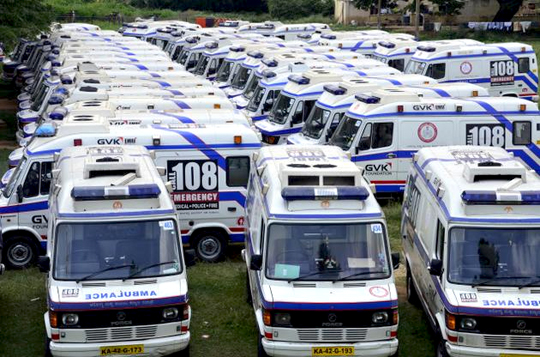
Bengaluru, Jan 17: UT Khader, minister for health and family welfare, has threatened to terminate agreement with GVK EMRI, a private agency, that runs the ‘108’ ambulance service if it failed to ensure quality and disciplined service.
108

At a press conference here Mr Khader warned that the staff of the ‘108’ ambulance had not been providing efficient service. “Taking patients to private hospitals, poor maintenance of vehicles, wearing dirty clothes, and parking ambulances outside hotels etc. are not good signs” from the view point of public, he said.

The ambulance staff have threatened to go on strike from next week seeking higher pay.

“We will run ambulance service, let them go on strike. Lack of discipline will not be tolerated. We will take action against GVK,” the Minister said, and threatened to terminate the contract with the private firm if the latter failed to provide quality service.

The Minister said an order was issued on January 14, 2016, for increasing the salary of emergency medical technicians and pilots for the ambulance service. The order would be kept in abeyance if the staff goes on strike next week.

The increased salary costs the State exchequer Rs. 6.64 crore a year, he said.

The Minister said a group with the ‘108’ ambulance employees had been blackmailing the government and encouraging drivers to go on strike.

Comments

rikaz
 - 
Sunday, 17 Jan 2016

for government 6.64 crore is not a big deal....

Add new comment

  • Coastaldigest.com reserves the right to delete or block any comments.
  • Coastaldigset.com is not responsible for its readers’ comments.
  • Comments that are abusive, incendiary or irrelevant are strictly prohibited.
  • Please use a genuine email ID and provide your name to avoid reject.
News Network
March 19,2020

Belagavi, Mar 19: South Western Railway (SWR) on Thursday increased the fares of the platform tickets at Belagavi, Hubballi and Ballari.

The rate of platform tickets has been increased to Rs 50 with effect from Thursday till March 31, in order to control the crowding at platforms in view of the coronavirus outbreak.

Belagavi, Hubballi, and Bellari were all big stations and maximum number of people, including both passengers and those there to see them off come or to receive them at these railway stations, a SWR official sources said.

Comments

Add new comment

  • Coastaldigest.com reserves the right to delete or block any comments.
  • Coastaldigset.com is not responsible for its readers’ comments.
  • Comments that are abusive, incendiary or irrelevant are strictly prohibited.
  • Please use a genuine email ID and provide your name to avoid reject.
Dr Parinitha
January 17,2020

We came on foot, we came on boats, shouting slogans of Azadi.

We stood on roof tops and sat on walls under the burning midday sun,

Listening to the words that we had longed to hear for so long.

Words that had been scripted through the lonely fears of our hearts.

Words that were spoken now with the clarity of courage.

Words that were spoken now with the suppressed strength of pent up anger.

Words that were spoken now with the certainty of belonging to the soil 

Which had become one with the dust of our ancestors.

We stood there in the waves of heat

Feeling the surge and press  of countless bodies around us.

Bodies meshed through the odour of sweat 

And the shared fear of a common persecution.

And hanging from the roof tops,

And tied to the poles,

And clutched in hands slippery with sweat,

And wrapped round the pillars,

And spreading into our blood,

Were three strips of colour with a wheel of spokes,

Sewn together into the shape of our being.

Woven into the folds of our future and the creases of our past. 

Stitched to the seams of the earth, the water, the air and the sky 

That belonged to us and to which we belonged. 

And we stood there from noon to evening,

We the people of India.

Raising our clenched fists like signposts to the future.

Chanting slogans like a new anthem.

Kin to each other through the ties of community.

Born to live and die 

In a nation that was ours to hold on to

And ours to belong to.

Dr Parinitha is a professor of English in Mangalore University. She penned the poem soon after participating in the historic protest against CAA, NPR and NRC at Shah Garden, Adyar, Mangaluru on 15th January, 2020.

Also Read: 

‘The more you try to divide us, the stronger and united we’ll be’: Record turnout in Mangaluru’s anti-NRC protest

Anti-NRC protest in Mangaluru brings ‘media bias’ to the fore

Comments

Abdullah
 - 
Wednesday, 29 Jan 2020

Salute to you siter for your meaningful poem.  This is reality.  However, the enmy is blind/deaf/dumb.   May God give right way of thinking to enmy and in case he is unlucky, let God finish him and let him beg for death.  

Indian
 - 
Thursday, 23 Jan 2020

Waav..What a Heart Touching poetry...


Hats off to you ma'am....


Love from all Indians...


Add new comment

  • Coastaldigest.com reserves the right to delete or block any comments.
  • Coastaldigset.com is not responsible for its readers’ comments.
  • Comments that are abusive, incendiary or irrelevant are strictly prohibited.
  • Please use a genuine email ID and provide your name to avoid reject.
News Network
February 28,2020

Bengaluru, Feb 28: Historian S. Shettar, 85, breathed his last early on February 28 in Bengaluru. He was suffering from respiratory problems and was hospitalised for over a week.

Shettar was known for his multi-disciplinary work, encompassing linguistics, epigraphy, anthropology, the study of religions and art history. He had extensively worked on the Jain practice of ritual death in Karnataka and Asoka edicts. He had studied and compiled early edicts in Kannada and worked extensively on the growth of Kannada language down the ages.

Born in 1935 at Hampasagara, Ballari district, he went on to study at Cambridge University and started his career as a Professor of History at Karnatak University, Dharwad, his alma mater. He later headed the National Museum Institute of the History of Art, Conservation and Museology in 1978 and Indian Council for Historical Research in 1996. He was also a visiting professor at the National Institute of Advanced Studies, Bengaluru.

He was a bilingual historian who wrote in English for most of his career, but started writing in Kannada in later years. In the last two decades, he developed a keen interest in linguistics and wrote multiple books on classical Kannada and Prakrit. His 2007 book “Shangam Tamilagam” is considered a seminal work in the study of the early period of Dravidian languages. It won him Bhasha Samman from Central Sahitya Akademi. He later wrote two works on Halegannada, classical Kannada. His most recent work was “Prakrita Jagadvalaya” in 2018.

Comments

Add new comment

  • Coastaldigest.com reserves the right to delete or block any comments.
  • Coastaldigset.com is not responsible for its readers’ comments.
  • Comments that are abusive, incendiary or irrelevant are strictly prohibited.
  • Please use a genuine email ID and provide your name to avoid reject.