Will terminate pact if 108 failed to ensure better service: UT Khader

[email protected] (CD Network)
January 17, 2016

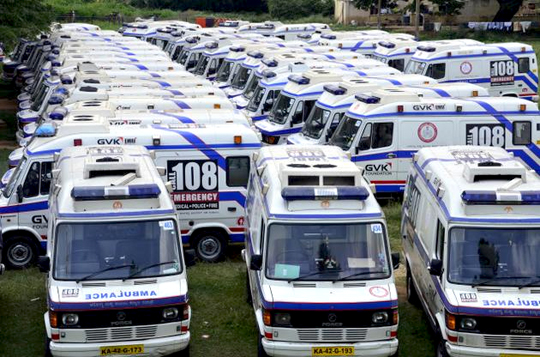
Bengaluru, Jan 17: UT Khader, minister for health and family welfare, has threatened to terminate agreement with GVK EMRI, a private agency, that runs the ‘108’ ambulance service if it failed to ensure quality and disciplined service.

108

At a press conference here Mr Khader warned that the staff of the ‘108’ ambulance had not been providing efficient service. “Taking patients to private hospitals, poor maintenance of vehicles, wearing dirty clothes, and parking ambulances outside hotels etc. are not good signs” from the view point of public, he said.

The ambulance staff have threatened to go on strike from next week seeking higher pay.

“We will run ambulance service, let them go on strike. Lack of discipline will not be tolerated. We will take action against GVK,” the Minister said, and threatened to terminate the contract with the private firm if the latter failed to provide quality service.

The Minister said an order was issued on January 14, 2016, for increasing the salary of emergency medical technicians and pilots for the ambulance service. The order would be kept in abeyance if the staff goes on strike next week.

The increased salary costs the State exchequer Rs. 6.64 crore a year, he said.

The Minister said a group with the ‘108’ ambulance employees had been blackmailing the government and encouraging drivers to go on strike.

Comments

rikaz
 - 
Sunday, 17 Jan 2016

for government 6.64 crore is not a big deal....

Add new comment

  • Coastaldigest.com reserves the right to delete or block any comments.
  • Coastaldigset.com is not responsible for its readers’ comments.
  • Comments that are abusive, incendiary or irrelevant are strictly prohibited.
  • Please use a genuine email ID and provide your name to avoid reject.
Ram Puniyani
February 10,2020

Noam Chomsky is one of the leading peace workers in the world. In the wake of America’s attack on Vietnam, he brought out his classic formulation, ‘manufacturing consent’. The phrase explains the state manipulating public opinion to have the public approve of it policies—in this case, the attack of the American state on Vietnam, which was then struggling to free itself from French colonial rule.

In India, we are witness to manufactured hate against religious minorities. This hatred serves to enhance polarisation in society, which undermines India’s democracy and Constitution and promotes support for a Hindu nation. Hate is being manufactured through multiple mechanisms. For example, it manifests in violence against religious minorities. Some recent ghastly expressions of this manufactured hate was the massive communal violence witnessed in Mumbai (1992-93), Gujarat (2002), Kandhamal (2008) and Muzaffarnagar (2013). Its other manifestation was in the form of lynching of those accused of having killed a cow or consumed beef. A parallel phenomenon is the brutal flogging, often to death, of Dalits who deal with animal carcasses or leather.

Yet another form of this was seen when Shambhulal Regar, indoctrinated by the propaganda of Hindu nationalists, burned alive Afrazul Khan and shot the video of the heinous act. For his brutality, he was praised by many. Regar was incited into the act by the propaganda around love jihad. Lately, we have the same phenomenon of manufactured hate taking on even more dastardly proportions as youth related to Hindu nationalist organisations have been caught using pistols, while police authorities look on.

Anurag Thakur, a BJP minster in the central government recently incited a crowd in Delhi to complete his chant of what should happen to ‘traitors of the country...” with a “they should be shot”. Just two days later, a youth brought a pistol to the site of a protest at Jamia Millia Islamia university and shouted “take Azaadi!” and fired it. One bullet hit a student of Jamia. This happened on 30 January, the day Nathuram Godse had shot Mahatma Gandhi in 1948. A few days later, another youth fired near the site of protests against the CAA and NRC at Shaheen Bagh. Soon after, he said that in India, “only Hindus will rule”.

What is very obvious is that the shootings by those associated with Hindu nationalist organisations are the culmination of a long campaign of spreading hate against religious minorities in India in general and against Muslims in particular. The present phase is the outcome of a long and sustained hate campaign, the beginning of which lies in nationalism in the name of religion; Muslim nationalism and Hindu nationalism. This sectarian nationalism picked up the communal view of history and the communal historiography which the British introduced in order to pursue their ‘divide and rule’ policy.

In India what became part of “social common sense” was that Muslim kings had destroyed Hindu temples, that Islam was spread by force, and that it is a foreign religion, and so on. Campaigns, such as the one for a temple dedicated to the Hindu god Rama to be built at the site where the Babri masjid once stood, further deepened the idea of a Muslim as a “temple-destroyer”. Aurangzeb, Tipu Sultan and other Muslim kings were tarnished as the ones who spread Islam by force in the subcontinent. The tragic Partition, which was primarily due to British policies, and was well-supported by communal streams also, was entirely attributed to Muslims. The Kashmir conflict, which is the outcome of regional, ethnic and other historical issues, coupled with the American policy of supporting Pakistan’s ambitions of regional hegemony, (which also fostered the birth of Al-Qaeda), was also attributed to the Muslims.

With recurring incidents of communal violence, these falsehoods went on going deeper into the social thinking. Violence itself led to ghettoisation of Muslims and further broke inter-community social bonds. On the one hand, a ghettoised community is cut off from others and on the other hand the victims come to be presented as culprits. The percolation of this hate through word-of-mouth propaganda, media and re-writing of school curricula, had a strong impact on social attitudes towards the minorities.

In the last couple of decades, the process of manufacturing hate has been intensified by the social media platforms which are being cleverly used by the communal forces. Swati Chaturvedi’s book, I Am a Troll: Inside the Secret World of the BJP’s Digital Army, tells us how the BJP used social media to spread hate. Whatapp University became the source of understanding for large sections of society and hate for the ‘Other’, went up by leaps and bounds. To add on to this process, the phenomenon of fake news was shrewdly deployed to intensify divisiveness.

Currently, the Shaheen Bagh movement is a big uniting force for the country; but it is being demonised as a gathering of ‘anti-nationals’. Another BJP leader has said that these protesters will indulge in crimes like rape. This has intensified the prevalent hate.

While there is a general dominance of hate, the likes of Shambhulal Regar and the Jamia shooter do get taken in by the incitement and act out the violence that is constantly hinted at. The deeper issue involved is the prevalence of hate, misconceptions and biases, which have become the part of social thinking.

These misconceptions are undoing the amity between different religious communities which was built during the freedom movement. They are undoing the fraternity which emerged with the process of India as a nation in the making. The processes which brought these communities together broadly drew from Gandhi, Bhagat Singh and Ambedkar. It is these values which need to be rooted again in the society. The communal forces have resorted to false propaganda against the minorities, and that needs to be undone with sincerity.

Combating those foundational misconceptions which create hatred is a massive task which needs to be taken up by the social organisations and political parties which have faith in the Indian Constitution and values of freedom movement. It needs to be done right away as a priority issue in with a focus on cultivating Indian fraternity yet again.


Comments

Add new comment

  • Coastaldigest.com reserves the right to delete or block any comments.
  • Coastaldigset.com is not responsible for its readers’ comments.
  • Comments that are abusive, incendiary or irrelevant are strictly prohibited.
  • Please use a genuine email ID and provide your name to avoid reject.
News Network
March 13,2020

Bengaluru, Mar 13: Senior IPS officer KSR Charan Reddy, who was the Additional Director General of Police in Criminal Investigation Department, Karnataka passed away in Bengaluru on Friday after prolonged illness. 

He was reportedly battling cancer for at least three years now and had suffered multiple recurs after treatment. 

"Shri Charan Reddy, IPS, ADGP, Karnataka State, passed away this morning, after a prolonged illness. He was one of our finest officers. Always stood tall and held his head high!! May his soul rest in peace," Retired IPS officer and former Director General of Police (Fire Services) MN Reddi tweeted. 

IPS officer Charan Reddy was heading the Special Investigation Team of the Lokayukta when he arrested Vijayanagara MLA Anand Singh in 2015 for illegally transporting iron ore out of Ballari. The illegal mining scam had rocked the former BJP government in 2011.

Karnataka Chief Minister BS Yediyurappa condoled his death and said that he was an honest officer in the state. "Charan Reddy was a dedicated and honest officer. I pray that his soul rests in peace. I pray that god gives his family the strength to go through such a turbulent time after his departure," BS Yediyurappa tweeted. 

A 1993-batch IPS officer, Charan Reddy KSR is originally from Chittoor and has served under various departments of the state's police force. He was serving as the Inspector General of Police in Belagavi division in 2013, when he was transferred to Bengaluru as the IGP (Training). In 2014, he was posted as the IGP of the SIT probing the illegal mining scam in which former Tourism Minister Gali Janardhana Reddy is also allegedly involved.

He was transferred out of the SIT in Lokayukta in 2016 and posted as Additional Commissioner of Police (law and order) in Bengaluru. He served as the ADGP of Crime in Mangaluru in 2018 and was later appointed as the Additional Director General of Police (training) the same year. In 2019, he was transferred and appointed as the ADGP of CID.

Comments

Add new comment

  • Coastaldigest.com reserves the right to delete or block any comments.
  • Coastaldigset.com is not responsible for its readers’ comments.
  • Comments that are abusive, incendiary or irrelevant are strictly prohibited.
  • Please use a genuine email ID and provide your name to avoid reject.
News Network
January 29,2020

Bengaluru, Jan 29: The high court has granted bail to a 37-year-old Bangladeshi woman from the Christian community on the strength of Citizenship (Amendment) Act 2019.

The court cited Section 2 of the amended Citizenship Act 1955, according to which minorities from Pakistan, Bangladesh and Afghanistan who entered India on or before December 31, 2014 should not be treated as illegal immigrants, while granting her bail.

Allowing the petition filed by Archana Purnima Pramanik, an illegal immigrant from Bangladesh, who claims to be staying in India since 2003, justice John Michael Cunha on Monday directed her to furnish a bail bond for Rs 2 lakh to the satisfaction of the investigating officer and cooperate with the probe.

The judge observed the allegations made against her must be proved in a full-dressed trial. Archana was booked for obtaining documents such as PAN and Aadhaar cards and also fraudulently obtaining an Indian passport on March 28 last year. Based on a complaint filed by the assistant passport officer, Archana was arrested on November 7, 2019 and her bail petition was dismissed by a sessions court on December 4, 2019.

Born on March 23, 1983 at Tanore, Rajshahi district of Bangladesh, Archana came to India in 2003 to pursue a career in nursing. After obtaining a diploma in general nursing and midwifery at Ranchi in 2006, she worked in many reputed hospitals.

In 2010, she got married to Rajashekaran Krishnamurthy and the marriage was registered at Ranchi. After the wedding, she moved to Bengaluru and obtained PAN, Aadhaar and voter ID cards.

On April 1, 2019, Archana applied for a visa to Bangladesh for herself and her son. During her journey on May 20, 2019, they were detained at Kolkata airport and released later. However, the regional passport office issued a notice revoking Archana’s passport and she was arrested by RT Nagar police on November 7, 2019.

Comments

Add new comment

  • Coastaldigest.com reserves the right to delete or block any comments.
  • Coastaldigset.com is not responsible for its readers’ comments.
  • Comments that are abusive, incendiary or irrelevant are strictly prohibited.
  • Please use a genuine email ID and provide your name to avoid reject.