



Wolf-sized otters roamed Earth over 6 million years ago

January 25, 2017

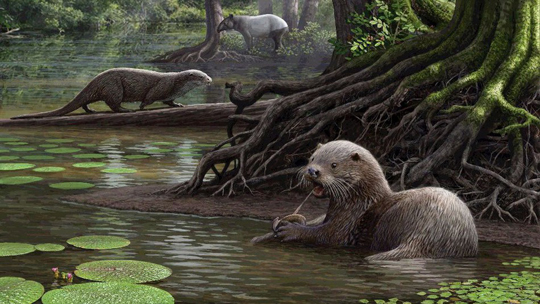
Washington, Jan 25: Prehistoric otters may have been of the size of a modern wolf, say scientists who have discovered 6.24 million-year-old fossils of one of the largest otter species known to science. Remains of the large extinct otter, which had large, powerful jaws and is estimated to have weighed about 50 kilogrammes, was found in the northeastern Yunnan Province in China.
Wolf

The species, named Siamogale melilutra, belongs to an ancient lineage of extinct otters that was previously known only from isolated teeth from a different, much older species that was recovered in Thailand. Researchers from Cleveland Museum of Natural History in the US recovered a complete cranium, mandible, dentition and various skeletal elements - offering a wealth of insight into the taxonomy, evolutionary history and functional morphology of this new species.

"While the cranium is incredibly complete, it was flattened during the fossilisation process," said Denise Su, from the Cleveland Museum of Natural History. "The bones were so delicate that we could not physically restore the cranium. Instead, we CT-scanned the specimen and virtually reconstructed it in a computer," said Su.

The CT restoration showed a combination of otter-like and badger-like features, giving way to the species name "melilutra," which combines the Latin names for badger (meles) and otter (lutra). Siamogale melilutra had a large, powerful jaw with the enlarged, bunodont (rounded-cusped) teeth typical of many otter lineages.

This raises the question of whether these bunodont teeth were inherited by all otters from a common ancestor or evolved independently in different otter lineages over time because of the evolution of similar adaptations to thrive in similar environments - a phenomenon called "convergent evolution."

Through their analysis, researchers found that bunodont teeth independently appeared at least three times over the evolutionary history of otters, suggesting convergent evolution to be the cause. The completeness of the specimens from Shuitangba allows the scientists to better understand the evolutionary history of otters and specifically this enigmatic genus from the Miocene, of which there had been little information.

The findings show that Siamogale belongs to one of the oldest and most primitive lineages of the otter family, which goes back at least 18 million years in the form of Paralutra from Europe. The scientists are working to understand other aspects of the life of Siamogale melilutra.

"The discovery of the otter helps solve some questions about otter relationships, but has opened the door to new questions," said Xiaoming Wang from the Natural History Museum of Los Angeles County in the US. The study was published in The Journal of Systematic Paleontology.

Comments

Add new comment

  • Coastaldigest.com reserves the right to delete or block any comments.
  • Coastaldigset.com is not responsible for its readers’ comments.
  • Comments that are abusive, incendiary or irrelevant are strictly prohibited.
  • Please use a genuine email ID and provide your name to avoid reject.
Agencies
January 4,2020

Washington D.C: One of the greatest spectacles of modern art is still thriving in the Australian outback as confirmed by satellite imagery of NASA. The Marree Man is a massive geoglyph depicting an aboriginal hunter, that spans over 2.6 miles in the Southern Australian region.

Discovered by a pilot in 1998, its origin still remains a mystery even to this date.

The Marree Man was given a new lease of life in 2016 when a group of people from the neighboring town of Marree plowed its lines to avert its fading due to erosion.

After NASA shared the image of the art-work that was taken in June, the efforts of the good samaritans turned out to be a total success, reported CNN Travel.

The restoration team believes that the refurbished Marree Man would last longer than its original version.

According to NASA, "They [the team] created wind grooves, designed to trap water and encourage the growth of vegetation. They hope that eventually, the man will turn green."

In a previous article, CNN reported that an entrepreneur by the name of Dick Smith took upon himself to unravel the geoglyph's mystery in 2016. His team combed through all the available evidence but couldn't find anything conclusive.

In 2018 he even offered a 5,000 Australian dollar reward for anyone who knows the identity of its creator.

Nobody turned up with an answer but it was speculated that unknown artist lives in Alice Springs or even might be an American.

Comments

Add new comment

  • Coastaldigest.com reserves the right to delete or block any comments.
  • Coastaldigset.com is not responsible for its readers’ comments.
  • Comments that are abusive, incendiary or irrelevant are strictly prohibited.
  • Please use a genuine email ID and provide your name to avoid reject.
Agencies
February 17,2020

Google on Monday announced it is gradually winding down its free public Wi-Fi Station programme currently available at over 400 railway stations in India, and will work with the Indian Railways and Railtel Corporation to help them with existing sites so they can remain useful resources for people.

Google launched its Station initiative in India in 2015 to bring fast, free public Wi-Fi to over 400 of the busiest railway stations in the country by mid-2020.

"We crossed that number by June 2018 and implemented Station in thousands of other locations around the country in partnership with telecommunications companies, ISPs and local authorities," Caesar Sengupta, Vice President, Payments and Next Billion Users, Google, said in a statement.

"Over time, partners in other countries asked for Station too and we responded accordingly. We're grateful for these partnerships, especially with the Indian Railways and the Government of India, that helped us serve millions of users over the last few years," he added.

According to Google, the decision to shut Station has been taken keeping the affordable mobile data plans and mobile connectivity in mind that is improving globally including in India.

"India, specifically now has among the cheapest mobile data per GB in the world, with mobile data prices having reduced by 95 per cent in the last 5 years, as per TRAI in 2019," said Sengupta.

The Indian users consume close to 10GB of data, each month, on average, according to reports.

"Our commitment to supporting the next billion users remains stronger than ever, from continuing our efforts to make the internet work for more people and building more relevant and helpful apps and services," Sengupta noted.

Global networking giant Cisco last year teamed up with Google to roll out free, high-speed public Wi-Fi access globally, starting with India.

The first pilot under the partnership was rolled out at 35 locations in Bengaluru.

Sengupta said that in addition to the changed context, the challenge of varying technical requirements and infrastructure among our partners across countries has also made it difficult for Station to scale and be sustainable, especially for our partners.

"And when we evaluate where we can truly make an impact in the future, we see greater need and bigger opportunities in building products and features tailored to work better for the next billion user markets," he said.

Comments

Add new comment

  • Coastaldigest.com reserves the right to delete or block any comments.
  • Coastaldigset.com is not responsible for its readers’ comments.
  • Comments that are abusive, incendiary or irrelevant are strictly prohibited.
  • Please use a genuine email ID and provide your name to avoid reject.
Agencies
June 12,2020

Mumbai, Jun 12: Following an overwhelming response for the mega rights issue of Mukesh Ambani-owned Reliance Industries, the partly paid-up rights shares are set to debut on stock exchanges on June 15.

The biggest ever Rs 53,124 crore rights issue was subscribed 1.59 times and received bids worth Rs 84,000 crore on June 3.

Reliance said the rights issue saw a huge investor interest, including from lakhs of small investors and thousands of institutional investors, both Indian and foreign.

In 2019, Ambani said in the Reliance's annual general meeting that the company will be net zero debt by March 2021. The company is on course to achieve its target ahead of the deadline.

"In spite of the COVID-19 crisis and the lockdowns, the due-diligence by Saudi Aramco for the planned investment in the O2C business is on track as both the parties are committed and actively engaged," he said recently.

"With a strong visibility to these equity infusions, Reliance is set to achieve net zero debt status ahead of its own aggressive timeline. We believe rights issue was a part of the company's strategy of deleveraging its balance sheet," said Ambani. 

Comments

Add new comment

  • Coastaldigest.com reserves the right to delete or block any comments.
  • Coastaldigset.com is not responsible for its readers’ comments.
  • Comments that are abusive, incendiary or irrelevant are strictly prohibited.
  • Please use a genuine email ID and provide your name to avoid reject.