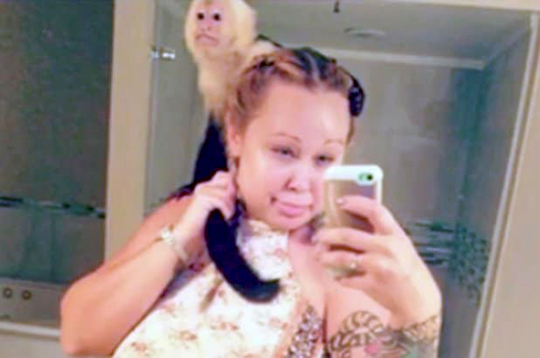
Woman held for keeping tigers, monkeys, fox at home

November 15, 2016

New York, Nov 15: An American woman has been arrested for keeping three tigers, a skunk, a cougar, a fox and several monkeys at home.

trisha1

Trisha Meyer, 34, lived in Houston with her 14-year-old daughter as well as the animals. After a month-long investigation, police charged her with theft and child endangerment on Monday, reports Xinhua news agency.

Meyer had permits for the tigers but her keeping of other animals was illegal. Furthermore, she has records of scamming other people.

Investigation against the Texas mother started with a California man who paid Meyer $3,000 for a Savannah kitten but failed to receive it.

She told police she usually let her animals wander freely in the house and only locked up the tigers when she was out even though the tigers could be dangerous at their age and some monkeys were "vicious" and had attacked people before.

After the landlord of the house in which Meyer was living got to know her pets from police and kicked her out, she fled the Houston home and ran away with all her animals. The authorities finally pinned her down in Nye county in Nevada.

She is now in custody and her tigers have been confiscated.

trisha2

Comments

Add new comment

  • Coastaldigest.com reserves the right to delete or block any comments.
  • Coastaldigset.com is not responsible for its readers’ comments.
  • Comments that are abusive, incendiary or irrelevant are strictly prohibited.
  • Please use a genuine email ID and provide your name to avoid reject.
Agencies
June 5,2020

With the scrapping of Mitron and Remove China Apps from its Play Store gaining a lot of attention in India, Google on Thursday said that it removed a video app "for a number of technical policy violations", while adding that it also does not allow an app that "encourages or incentivizes users into removing or disabling third-party apps".

Both the apps became immensely popular in India within a short span of time due to the prevailing anti-China sentiment amid border tensions between India and China in Ladakh and calls by Indian activists to boycott Chinese products.

Reports suggested that the Mitron app is a repackaged version of TicTic, which is a TikTok clone.

The Remove China Apps was designed to help users identify applications of Chinese origin.

Without naming the apps, Google hinted that the Mitron app may make a comeback on the Play Store once it fixes some technical issues, but the chances of the Remove China Apps are thin.

"We have an established process of working with developers to help them fix issues and resubmit their apps. We've given this developer (of the video app) some guidance and once they've addressed the issue the app can go back up on Play," Sameer Samat, Vice President, Android and Google Play, said in a statement.

Google said that its Android app store was designed to provide a safe and secure experience for the consumers while also giving developers the platform and tools they need to build sustainable businesses.

Samat said that Google Play recently suspended a number of apps for violating the policy that it does not allow an app that "encourages or incentivizes users into removing or disabling third-party apps or modifying device settings or features unless it is part of a verifiable security service".

"This is a longstanding rule designed to ensure a healthy, competitive environment where developers can succeed based upon design and innovation. When apps are allowed to specifically target other apps, it can lead to behaviour that we believe is not in the best interest of our community of developers and consumers," Samat said.

"We've enforced this policy against other apps in many countries consistently in the past - just as we did here," he added.

Comments

Add new comment

  • Coastaldigest.com reserves the right to delete or block any comments.
  • Coastaldigset.com is not responsible for its readers’ comments.
  • Comments that are abusive, incendiary or irrelevant are strictly prohibited.
  • Please use a genuine email ID and provide your name to avoid reject.
Agencies
July 19,2020

New Delhi, Jul 19: Indian equities will be driven by a host of factors like corporate earnings, coronavirus cases trend and geo-political developments this week, according to analysts.

Market participants will also keenly watch the progress of monsoon, with experts saying that the farm sector revival will play a key role in lifting the coronavirus-hit economy.

"With no major event, the ongoing earnings season and global cues will continue to dictate the market trend. Besides, the progress of monsoon will also be closely watched," Ajit Mishra, VP - Research, Religare Broking, said.

Globally, the rising coronavirus infections and geo-political tensions have created uncertainty on the economic recovery front.

With India's COVID-19 cases fast approaching the 11 lakh mark, the third-highest behind the US and Brazil, and the death toll nearing 27,000, participants are expected to tread cautiously going forward.

At global level, confirmed COVID-19 cases have crossed 1.4 crore and deaths totalled about 6 lakh.

Markets globally will closely follow developments on the trade and political level between the US and China, according to analysts.

"We would continue witnessing stock-specific action as the earnings season unfold. Though the near-term momentum looks positive, we would advise traders to be cautious, given flaring US-China trade relations, persistent rise in virus cases and implementation of fresh lockdowns in parts of the country," said Siddhartha Khemka, Head - Retail Research, Motilal Oswal Financial Services Ltd.

HDFC Bank will remain in focus on Monday after having announced its June quarter earnings on Saturday.

The lender reported 19.6 per cent rise in its standalone net profit at Rs 6,658.62 crore for April-June 2020; while its income rose to Rs 34,453.28 crore during the quarter.

Other major companies to announce their quarterly results this week are Axis Bank, Bajaj Finance, Hindustan Unilever Limited, Bajaj Auto and ITC.

"Going ahead market participants will closely track the development related to covid vaccine, the rising infection of coronavirus, development on economic activities, corporate earnings and US-China relationship," said Sumeet Bagadia, Executive Director, Choice Broking.

On weekly basis, the Sensex gathered 425.81 points or 1.16 per cent, and the Nifty gained 133.65 points or 1.24 per cent.

Comments

Add new comment

  • Coastaldigest.com reserves the right to delete or block any comments.
  • Coastaldigset.com is not responsible for its readers’ comments.
  • Comments that are abusive, incendiary or irrelevant are strictly prohibited.
  • Please use a genuine email ID and provide your name to avoid reject.
News Network
May 7,2020

Toronto, May 7: Scientists have uncovered how bats can carry the MERS coronavirus without getting sick, shedding light on what triggers coronaviruses, including the one behind the COVID-19 pandemic, to jump to humans.

According to the study, published in the journal Scientific Reports, coronaviruses like the Middle East respiratory syndrome (MERS) virus, and the COVID19-causing SARS-CoV-2 virus, are thought to have originated in bats.

While these viruses can cause serious, and often fatal disease in people, bats seem unharmed, the researchers, including those from the University of Saskatchewan (USask) in Canada, said.

"The bats don't get rid of the virus and yet don't get sick. We wanted to understand why the MERS virus doesn't shut down the bat immune responses as it does in humans," said USask microbiologist Vikram Misra.

In the study, the scientists demonstrated that cells from an insect-eating brown bat can be persistently infected with MERS coronavirus for months, due to important adaptations from both the bat and the virus working together.

"Instead of killing bat cells as the virus does with human cells, the MERS coronavirus enters a long-term relationship with the host, maintained by the bat's unique 'super' immune system," said Misra, one of the study's co-authors.

"SARS-CoV-2 is thought to operate in the same way," he added.

Stresses on bats, such as wet markets, other diseases, and habitat loss, may have a role in coronavirus spilling over to other species, the study noted.

"When a bat experiences stress to their immune system, it disrupts this immune system-virus balance and allows the virus to multiply," Misra said.

The scientists, involved in the study, had earlier developed a potential treatment for MERS-CoV, and are currently working towards a vaccine against COVID-19.

While camels are the known intermediate hosts of MERS-CoV, they said bats are suspected to be the ancestral host.

There is no vaccine for either SARS-CoV-2 or MERS, the researchers noted.

Follow latest updates on the COVID-19 pandemic here

"We see that the MERS coronavirus can very quickly adapt itself to a particular niche, and although we do not completely understand what is going on, this demonstrates how coronaviruses are able to jump from species to species so effortlessly," said USask scientist Darryl Falzarano, who co-led the study.

According to Misra, coronaviruses rapidly adapt to the species they infect, but little is known on the molecular interactions of these viruses with their natural bat hosts.

An earlier study had shown that bat coronaviruses can persist in their natural bat host for at least four months of hibernation.

When exposed to the MERS virus, the researchers said, bat cells adapt, not by producing inflammation-causing proteins that are hallmarks of getting sick, but instead by maintaining a natural antiviral response.

On the contrary, they said this function shuts down in other species, including humans.

The MERS virus, the researchers said, also adapts to the bat host cells by very rapidly mutating one specific gene.

These adaptations, according to the study, result in the virus remaining long-term in the bat, but being rendered harmless until something like a disease, or other stressors, upsets this balance.

In future experiments, the scientists hope to understand how the bat-borne MERS virus adapts to infection and replication in human cells.

"This information may be critical for predicting the next bat virus that will cause a pandemic," Misra said.


Comments

Add new comment

  • Coastaldigest.com reserves the right to delete or block any comments.
  • Coastaldigset.com is not responsible for its readers’ comments.
  • Comments that are abusive, incendiary or irrelevant are strictly prohibited.
  • Please use a genuine email ID and provide your name to avoid reject.