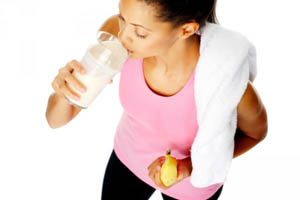
Women burn more calories when they exercise after taking protein

March 30, 2014

Mar 20: A new study has suggested that women should follow a high-protein meal with half an hour of moderate exercise as it burns more calories as compared to exercising on an empty stomach.

Burn_more_caloriesAshley Binns, a doctoral student in kinesiology and exercise science who led the study at the University of Arkansas, said the goal was to determine the interaction between the thermic effect of food and exercise on the body's total energy expenditure, as measured in calories.

Thermic effect is the amount of energy that it takes to digest, store and utilize the food we eat.

Binns said that her team looked at the effects of protein consumption alone on total energy expenditure and protein consumption combined with exercise, and found that with exercise, there is a trend for a continued increase in caloric expenditure with higher protein consumption.

Additionally, the consumption of the high- or low-protein meals resulted in greater energy expenditure than the fasted state, she said.

"That means that eating prior to exercise does provide fuel to burn, making us more like an energy-burning machine," she asserted.

Ten "recreationally active" college-age women of normal body weight participated in the study. For their testing sessions, they were given a high-protein meal, low-protein meal, or no food at all, before walking on a treadmill.

Binns said that previous studies involving high- and low-protein diets have typically examined the athletic populations and morbidly obese individuals, but she wanted to see what the thermic effect of food was like for a normal individual, who didn't have any metabolic disorders or medications that would affect their metabolism.

Exercise was key to the study, Binns said, because high-protein diets without exercise can lead to muscle loss.

With just a high-protein diet and no exercise, the body heats up to break down the protein but what also happens is it breaks down muscle, she said.

The study has been published in the Journal of Science and Medicine in Sport.

Comments

Add new comment

  • Coastaldigest.com reserves the right to delete or block any comments.
  • Coastaldigset.com is not responsible for its readers’ comments.
  • Comments that are abusive, incendiary or irrelevant are strictly prohibited.
  • Please use a genuine email ID and provide your name to avoid reject.
Agencies
July 15,2020

The first COVID-19 vaccine tested in the US revved up people's immune systems just the way scientists had hoped, researchers reported Tuesday -- as the shots are poised to begin key final testing.

No matter how you slice this, this is good news, Dr. Anthony Fauci, the U.S. government's top infectious disease expert, told The Associated Press.

The experimental vaccine, developed by Fauci's colleagues at the National Institutes of Health and Moderna Inc., will start its most important step around July 27: A 30,000-person study to prove if the shots really are strong enough to protect against the coronavirus.

But Tuesday, researchers reported anxiously awaited findings from the first 45 volunteers who rolled up their sleeves back in March. Sure enough, the vaccine provided a hoped-for immune boost.

Those early volunteers developed what are called neutralizing antibodies in their bloodstream -- molecules key to blocking infection -- at levels comparable to those found in people who survived COVID-19, the research team reported in the New England Journal of Medicine.

This is an essential building block that is needed to move forward with the trials that could actually determine whether the vaccine does protect against infection, said Dr. Lisa Jackson of the Kaiser Permanente Washington Research Institute in Seattle, who led the study.

There's no guarantee but the government hopes to have results around the end of the year -- record-setting speed for developing a vaccine.

The vaccine requires two doses, a month apart.

There were no serious side effects. But more than half the study participants reported flu-like reactions to the shots that aren't uncommon with other vaccines -- fatigue, headache, chills, fever and pain at the injection site. For three participants given the highest dose, those reactions were more severe; that dose isn't being pursued.

Some of those reactions are similar to coronavirus symptoms but they're temporary, lasting about a day and occur right after vaccination, researchers noted.

Small price to pay for protection against COVID, said Dr. William Schaffner of Vanderbilt University Medical Center, a vaccine expert who wasn't involved with the study.

He called the early results a good first step, and is optimistic that final testing could deliver answers about whether it's really safe and effective by the beginning of next year.

It would be wonderful. But that assumes everything's working right on schedule, Schaffner cautioned.

Moderna's share price jumped nearly 15 percent in trading after US markets closed. Shares of the company, based in Cambridge, Massachusetts, have nearly quadrupled this year.

Tuesday's results only included younger adults. The first-step testing later was expanded to include dozens of older adults, the age group most at risk from COVID-19.

Those results aren't public yet but regulators are evaluating them. Fauci said final testing will include older adults, as well as people with chronic health conditions that make them more vulnerable to the virus and Black and Latino populations likewise affected.

Nearly two dozen possible COVID-19 vaccines are in various stages of testing around the world. Candidates from China and Britain's Oxford University also are entering final testing stages.

The 30,000-person study will mark the world's largest study of a potential COVID-19 vaccine so far. And the NIH-developed shot isn't the only one set for such massive U.S. testing, crucial to spot rare side effects. The government plans similar large studies of the Oxford candidate and another by Johnson & Johnson; separately, Pfizer Inc. is planning its own huge study.

Already, people can start signing up to volunteer for the different studies.

People think this is a race for one winner. Me, I'm cheering every one of them on, said Fauci, who directs NIH's National Institute of Allergy and Infectious Diseases.

We need multiple vaccines. We need vaccines for the world, not only for our own country. Around the world, governments are investing in stockpiles of hundreds of millions of doses of the different candidates, in hopes of speedily starting inoculations if any are proven to work.


Comments

Add new comment

  • Coastaldigest.com reserves the right to delete or block any comments.
  • Coastaldigset.com is not responsible for its readers’ comments.
  • Comments that are abusive, incendiary or irrelevant are strictly prohibited.
  • Please use a genuine email ID and provide your name to avoid reject.
Agencies
July 4,2020

The Union health ministry on Friday revised the dosage of anti-viral drug remdesivir to be administered to coronavirus patients in the moderate stage of illness from the earlier six days to five days as it issued an updated 'Clinical Management Protocols for COVID-19'.

The drug, administered in the form of injection, should be given at a dose of 200 mg on day one followed by 100 mg daily for four days (total five days), the new treatment protocols stated.

The Health Ministry on June 13 had allowed the use of remdesivir for restricted emergency use in moderate cases under "investigational therapies".

"Under emergency use authorisation, remdesivir may be considered for patients in moderate stage requiring oxygen support," the document stated.

It is not recommended for those with severe renal impairment and high level of liver enzymes, pregnant and lactating women, and those below 12 years, it said.

The ministry also okayed off-label application of tocilizumab, a drug that modifies the immune system or its functioning, and convalescent plasma for treating COVID-19 patients in the moderate stage of illness as "investigational therapies".

It also recommended hydroxychloroquine for patients during the early course of the disease and not for critically-ill patients.

On June 27, the ministry had included an inexpensive, widely used steroid dexamethasone in treatment protocols for COVID-19 patients in the moderate to severe stages of their illness among other therapeutic measures.

The ministry advised use of dexamethasone, which is already used in a wide range of conditions for its anti-inflammatory and immunosuppressant effects, as an alternative choice to methylprednisolone for managing moderate to severe cases of coronavirus infection.

India's COVID-19 cases soared by over 20,000 in a day for the first time taking the country's total tally to 6,25,544 on Friday while the death toll climbed to 18,213 with 379 new fatalities, according to the Union Health Ministry data updated at 8 am.

Comments

Add new comment

  • Coastaldigest.com reserves the right to delete or block any comments.
  • Coastaldigset.com is not responsible for its readers’ comments.
  • Comments that are abusive, incendiary or irrelevant are strictly prohibited.
  • Please use a genuine email ID and provide your name to avoid reject.
Agencies
June 21,2020

Lower neighbourhood socioeconomic status and greater household crowding increase the risk of becoming infected with SARS-CoV-2, the virus that causes COVID-19, warn researchers.

"Our study shows that neighbourhood socioeconomic status and household crowding are strongly associated with risk of infection," said study lead author Alexander Melamed from Columbia University in the US.

"This may explain why Black and Hispanic people living in these neighbourhoods are disproportionately at risk for contracting the virus," Melamed added.

For the findings, published in the journal JAMA, the researchers examined the relationships between COVID-19 infection and neighbourhood characteristics in 396 women who gave birth during the peak of the Covid-19 outbreak in New York City. Since March 22, all women admitted to the hospitals for delivery have been tested for the virus, which gave the researchers the opportunity to detect all infections -- including infections with no symptoms -- in a defined population

The strongest predictor of COVID-19 infection among these women was residence in a neighbourhood where households with many people are common.The findings showed that women who lived in a neighbourhood with high household membership were three times more likely to be infected with the virus. Neighbourhood poverty also appeared to be a factor, the researchers said.Women were twice as likely to get COVID-19 if they lived in neighbourhoods with a high poverty rate, although that relationship was not statistically significant due to the small sample size.

The study revealed that there was no association between infection and population density.

"New York City has the highest population density of any city in the US, but our study found that the risks are related more to density in people's domestic environments rather than density in the city or within neighbourhoods," says co-author Cynthia Gyamfi-Bannerman."

The knowledge that SARS-CoV-2 infection rates are higher in disadvantaged neighbourhoods and among people who live in crowded households could help public health officials target preventive measures," the authors wrote.

Recently, another study published in the Journal of the American Planning Association, showed that dense areas were associated with lower COVID-19 death rates.

Comments

Add new comment

  • Coastaldigest.com reserves the right to delete or block any comments.
  • Coastaldigset.com is not responsible for its readers’ comments.
  • Comments that are abusive, incendiary or irrelevant are strictly prohibited.
  • Please use a genuine email ID and provide your name to avoid reject.