Won't allow H1B visa holders to replace US workers: Trump

December 10, 2016

Washington, Dec 10: President-elect Donald Trump has said he would not allow Americans to be replaced by foreign workers, in an apparent reference to cases like that of Disney World and other American companies wherein people hired on H-1B visas, including Indians, displaced US workers.

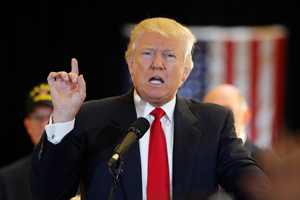
trump copy"We will fight to protect every last American life," Trump told thousands of his supporters in Iowa on Thursday as he referred to the cases of Disney world and other US companies.

"During the campaign I also spent time with American workers who were laid off and forced to train. The foreign workers brought in to replace them. We won't let this happen anymore," Trump vowed amidst cheers and applause from the audience.

"Can you believe that? You get laid off and then they won't give you your severance pay unless you train the people that are replacing you. I mean, that's actually demeaning maybe more than anything else," he said.

Disney World and two outsourcing companies have been slapped with a federal lawsuit by two of its former technology staff, alleging that they conspired to displace American workers with cheaper foreign labour brought to the US on H-1B visas, mostly from India.

The two employees - Leo Perrero and Dena Moore - were among 250 Disney tech workers laid off from their jobs at Walt Disney World in Orlando in January 2015. They have also dragged two IT companies HCL Inc and Cognizent Technologies into this class action lawsuit.

"You know the name of one of the companies that's doing it. I'm going to be nice because we're trying to get that company back. Don't forget much harder when a company announced a year and a half ago - some of these companies, like Carrier, they announced long before I even knew I was going to be running for president," Trump said.

On immigration, Trump reiterated that he will build the wall along the Mexico border. "We will put an end to illegal immigration and stop the drugs from pouring into our country, the drugs are pouring into our country, poisoning our youth and plenty of other people," he said.

"We will stop the drugs from pouring into our country. We will stop the drugs from poisoning our great and beautiful and loving youth. OK? We'll do it," he said, adding that the Trump administration will stop the violence that is "spilling across our border."

Comments

Add new comment

  • Coastaldigest.com reserves the right to delete or block any comments.
  • Coastaldigset.com is not responsible for its readers’ comments.
  • Comments that are abusive, incendiary or irrelevant are strictly prohibited.
  • Please use a genuine email ID and provide your name to avoid reject.
News Network
March 3,2020

Mar 3: Just hours after the ending of a week-long “reduction” in violence that was crucial for Donald Trump’s peace deal in Afghanistan, the Taliban struck again: On Monday, they killed three people and injured about a dozen at a football match in Khost province. This resumption of violence will not surprise anyone actually invested in peace for that troubled country. The point of the U.S.-Taliban deal was never peace. It was to try and cover up an ignominious exit for the U.S., driven by an election-bound president who feels no responsibility toward that country or to the broader region.

Seen from South Asia, every point we know about in the agreement is a concession by Trump to the Taliban. Most importantly, it completes a long-term effort by the U.S. to delegitimize the elected government in Kabul — and, by extension, Afghanistan’s constitution. Afghanistan’s president is already balking at releasing 5,000 Taliban prisoners before intra-Afghan talks can begin — a provision that his government did not approve.

One particularly cringe-worthy aspect: The agreement refers to the Taliban throughout  as “the Islamic Emirate of Afghanistan that is not recognized by the United States as a state and is known as the Taliban.” This unwieldy nomenclature validates the Taliban’s claim to be a government equivalent to the one in Kabul, just not the one recognised at the moment by the U.S. When read together with the second part of the agreement, which binds the U.S. to not “intervene in [Afghanistan’s] domestic affairs,” the point is obvious: The Taliban is not interested in peace, but in ensuring that support for its rivals is forbidden, and its path to Kabul is cleared.

All that the U.S. has effectively gotten in return is the Taliban’s assurance that it will not allow the soil of Afghanistan to be used against the “U.S. and its allies.” True, the U.S. under Trump has shown a disturbing willingness to trust solemn assurances from autocrats; but its apparent belief in promises made by a murderous theocratic movement is even more ridiculous. Especially as the Taliban made much the same promise to an Assistant Secretary of State about Osama bin Laden while he was in the country plotting 9/11.

Nobody in the region is pleased with this agreement except for the Taliban and their backers in the Pakistani military. India has consistently held that the legitimate government in Kabul must be the basic anchor of any peace plan. Ordinary Afghans, unsurprisingly, long for peace — but they are, by all accounts, deeply skeptical about how this deal will get them there. The brave activists of the Afghan Women’s Network are worried that intra-Afghan talks will take place without adequate representation of the country’s women — who have, after all, the most to lose from a return to Taliban rule.

But the Pakistani military establishment is not hiding its glee. One retired general tweeted: “Big victory for Afghan Taliban as historic accord signed… Forced Americans to negotiate an accord from the position of parity. Setback for India.” Pakistan’s army, the Taliban’s biggest backer, longs to re-install a friendly Islamist regime in Kabul — and it has correctly estimated that, after being abandoned by Trump, the Afghan government will have sharply reduced bargaining power in any intra-Afghan peace talks. A deal with the Taliban that fails also to include its backers in the Pakistani military is meaningless.

India, meanwhile, will not see this deal as a positive for regional peace or its relationship with the U.S. It comes barely a week after Trump’s India visit, which made it painfully clear that shared strategic concerns are the only thing keeping the countries together. New Delhi remembers that India is not, on paper, a U.S. “ally.” In that respect, an intensification of terrorism targeting India, as happened the last time the U.S. withdrew from the region, would not even be a violation of Trump’s agreement. One possible outcome: Over time the government in New Delhi, which has resolutely sought to keep its ties with Kabul primarily political, may have to step up security cooperation. Nobody knows where that would lead.

The irresponsible concessions made by the U.S. in this agreement will likely disrupt South Asia for years to come, and endanger its own relationship with India going forward. But worst of all, this deal abandons those in Afghanistan who, under the shadow of war, tried to develop, for the first time, institutions that work for all Afghans. No amount of sanctimony about “ending America’s longest war” should obscure the danger and immorality of this sort of exit.

Comments

Add new comment

  • Coastaldigest.com reserves the right to delete or block any comments.
  • Coastaldigset.com is not responsible for its readers’ comments.
  • Comments that are abusive, incendiary or irrelevant are strictly prohibited.
  • Please use a genuine email ID and provide your name to avoid reject.
News Network
July 1,2020

Jul 1: Hong Kong police moved swiftly on Wednesday against protesters gearing up for the first rally since the introduction of sweeping security legislation, making their first arrest under it and warning of punishment for pro-independence material.

Beijing on Tuesday unveiled the details of the much-anticipated law after weeks of uncertainty, pushing China's freest city and one of the world's most glittering financial hubs onto a more authoritarian path.

As hundreds of protesters gathered downtown for an annual rally marking the 23rd anniversary of the former British colony's handover to China, riot police used pepper spray to arrest at least two people, while one metro station closed.

Police, who earlier banned the rally, cited the law for the first time in confronting protesters and they also made their first arrest under it - a man holding a flag advocating independence.

"You are displaying flags or banners/chanting slogans/or conducting yourselves with an intent such as secession or subversion, which may constitute offences under the ... national security law," police said in a message displayed on a purple banner.

The law will punish crimes of secession, subversion, terrorism and collusion with foreign forces with up to life in prison, heralding a more authoritarian era for the Asian financial hub.

China's parliament adopted it in response to months of pro-democracy protests last year triggered by fears that Beijing was stifling the city's freedoms, guaranteed by a "one country, two systems" formula agreed when it returned to Chinese rule.

Authorities in Beijing and Hong Kong have repeatedly said the legislation is aimed at a few "troublemakers" and will not affect rights and freedoms, nor investor interests.

But critics fear it will crush the freedoms that are seen as key to Hong Kong's success as a financial centre.

"With the release of the full detail of the law, it should be clear to those in any doubt that this is not the Hong Kong they grew up in," said Hasnain Malik, head of equity research, Tellimer in Dubai.

"The difference is that U.S. and China relations are far worse and this could be used as a pretext to impede the role of Hong Kong as a finance hub."

In Beijing, Zhang Xiaoming, executive deputy director of Beijing's Hong Kong and Macau Affairs Office, told reporters suspects arrested by Beijing's new security office in Hong Kong could be tried on the mainland.

He said the mainland's national security office abided by Chinese law and that Hong Kong's legal system could not be expected to implement the laws of the mainland. Article 55 of the law states that Beijing's national security office in Hong Kong could exercise jurisdiction over "complex" or "serious" cases.

Mainland security agencies will also be based in Hong Kong officially for the first time, with powers that go beyond city laws.

"The law is a birthday gift to (Hong Kong) and will show its precious value in the future," Zhang said, adding the law would not be applied retroactively.

On July 1 last year, hundreds of protesters stormed and vandalised the city's legislature to protest against a now-scrapped bill that would have allowed extraditions to mainland China.

Those protests evolved into calls for greater democracy, paralysing parts of the city and paving the way for Beijing's imposition of the law this week.

'INEVITABLE'

Speaking at a flag-raising ceremony to mark the handover anniversary, the city's Beijing-backed leader, Carrie Lam, said the law was the most important development since the city's return to Chinese rule.

"It is also an inevitable and prompt decision to restore stability," Lam said at the same harbour-front venue where 23 years ago the last colonial governor, Chris Patten, a staunch critic of the security law, tearfully handed back Hong Kong to Chinese rule.

Some pro-Beijing officials and political commentators say the law is aimed at sealing Hong Kong's "second return" to the motherland after the first failed to bring residents to heel.

Luo Huining, the head of Beijing's top representative office in Hong Kong, said at the ceremony the law was a "common aspiration" of Hong Kong citizens.

Critics denounced the lack of transparency surrounding the details of the legislation until it was unveiled. It came into force at 11 p.m. (1500 GMT) on Tuesday.

Some pro-democracy activists gave up membership of their groups just before the law came into force, though calling for the campaign for democracy to go on offshore.

"I saw this morning there are celebrations for Hong Kong's handover, but to me it is a funeral, a funeral for 'one country two systems'," said democracy lawmaker Kwok Ka-ki.


Comments

Add new comment

  • Coastaldigest.com reserves the right to delete or block any comments.
  • Coastaldigset.com is not responsible for its readers’ comments.
  • Comments that are abusive, incendiary or irrelevant are strictly prohibited.
  • Please use a genuine email ID and provide your name to avoid reject.
News Network
April 10,2020

Paris, Apr 10: French pharma major Sanofi said on Friday it has decided to donate 100 million doses of hydroxychloroquine, the anti-malaria drug which could be a potential weapon against novel coronavirus, across 50 countries.

The company has already doubled its incremental production capacity on top of the usual production for current indications across its eight hydroxychloroquine manufacturing sites worldwide and is on track to quadruple it by the summer.

"In this global health emergency, Sanofi stands ready to assist as many countries as possible, starting with countries where its medicine is registered for current approved indications as well as countries where there are no hydroxychloroquine suppliers or countries with underserved populations," it said in a statement.

Sanofi called for coordination among the entire hydroxychloroquine chain worldwide to ensure the continued supply of the medicine if proven to be a well-tolerated and effective treatment in COVID-19 patients.

"The COVID-19 pandemic is an unprecedented health and economic crisis which is shaking some of the very fundamentals of international solidarity and cooperation among countries," said Chief Executive Officer Paul Hudson. "This virus does not care about the concept of borders, so we should not either," he added.

"It is critical that international authorities, local governments, manufacturers and all other players involved in the hydroxychloroquine chain work together in a coordinated manner to ensure all patients who may benefit from this potential treatment can access it. If the trials prove positive, we hope our donation will play a critical role for patients," said Hudson.

While hydroxychloroquine is generating a lot of hope for patients around the world, said Sanofi, it should be remembered that there are no results from ongoing studies and the results may be positive or negative.

To date, there is insufficient clinical evidence to draw any conclusion over the safety and efficacy of hydroxychloroquine in the management of COVID-19 patients.

It is one of several medicines being investigated by the World Health Organisation (WHO) in its international clinical trial seeking a treatment solution for COVID-19. "Sanofi is supporting ongoing trials by providing the medicine to some participating investigator sites and other independent research centres," it said.

Comments

Add new comment

  • Coastaldigest.com reserves the right to delete or block any comments.
  • Coastaldigset.com is not responsible for its readers’ comments.
  • Comments that are abusive, incendiary or irrelevant are strictly prohibited.
  • Please use a genuine email ID and provide your name to avoid reject.