


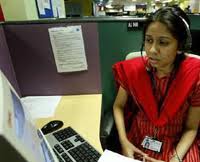
US bill against outsourcing of call centers gets 106 co-sponsors

April 13, 2012

iti


Washington, April 13: A Congressional bill that bars the US companies outsourcing call center jobs from receiving federal grants and loans now has over 100 co-sponsors, its promoter has said.


The US Call Center and Consumer Protection Act (HR 3596), introduced in the US House of Representatives by Congressman Tim Bishop now has as many as 106 lawmakers as its co-sponsors.

In a statement, Bishop hoped this would compel a hearing on the legislation in the Committee on Energy and Commerce.

The US Call Center and Consumer Protection Act, if passed by the Congress and signed into law, would require the US Department of Labor to track firms that move call center jobs overseas; the firms would then become ineligible for any direct or indirect federal loans or loan guarantees for five years.

"The provision is partially a response to the practice of companies taking millions in incentives from local taxpayers to open call centers in the US, only to off-shore their operations a short time later and leave local communities devastated and still paying the bill," Bishop said.

The bill also requires overseas call centre employees to disclose their location to US consumers and gives customers the right to be transferred to a US-based call centre upon request. "Recent reports of theft and misuse of sensitive information from British and Australian customers of Asian call centers are deeply disturbing, and it is impossible to believe that the financial and medical information of Americans has not been similarly compromised," Bishop said.

"It is clear that overseas call centers simply cannot provide the same level of security for sensitive personal data as facilities in the US, and Americans should be guaranteed the option of a domestic call center to conduct their business. Taxpayer dollars should not be supporting companies that choose protecting their bottom line over protecting their customers," the Congressman said.

"American companies should be taking all measures necessary to protect the identities and personal information of their customers, and these incidents strengthen the case to keep call centers in the US," said Congressman Michael Grimm, a former FBI agent.

"Furthermore, it is important that we do all we can to preserve American jobs and prevent them from moving overseas. This bill ensures that companies receiving taxpayer-funded federal aid or tax incentives don't use those incentives to move their call centers abroad," Grimm said.

The Communications Workers of America (CWA), who represent 150,000 call center employees across the US, have supported US Call Center and Consumer Protection Act.

"Americans are fed up with good-paying, family-supporting call center jobs here in the US being shipped overseas," said CWA chief of staff Ron Collins, who began his career in a US-based Verizon call center.

"Now, to hear that personal information is being stolen at overseas call centers just days after T-Mobile USA announces it will be closing seven call centers in the USA -- affecting 3,300 American workers - just makes your blood boil," Collins said.


Comments

Add new comment

  • Coastaldigest.com reserves the right to delete or block any comments.
  • Coastaldigset.com is not responsible for its readers’ comments.
  • Comments that are abusive, incendiary or irrelevant are strictly prohibited.
  • Please use a genuine email ID and provide your name to avoid reject.
News Network
May 21,2020

Canberra, May 21: Australian Prime Minister Scott Morrison and his Indian counterpart, Narendra Modi, are looking forward to deepening the countries' strategic relationship, with both sides expected to sign a range of pacts from defence to trade in strategic sectors amid heightened tensions with China over Beijing's response to coronavirus pandemic.

During a virtual summit, scheduled to take place on June 4, both leaders are expected to ramp up efforts to diversify Australia's export markets and find trusted suppliers of vital products and components, a local newspaper, The Australian reported on Tuesday.

The new agreements will focus on reliable supply chains in key strategic sectors, including medical goods, technology and critical minerals, amid heightened tensions with China over Beijing's response to coronavirus pandemic.

The leaders will seal a new defence agreement allowing reciprocal access to bases and co-operation on military technology projects, while a new education partnership will be on the table to help overcome Australian university reliance on Chinese students.

The talks in terms of strategic convergence, now have greater significance as COVID-19 exacerbates the strategic contest between the US and China, and forces like-minded countries to seek out reliable partners.

Australian farmers could also benefit, with talks underway on expanding agricultural exports to India, including barley, as China throws up new trade barriers, media reports stated.

The virtual summit follows the cancellation of Morrison's planned state visit to India in January due to the bushfires.

Morrison said last year, ahead of his planned visit, that India was "a natural partner for Australia", referring to the countries' "shared values" -- a point of differentiation with China.

Former Department of Foreign Affairs and Trade secretary Peter Varghese, who wrote a landmark report on the bilateral relationship in 2018, was quoted by the newspaper as saying that India would be even more important to Australia in the post-COVID world. "If one of the lessons from COVID is that countries need to spread their risk, then finding new markets or building up existing markets is a crucial part of that," he added.

Varghese noted that India, a member of the Quadrilateral Security Dialogue along with Australia, Japan and the US, was a vital strategic partner to Australia in helping "constrain China's ambitions to be the predominant power".

"That shared objective between Australia and India of not wanting to see the region dominated by China is a key component of building up our geopolitical relationship," he told The Australian.

The summit also follows recent talks between Australian Foreign Minister Marise Payne and Indian counterpart Subrahmanyam Jaishankar on the pandemic response and Australia's call for an independent inquiry, which was overwhelmingly backed at the World Health Assembly on Tuesday.

Australia wants to support India to develop a domestic critical minerals processing industry, which would provide Western nations with an alternative to sourcing the materials from China.

Meanwhile, India has strong expertise as a manufacturer of drugs and medical equipment, while Australia is a centre of biomedical research, opening the possibility for closer co-operation in the key sector, the media reported further.

Comments

Add new comment

  • Coastaldigest.com reserves the right to delete or block any comments.
  • Coastaldigset.com is not responsible for its readers’ comments.
  • Comments that are abusive, incendiary or irrelevant are strictly prohibited.
  • Please use a genuine email ID and provide your name to avoid reject.
News Network
June 9,2020

Jun 9: The World Health Organization says it still believes the spread of the coronavirus from people without symptoms is “rare,” despite warnings from numerous experts worldwide that such transmission is more frequent and likely explains why the pandemic has been so hard to contain.

Maria Van Kerkhove, WHO''s technical lead on COVID-19 said at a press briefing on Monday that many countries are reporting cases of spread from people who are asymptomatic, or those with no clinical symptoms.

But when questioned in more detail about these cases, Van Kerkhove said many of them turn out to have mild disease, or unusual symptoms.

Although health officials in countries including Britain, the U.S. and elsewhere have warned that COVID-19 is spreading from people without symptoms, WHO has maintained that this type of spread is not a driver of the pandemic and is probably accounts for about 6 per cent of spread, at most.

Numerous studies have suggested that the virus is spreading from people without symptoms, but many of those are either anecdotal reports or based on modeling.

Van Kerkhove said that based on data from countries, when people with no symptoms of COVID-19 are tracked over a long period to see if they spread the disease, there are very few cases of spread.

“We are constantly looking at this data and we''re trying to get more information from countries to truly answer this question,” she said. “It still appears to be rare that asymptomatic individuals actually transmit onward.”

Comments

Add new comment

  • Coastaldigest.com reserves the right to delete or block any comments.
  • Coastaldigset.com is not responsible for its readers’ comments.
  • Comments that are abusive, incendiary or irrelevant are strictly prohibited.
  • Please use a genuine email ID and provide your name to avoid reject.
News Network
May 2,2020
Seoul, May 2: North Korean leader Kim Jong Un has made his first public appearance since speculation about his health began last month, cutting the ribbon at the opening of a fertilizer factory, KCNA reported Saturday.
 
Kim attended the event on Friday in Sunchon, near the capital Pyongyang, after nearly three weeks of swirling rumours that the leader of the nuclear-armed nation was seriously ill or possibly dead.
 
The North Korean leader had not made a public appearance since presiding over a Workers' Party politburo meeting on April 11, and the following day state media reported that he had inspected fighter jets.
 
At Friday's event, "all the participants broke into thunderous cheers of 'hurrah!'" when Kim appeared, the Korean Central news agency reported.
 
He inspected the facility and was "briefed about the production processes," the report said.
 
Kim "said with deep emotion" that his grandfather Kim Il Sung and father Kim Jong Il "would be greatly pleased if they heard the news that the modern phosphatic fertilizer factory has been built," it added.
 
Also in attendance were other senior officials, including his sister and close adviser, Kim Yo Jong. Photos from the ceremony were not immediately released.
 
Conjecture over Kim's health had grown since his conspicuous no-show at April 15 celebrations for the birthday of his grandfather, the North's founder -- the most important day in the country's political calendar.
 
His absence unleashed a series of unconfirmed reports over his condition, triggering global fears over the North's nuclear arsenal -- and who would succeed Kim were he unable to lead.
 
A top security advisor to South Korea's President Moon Jae-in said less than a week ago that Kim was "alive and well," downplaying rumors that he was ill or incapacitated.
 
The advisor, Moon Chung-in, told CNN that Kim had been staying in Wonsan -- a resort town in the east of North Korea -- since April 13, adding: "No suspicious movements have so far been detected."
 
South Korea Reports Kim Jong Un Is 'Alive and Well' Amid Rumours of His Death
 
South Korea has told CNN that the rumours of North Korean leader Kim Jong Un's death are untrue.
 
Rumours of ill health
 
Daily NK, an online media outlet run mostly by North Korean defectors, reported that Kim was undergoing treatment after a cardiovascular procedure last month.
 
Citing an unidentified source inside the country, it said Kim -- who is in his mid-30s -- had needed urgent treatment due to heavy smoking, obesity and fatigue.
 
Soon afterwards, CNN reported that Washington was "monitoring intelligence" that Kim was in "grave danger" after undergoing surgery, quoting an anonymous US official.
 
US President Donald Trump appeared to confirm that Kim was alive earlier this week.
 
On Friday, Trump refused to comment on Kim's reported re-emergence.
 
Previous absences from the public eye on Kim's part have prompted speculation about his health.
 
The North is extremely secretive, and doubly so about its leadership.
 
Kim's father and predecessor had been dead for two days before anyone outside the innermost circles of North Korean leadership was any the wiser.
 
In 2014, Kim Jong Un dropped out of sight for nearly six weeks before reappearing with a cane.
 
Days later, the South's spy agency said he had undergone surgery to remove a cyst from his ankle.

Comments

Add new comment

  • Coastaldigest.com reserves the right to delete or block any comments.
  • Coastaldigset.com is not responsible for its readers’ comments.
  • Comments that are abusive, incendiary or irrelevant are strictly prohibited.
  • Please use a genuine email ID and provide your name to avoid reject.