



Taliban attacks Kabul and 3 more cities, all Indians safe

April 15, 2012

attack

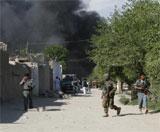
Kabul, April 15: Heavily-armed Taliban suicide bombers today unleashed a wave of coordinated attacks in Afghanistan with several explosions and gunfire rocking the diplomatic area and Parliament in Kabul and three other cities but no Indian target was attacked.

According to India's ambassador to Afghanistan Gautam Mukhopadhyay, all Indians were safe.

ITBP director general Ranjit Sinha said there was no threat to the Indian embassy as it was located three to four km away from the scene of the attack this afternoon by the Taliban gunmen who came from different directions in perhaps an unprecedented assault of this nature.

Taliban claimed responsibility for around a dozen attacks by the gunmen in central Kabul which has stunned Afghan authorities. Any casualties is still unknown but Kabul police chief Mohammad Ayoubi Salangi was quoted as having said one attacker had been killed near the Parliament.

The militants attacked five-star Kabul Star Hotel in Wazir Akhbar Khan area of the capital and some tried to enter the Afghan parliament firing rockets but were engaged by security forces and driven back, officials said.

An unknown number of Taliban men armed with light and heavy weapons targeted Afghan governmental and International offices in three different areas of Kabul, police said.

A number of Taliban militants took positions at a newly-build building at the Shahr-e-Naw, a neighborhood of Kabul. They battled with Afghan forces for several hours after the militants began assaulting Western embassies.

The building is located close to American embassy, Turkey embassy, presidential palace, Iranian embassy, ISAF's headquarters, German embassy, UK embassy and different other diplomatic offices.

"I am on the spot and hearing the gunfire being traded between the suicide bombers and Afghan forces. Until now I heard several explosions," a PTI correspondent reported from the scene of attack.

In a text message to the reporters, Taliban spokesman Zabihullah Mujahed said: "Today, afternoon, at 1 pm, suicide bombings are happening by our Mujaheddeen at the ISAF headquarters, Parliament building, and other diplomatic offices in Kabul, and our enemies got many casualties."

The militants also struck at an airport in Jalalabad, Logar and Paktia.

A few others Taliban militants armed with heavy weapons positioned at a newly-build building are targeting Afghan parliament at the Darul Aman area of Kabul. The battle is ongoing between Afghan and Taliban militant forces, Afghan private tv, Tolo Tv, said today.

Another group of militants are targeting an ISAF's base, Turkish military base, and a training camp of Afghan national army at Pule Charkhi area of Kabul. They are targeting them from a building which they took under their control.

According to the eyewitness, suicide bombers had taken over the newly-built five-star hotel in Kabul, which was reportedly on fire.

Outside Kabul, two suicide bombers blew themselves up at the gates to Jalalabad airport in eastern city of Nangarhar province, wounding several people, police said.

Four bombers tried to enter the airport and two detonated their explosives when they were stopped at the gate, officials said. Two others were wounded and arrested.

Taliban militants also attacked ISAF's Provincial Reconstruction Team, Or PRT, in Jalalabad. "The battle is going on," Tolo tv said.

"In Jalalabad, several mujahidin attacked airport and PRT compound. The fighting is going on and our mujahidin are showing very strong resistance," the Taliban spokesman said.

According to reports, Taliban also attacked military academy compound in Jalalabad road, District No 9 of Kabul.

In Logar province, Taliban militants attacked a police compound, PRT compound and provincial intelligence department.

In Paktia province also, Taliban attacked police regional zone compound, airport, police headquarters and intelligence department. "The fighting is going on in all the provinces," Mujahed said.

"Our mujahidin are equipped with small and heavy weapons and also suicide vests," Mujahed said, adding "this attack was planned very well."

"Mujahidin attacked Afghanistan parliament compound and still the fighting is going on and we don't have casualties reports until now," the Taliban spokesman said.

The attackers also fired rockets at the parliament building and at the Russian embassy, officials said.

The embassies were not immediately available to comment.



Comments

Add new comment

  • Coastaldigest.com reserves the right to delete or block any comments.
  • Coastaldigset.com is not responsible for its readers’ comments.
  • Comments that are abusive, incendiary or irrelevant are strictly prohibited.
  • Please use a genuine email ID and provide your name to avoid reject.
News Network
June 22,2020

Karachi, Jun 22: India-born renowned Pakistani Shia scholar and author Talib Jauhari passed away here after a prolonged illness. He was 80.

Jauhari, who was born on August 27, 1939 in Patna, is survived by his three sons, Dawn News reported on Monday.

He migrated to Pakistan along with his father in 1949, two years after the Partition.

After obtaining early education from his father, he went to Iraq where he studied religion for 10 years under the renowned Shia scholars of that time.

Jauhari, who was on a ventilator in the intensive care unit of a private hospital for the past 15 days, breathed his last on Sunday night.

His son Riaz Jauhari confirmed his death and said that the body has been shifted to Ancholi Imambargah for the funeral prayers, The Express Tribune newspaper quoted his son as saying.

Jauhari was respected among his sect as he was a class fellow of the widely revered scholar Ayatollah Sayyid Ali al-Husayni al-Sistani.

He was also a poet, historian and philosopher and authored many books.

Pakistan Prime Minister Imran Khan has condoled Jauhari's death.

Comments

Add new comment

  • Coastaldigest.com reserves the right to delete or block any comments.
  • Coastaldigset.com is not responsible for its readers’ comments.
  • Comments that are abusive, incendiary or irrelevant are strictly prohibited.
  • Please use a genuine email ID and provide your name to avoid reject.
Agencies
January 20,2020

For the first time in the 15 years of the Global Risks Report, the climate change and environment risk has occupied all the top five slots.

According to the 15th edition of the World Economic Forum's (WEF) Global Risks Report, the top five risks in terms of likelihood are extreme weather, climate action failure, natural disasters, biodiversity loss and human-made environmental disasters. They all fall in the one category of climate change and related environmental disasters.

WEF President Borge Brende said the world was feeling long-mounting and interconnected risks.

The report also points to how citizens are protesting across the world as discontent rises with failed systems that are creating inequality. The citizens' discontent had hardened with systems that had failed to promote advancement, it said.

"Disapproval of how governments are addressing profound economic and social issues has sparked protests throughout the world, potentially weakening the ability of governments to take decisive action should a downturn occur. Without economic and social stability, countries could lack the financial resources, fiscal margin, political capital or social support needed to confront key global risks," it said.

Listing the grim scenario, Borge said the global economy was faced with "synchronised slowdown", the past five years had been the warmest on record and cyber attacks were expected to increase this year.

The report warns that while the myriad risks were rising, time was running out on how to prevent them.

Borge said the growing palpability of shared economic, environmental and societal risks indicated that the horizon had shortened for preventing "or even mitigating" some of the direst consequences of global risks.

"It's sobering that in the face of this development, when the challenges before us demand immediate collective action, fractures within the global community appear to only be widening," he said.

The report points to grave concern about the consequences of continued environmental degradation, including the record pace of species decline.

Pointing to an unsettled geopolitical environment, the report said today's risk landscape was one in which new centres of power and influence were forming and old alliance structures and global institutions were being tested.

"While these changes can create openings for new partnership structures in the immediate term, they are putting stress on systems of coordination and challenging norms around shared responsibility. Unless stakeholders adapt multilateral mechanisms for this turbulent period, the risks that were once on the horizon will continue to arrive," it said.

Calling it a "an unsettled world", the WEF report notes that powerful economic, demographic and technological forces were shaping a new balance of power. "The result is an unsettled geopolitical landscape in which states are increasingly viewing opportunities and challenges through unilateral lenses," it said.

"What were once givens regarding alliance structures and multilateral systems no longer hold as states question the value of long-standing frameworks, adopt more nationalist postures in pursuit of individual agendas and weigh the potential geopolitical consequences of economic decoupling. Beyond the risk of conflict, if stakeholders concentrate on immediate geo-strategic advantage and fail to re-imagine or adapt mechanisms for coordination during this unsettled period, opportunities for action on key priorities may slip away," the WEF said.

In a chapter on risks to economic stability and social cohesion, it said a challenging economic climate might persist this year and members of the multi-stakeholder community saw "economic confrontations" and "domestic political polarisation" as the top risks in 2020.

The report also warned of downward pressure on the global economy from macroeconomic fragilities and financial inequality. These pressures continued to intensify in 2019, increasing the risk of economic stagnation.

Low trade barriers, fiscal prudence and strong global investment, once seen as fundamentals for economic growth, are fraying as leaders advance nationalist policies. The margins for monetary and fiscal stimuli are also narrower than before the 2008-2009 financial crisis, creating uncertainty about how well countercyclical policies will work.

The strategic partners for the WEF report included Marsh & McLennan and Zurich Insurance Group. The academic advisers were National University of Singapore, Oxford Martin School, University of Oxford and Wharton Risk Management and Decision Processes Center, University of Pennsylvania.

Comments

Add new comment

  • Coastaldigest.com reserves the right to delete or block any comments.
  • Coastaldigset.com is not responsible for its readers’ comments.
  • Comments that are abusive, incendiary or irrelevant are strictly prohibited.
  • Please use a genuine email ID and provide your name to avoid reject.
Agencies
June 16,2020

India continues to remain ranked 43rd on an annual World Competitiveness Index compiled by Institute for Management Development (IMD) with some traditional weaknesses like poor infrastructure and insufficient education investment keeping its ranking low, the international business school said on Tuesday.

Singapore has retained its top position on the 63-nation list.

Denmark has moved up to the second position (from 8th last year), Switzerland has gained one place to rank 3rd, the Netherlands has retained its 4th place and Hong Kong has slipped to the fifth place (from 2nd in 2019).

The US has moved down to 10th place (from 3rd last year), while China has also slipped from 14th to 20th place. Among the BRICS nations, India is ranked second after China, followed by Russia (50th), Brazil (56th) and South Africa (59th).

India was ranked 41st on the IMD World Competitiveness Ranking, being produced by the business school based in Switzerland and Singapore every year since 1989, but had slipped to 45th in 2017 before improving to 44th in 2018 and then to 43rd in 2019.

While its overall position has remained unchanged in the 2020 list, it has recorded improvements in areas like long-term employment growth, current account balance, high-tech exports, foreign currency reserves, public expenditure on education, political stability and overall productivity, the IMD said.

However, it has moved down in areas like exchange rate stability, real GDP growth, competition legislation and taxes.

Arturo Bris, Head of Competitiveness Center at IMD Business School, said India continues to struggle on the list and the recent country rating downgrade by Moody’s reflects the uncertainties regarding the economy’s future.

"In our ranking this year, we again emphasize the traditional weaknesses of India -- poor infrastructure, an important deficit in education investment, and a health system that does not reach everybody. For India to follow the path of China, it must stress its intangible infrastructure," Bris said.

"In a less global world, with China, USA, and Europe looking inwards, currencies like the rupee (and the Brazilian real for instance) are going to suffer and display high volatilities.

"Moody’s has threatened the country with a downgrade to junk and that would put India in a terrible position to attract foreign capital. So the urgency for the government should be to fix the short-term problems—and this requires to improve the credibility of the government itself," Bris added.

With the exception of Singapore, the Philippines, Taiwan and the Korean Republic, most Asian economies dropped in rankings this year, the IMD said.

The reason for the Asian economies’ less stellar performance as a region, this year is partly the result of the trade frictions between China and the US, particularly because these economies are highly dependent on trade with China.

About Singapore, which moved to the top rank last year, the IMD said its position is largely driven by the relative ease of setting up business, availability of skilled labour and its cutting-edge technological infrastructure.

The IMD said the impact of COVID-19 on the competitiveness ranking has partially been captured by executives’ opinions about the effectiveness of the different health systems.

In the ASEAN countries included in the survey, only Singapore and Thailand have a positive performance in the effectiveness of the health infrastructure.

Comments

Add new comment

  • Coastaldigest.com reserves the right to delete or block any comments.
  • Coastaldigset.com is not responsible for its readers’ comments.
  • Comments that are abusive, incendiary or irrelevant are strictly prohibited.
  • Please use a genuine email ID and provide your name to avoid reject.