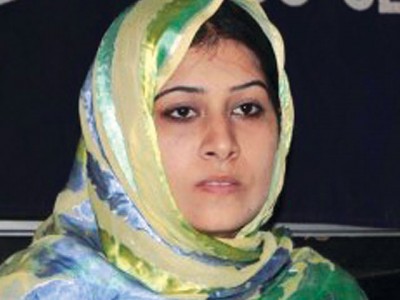
Hindu girls pick Muslim hubbies in Pak court

April 19, 2012

convert


Islamabad, April 19: Three Pakistani Hindu women, who had married Muslim men after 'converting' to Islam, opted to live with their husbands on Wednesday following the supreme court's decision they should be free to decide what they want to do and which religion to opt for.

The apex court was hearing a Pakistan Hindu Council's petition that alleged that the three - Faryal (Rinkle Kumari ), Hafsa Bibi (Dr Lata) and Haleema Bibi (Asha Kumari ) - were forced to convert to Islam. The three recorded their statements, saying they would prefer their husbands over their families.

Earlier, chief justice Iftikhar Muhammad Chaudhry led three-member bench said that three were old enough to make decisions themselves.

It also asked the police to provide security to them. "In case of any harm faced by the girls, the police officials will be blamed for negligence.'' The SC had earlier sent Rinkle and Lata to a shelter home in Karachi for three weeks to decide without about their future without any pressure.

Earlier, Rinkle had said she was neither kidnapped, nor converted or married forcibly but did everything of her free will. But her family had alleged she was abducted and forced to convert and marry.


Comments

Add new comment

  • Coastaldigest.com reserves the right to delete or block any comments.
  • Coastaldigset.com is not responsible for its readers’ comments.
  • Comments that are abusive, incendiary or irrelevant are strictly prohibited.
  • Please use a genuine email ID and provide your name to avoid reject.
News Network
June 9,2020

Washington, Jun 9: When epidemiologists talked about "flattening the curve," they probably didn't mean it this way: the US hit its peak coronavirus caseload in April, but since that time the graph has been on a seemingly unending plateau.

That's unlike several other hard-hit countries which have successfully pushed down their numbers of new cases, including Spain and Italy, which now have bell-shaped curves.

Experts say the prolonged nature of the US epidemic is the result of the cumulative impact of regional outbreaks, as the virus that started out primarily on the coasts and in major cities moves inward.

Layered on top of that are the effects of lifting lockdowns in parts of the country that are experiencing rising cases, as well as a lapse in compliance with social distancing guidelines because of economic hardship, and in some cases a belief that the threat is overstated.

"The US is a large country both in geography and population, and the virus is at very different stages in different parts of the country," Tom Frieden, a former director of the Centers for Disease Control and Prevention told AFP.

The US saw more than 35,000 new cases for several days in April. While that figure has declined, it has still been exceeding 20,000 regularly in recent days.

By contrast, Italy was regularly hitting more than 5,000 cases per day in March but is currently experiencing figures in the low hundreds.

"We did not act quickly and robustly enough to stop the virus spreading initially, and data indicate that it travelled from initial hotspots along major transport routes into other urban and rural areas," added Frieden, now CEO of the non-profit Resolve to Save Lives.

To wit: the East Coast states of New York, New Jersey and Massachusetts accounted for about 50 percent of all cases until about a month or so ago -- but now the geographic footprint of the US epidemic has shifted to the Midwest and southeast, including Florida.

Another key problem, said Jennifer Nuzzo, an epidemiologist at Johns Hopkins, is that the United States is still not doing enough testing, contact tracing and isolation.

After coming late to the testing party -- for reasons ranging from technical issues to regulatory hurdles -- the US has now conducted more COVID-19 tests than any other country.

It even has one of the highest per capita rates per country of 62 per 1,000 people, according to the website ourworldindata.org -- better than Germany (52 per 1,000) and South Korea (20 per 1,000).

But according to Nuzzo, these numbers are misleading, because "the amount of testing that a country should do should be scaled to the size of its epidemic.

"The United States has the largest epidemic in the world so obviously we need to do a lot more testing than any other country."

For Johns Hopkins, the more important metric is the positivity rate -- that is, out of all tests conducted, how many came back positive for COVID-19.

As of June 7, the United States had an average daily positivity rate of 14 percent, well above the World Health Organization guideline of 5 percent over two weeks before social distancing guidelines should be relaxed.

By contrast, Germany, which has tested far fewer people in relation to its population, has a positivity rate of 5 percent.

Even if testing were scaled up, carrying out tests in of itself does very little good without the next steps -- finding out who was exposed and then asking them to isolate.

Here also, too many US states are lagging woefully behind.

Texas, which is experiencing a surge in cases after relaxing its lockdown, is a case in point. The state targeted hiring a modest 4,000 tracers by June, but according to local reports is still more than a thousand shy of even that goal.

Opt-in app based efforts have also been slow to get off the ground.

Then there is the fact that some people are growing tired of lockdowns, while others don't have the economic luxury of being able to stay home for prolonged periods.

The government sent some 160 million Americans a single stimulus check of up to $1,200 back in April but it's not clear whether more will be forthcoming.

Still others, particularly in so-called red states under Republican leadership, have chafed under restrictions and mask-wearing guidelines that they see as an affront to their personal freedom.

"The US is kind of on the extreme of the individual liberty side," Sten Vermund, dean of the Yale School of Public Health, told AFP.

Part of this has to do with mixed messaging from Republican leaders, including President Donald Trump, said Nuzzo.

"We have had at the highest political level an assertion that this is a situation that's been overblown, and that maybe certain protective behaviors are not necessary," she said.

More recently, tens of thousands of people across the country have taken to the streets to protest the killing on an unarmed black man by police, risking coronavirus infection to demonstrate against the public health threat of racialized state violence.


Comments

Add new comment

  • Coastaldigest.com reserves the right to delete or block any comments.
  • Coastaldigset.com is not responsible for its readers’ comments.
  • Comments that are abusive, incendiary or irrelevant are strictly prohibited.
  • Please use a genuine email ID and provide your name to avoid reject.
News Network
January 24,2020

Davos, Jan 24: Pakistan Prime Minister Imran Khan claimed that he met with a “brick wall” when he approached Indian Prime Minister Narendra Modi with a peace proposal, soon after assuming office.

In an interview to Foreign Policy magazine on the sidelines of WEF 2020 here, Khan also said he told Modi that Pakistan will act firmly if it was given evidence of any involvement in the Pulwama terror attack, but India instead “bombed” Pakistan.

Tensions have escalated between the two countries, following India withdrawing the special status of Jammu and Kashmir in August 2019. Even since, Khan has been trying to seek global intervention to de-escalate the tensions between the two countries.

On Thursday, India's External Affairs Ministry spokesperson Raveesh Kumar categorically ruled out any third party role on the Kashmir issue, asserting that any issue between the two countries should be resolved bilaterally.

In the interview, Khan said that he is a firm believer that military means are not a solution to ending conflicts. “After assuming office, I immediately reached out to Prime Minister Modi. I was amazed by the reaction I got, which was quite weird.

The subcontinent hosts the greatest number of poor people in the world, and the best way to fight poverty is to have a trading relationship between the two countries rather than spending money on arms. This is what I said to the Indian Prime Minister. But I was met by brick wall,” Khan said.

Khan took charge as Prime Minister in August 2018. Referring to the suicide attack in Pulwama, Khan said he immediately told Modi ,“if you can give us any actionable intelligence (that Pakistanis were involved), we will act on it. But rather than do so, they bombed us.”

Noting that the both countries are not close to conflict right now, Khan said that it is important that the UN and the US act.

When asked about US President Donald Trump’s close relationship with Modi, Khan said the relationship is understandable because India is a huge market. “My concern is not about the US-India relationship. My concern is the direction in which India is going,” Khan said.

Khan also sought to compare the events in India to what happened in Nazi Germany.

“Between 1930 and 1934, Germany went from a liberal democracy to a fascist, totalitarian, racist state. If you look at what is happening in India under the BJP in the last five years, look where it's heading, you'll see the danger. And you're talking about a huge country of 1.3 billion people that is nuclear-armed,” he said.

Comments

Add new comment

  • Coastaldigest.com reserves the right to delete or block any comments.
  • Coastaldigset.com is not responsible for its readers’ comments.
  • Comments that are abusive, incendiary or irrelevant are strictly prohibited.
  • Please use a genuine email ID and provide your name to avoid reject.
News Network
March 5,2020

Washington, Feb 5: Experts warned a US government panel last night that India's Muslims face risks of expulsion and persecution under the country’s new Citizenship Amendment Act (CAA) which has triggered major protests.

The hearing held inside Congress was called by the US Commission on International Freedom, which has been denounced by the Indian government as biased.

Ashutosh Varshney, a prominent scholar of sectarian violence in India, told the panel that the law championed by prime minister Narendra Modi's government amounted to a move to narrow the democracy's historically inclusive and secular definition of citizenship.

"The threat is serious, and the implications quite horrendous," said Varshney, a professor at Brown University.

"Something deeply injurious to the Muslim minority can happen once their citizenship rights are taken away," he said.

Varshney warned that the law could ultimately lead to expulsion or detention -- but, even if not, contributes to marginalization.

"It creates an enabling atmosphere for violence once you say that a particular community is not fully Indian or its Indianness in grave doubt," he said.

India's parliament in December passed a law that fast-tracks citizenship for persecuted non-Muslim minorities from neighboring countries.

Responding to criticism at the time from the US commission, which advises but does not set policy, India's External Affairs Ministry said the law does not strip anyone's citizenship and "should be welcomed, not criticized, by those who are genuinely committed to religious freedom."

Fears are particularly acute in Assam, where a citizens' register finalized last year left 1.9 million people, many of them Muslims, facing possible statelessness.

Aman Wadud, a human rights lawyer from Assam who traveled to Washington for the hearing, said that many Indians lacked birth certificates or other documentation to prove citizenship and were only seeking "a dignified life."

The hearing did not exclusively focus on India, with commissioners and witnesses voicing grave concern over Myanmar's refusal to grant citizenship to the Rohingya, the mostly Muslim minority that has faced widespread violence.

Gayle Manchin, the vice chair of the commission, also voiced concern over Bahrain's stripping of citizenship from activists of the Shiite majority as well as a new digital ID system in Kenya that she said risks excluding minorities.

More than 40 people were killed last week in New Delhi in sectarian violence sparked by the citizenship law.

India on Tuesday lodged another protest after the UN human rights chief, Michele Bachelet, sought to join a lawsuit in India that challenges the citizenship law's constitutionality.

Comments

Add new comment

  • Coastaldigest.com reserves the right to delete or block any comments.
  • Coastaldigset.com is not responsible for its readers’ comments.
  • Comments that are abusive, incendiary or irrelevant are strictly prohibited.
  • Please use a genuine email ID and provide your name to avoid reject.