



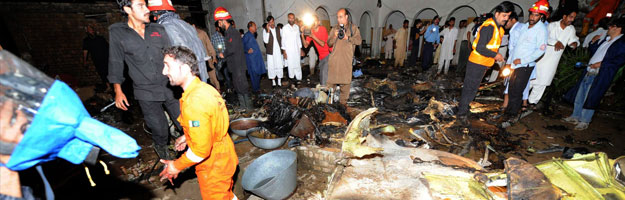
Pak plane crashes with 127 on board, no survivors found

April 20, 2012

crash

Islamabad, April 20: A Pakistani airliner with 127 people on board crashed in bad weather as it came in to land in Islamabad on Friday, scattering wreckage and leaving no sign of survivors.


The Boeing 737, operated by local airline Bhoja Air, was flying to the capital from Pakistan's biggest city and business hub Karachi. It crashed into wheat fields more than 5 miles (about 9 km) from the airport.


Rawal Khan Maitla, director general of Emergency Disaster Management for the Capital Development Authority, said there were no survivors.


TV reports claimed that the black box of the ill-fated aircraft has been found. However, there was no official confirmation on this.


Rescue workers walked through mud at the crash site with flashlights or with the lights of their cellphones looking for passengers' remains. One held up a tattered e-ticket receipt.


Body parts, wallets and eyeglasses lay among wreckage strewn in a small settlement just outside Islamabad.


"It was as if the entire sky had burst into flames," said a resident of the area.


Parts of the aircraft smashed into electricity poles, blanketing the area in darkness, or into houses. There were no reports of casualties on the ground.


Bhoja Air said the airplane crashed during its approach in Islamabad due to bad weather. There was no indication from the government that it could have been the result of foul play.


A man who had been waiting at Islamabad's Benazir Bhutto International Airport for the flight yelled "my two daughters are dead" as tears streamed down his face.


In a state of shock, he then slumped on the floor and sat silently as other relatives of passengers crowded around lists of those on board.


The uncle of the sisters, 18 and 20, said they were supposed to return to Islamabad on Sunday but flew early to see an aunt who is visiting from London.


"We don't even know when or where we will get to see their bodies," said the uncle, Qamar Abbas, who kept mumbling "no, no, no" to himself.


Headed for honeymoon:

When Sajjad Rizvi and Sania Abbas boarded the flight, they were looking forward to their honeymoon in a hill resort near Islamabad. "We had a joint wedding on March 28," said Sania's brother Zeeshan at the airport.


Nearby, relatives of passengers hugged each other and sobbed. One man cried "my kids, my kids".


The last major aviation accident in Pakistan was in July 2010, when a commercial airliner operated by AirBlue with 152 people on board crashed into the hills overlooking Islamabad.


In 2006, a Pakistan International Airlines aircraft crashed near the central city of Multan, killing 45 people.


State television reported that all hospitals in Islamabad and the nearby city of Rawalpindi had been put on high alert after Friday's crash.


At the capital's main hospital, rescue workers brought in remains of the passengers placed under white sheets soaked in blood.


"Two years later the same story is being repeated in my house again," said Nasreen Mubasher, who was at the hospital waiting for the remains of her brother-in-law, who was a passenger. Another brother-in-law died in the AirBlue crash.


As the police struggled to keep order, trying to keep the distraught calm and television cameras away, Mohammad Nasir hoped somehow that his brother's body would be intact despite the horrific force of the crash.


He approached other relatives of passengers and hospital workers. He kept asking "have you seen any whole bodies?"


The Boeing Company said in a statement on its website that it "wishes to extend its profound condolences to the families and friends" of the Bhoja Air passengers.


At Karachi airport, Asim Hashmi complained the airline's counter was shut and he had no way of obtaining information on his aunt and cousin, who were on flight B4-213.


"We don't know anything," he said. "Just pray for the souls of the departed. That is all we can do now."


Comments

Add new comment

  • Coastaldigest.com reserves the right to delete or block any comments.
  • Coastaldigset.com is not responsible for its readers’ comments.
  • Comments that are abusive, incendiary or irrelevant are strictly prohibited.
  • Please use a genuine email ID and provide your name to avoid reject.
News Network
May 13,2020

Islamabad, May 13 : The number of confirmed COVID-19 cases in Pakistan rose to 34,370 on Wednesday after new infections were confirmed in the country.

As per province-wise breakup of the total tally cited by Radio Pakistan, so far 13,225 cases have been registered in Punjab, 12,610 in Sindh, 5,021 in Khyber Pakhtunkhwa, 2,158 in Balochistan, 759 in Islamabad, 475 in Gilgit Baltistan and 88 in Pakistan-occupied Kashmir.

As many as 2,255 cases positive were confirmed, while 31 deaths reported during the last 24 hours.

At least 737 patients have died so far while 8,812 stand recovered, the media reported further.

Comments

Add new comment

  • Coastaldigest.com reserves the right to delete or block any comments.
  • Coastaldigset.com is not responsible for its readers’ comments.
  • Comments that are abusive, incendiary or irrelevant are strictly prohibited.
  • Please use a genuine email ID and provide your name to avoid reject.
News Network
March 5,2020

Washington, Feb 5: Experts warned a US government panel last night that India's Muslims face risks of expulsion and persecution under the country’s new Citizenship Amendment Act (CAA) which has triggered major protests.

The hearing held inside Congress was called by the US Commission on International Freedom, which has been denounced by the Indian government as biased.

Ashutosh Varshney, a prominent scholar of sectarian violence in India, told the panel that the law championed by prime minister Narendra Modi's government amounted to a move to narrow the democracy's historically inclusive and secular definition of citizenship.

"The threat is serious, and the implications quite horrendous," said Varshney, a professor at Brown University.

"Something deeply injurious to the Muslim minority can happen once their citizenship rights are taken away," he said.

Varshney warned that the law could ultimately lead to expulsion or detention -- but, even if not, contributes to marginalization.

"It creates an enabling atmosphere for violence once you say that a particular community is not fully Indian or its Indianness in grave doubt," he said.

India's parliament in December passed a law that fast-tracks citizenship for persecuted non-Muslim minorities from neighboring countries.

Responding to criticism at the time from the US commission, which advises but does not set policy, India's External Affairs Ministry said the law does not strip anyone's citizenship and "should be welcomed, not criticized, by those who are genuinely committed to religious freedom."

Fears are particularly acute in Assam, where a citizens' register finalized last year left 1.9 million people, many of them Muslims, facing possible statelessness.

Aman Wadud, a human rights lawyer from Assam who traveled to Washington for the hearing, said that many Indians lacked birth certificates or other documentation to prove citizenship and were only seeking "a dignified life."

The hearing did not exclusively focus on India, with commissioners and witnesses voicing grave concern over Myanmar's refusal to grant citizenship to the Rohingya, the mostly Muslim minority that has faced widespread violence.

Gayle Manchin, the vice chair of the commission, also voiced concern over Bahrain's stripping of citizenship from activists of the Shiite majority as well as a new digital ID system in Kenya that she said risks excluding minorities.

More than 40 people were killed last week in New Delhi in sectarian violence sparked by the citizenship law.

India on Tuesday lodged another protest after the UN human rights chief, Michele Bachelet, sought to join a lawsuit in India that challenges the citizenship law's constitutionality.

Comments

Add new comment

  • Coastaldigest.com reserves the right to delete or block any comments.
  • Coastaldigset.com is not responsible for its readers’ comments.
  • Comments that are abusive, incendiary or irrelevant are strictly prohibited.
  • Please use a genuine email ID and provide your name to avoid reject.
Agencies
April 25,2020

From loudspeakers on the roof of a Minnesota mosque, the Islamic call to prayer echoed for the first time ever throughout a Minneapolis neighbourhood late on Thursday as the Muslim community there prepared to begin the holy month of Ramadan.

It echoed again on Friday morning and will continue five times a day during the holy month. 

The simple, short call - known as the adhan - marked an historical moment for Minneapolis and major cities across the United States, community members said. While the adhan is commonly broadcast throughout the Middle East, North Africa and other places, for many Muslims in the US, it is only heard inside mosques or community centres.

"There's definitely a lot of excitement," said Imam Abdisalam Adam, who is on the board of the Dar al-Hijrah mosque, from where the adhan will be broadcast.
"Some people see it as historic," Adam told Al Jazeera. "To the point ... that they're not doing it, able to see it in their lifetime." 

Recited by different representatives from mosques around the city, the call to prayer is expected to reach thousands in the Cedar-Riverside neighbourhood in Minneapolis, according to Jaylani Hussein, the executive director of Minnesota's Council on American-Islamic Relations (CAIR).

While Hussein says the community had discussed broadcasting the call for years, it became even more pressing this year when the coronavirus pandemic forced mosques to shut their doors and residents to stay inside. The coronavirus has infected more than 870,000 people nationwide and killed at least 50,000.
"We wanted to touch those individuals who frequent this mosque and this community," Hussein said. "If we cannot be physically together, at least this echo, this voice, this call to prayer can be an extension of us being together at this difficult time. To give some people some solace."
Ramadan - Minnesota.

The Dar al-Hijrah mosque in the Cedar-Riverside neighbourhood of Minneapolis, Minnesota [Courtesy of Abdisalem Adam] 
Ramadan is traditionally a time when Muslims worldwide regularly attend mosques for daily prayers and break their fasts together. But this year, most have been told to pray at home and forgo community iftars in favour of staying safe from the COVID-19 crisis.

Adam, the imam, said while the Muslim community is experience loss this Ramadan, they hope the call to prayer broadcast will create a "semblance of normalcy".

"With the loss of Friday prayers and the regular congregational prayers, we are hoping that this will give a sense of solace and connection to the spiritual needs of community members," he added. 

An avenue to greater investment?

The Cedar-Riverside neighbourhood is a densely populated area of Minneapolis that has historically been an entry point for many immigrants and today is home to large Somali and Oromo communities.

Ramla Bile, a Somali American who lives in a neighbourhood adjacent to Cedar-Riverside, has been active in the community for years. She welcomed the broadcast of the call to prayer, saying it will help people "feel the spirit of Ramadan in a way that is meaningful".

But she also hopes the city of Minneapolis, which provided the noise permit for the broadcast, will make bigger strides to invest in the community in even more tangible ways.

"There's been a lot of need and a lot hurt in the community in light of the COVID-19 pandemic. And then there's the ongoing conversation you've been having," she said, pointing to deep-seated Islamophobia, systemic racism and the need for infrastructure projects like sprinkler systems in high-rise buildings. 

"We need to see greater investments to support the most vulnerable members of our community," Bile said referring to the neighbourhood's elders, undocumented individuals, low-income families and others.

"Right now, we're waiting for a bailout for our micro-businesses who comprise our Somali malls, or a rent freeze for neighbourhood residents," she added.

For CAIR's Hussein and Imam Adam, they hope this Ramadan's call to prayer helps encourage other communities around the US to take similar steps.

"This will hopefully inspire others … to think about what could happen in future Ramadans and beyond," Hussein said.

Adam added that while the virus has devastated communities and upended daily life, it has also shown that "we're in this together".

"It just shows the significance of the global village and how interconnected and interdependent we are as a world community," he said. "I think that there will be a lot of change in our way of life for the better. I hope so."


Comments

Add new comment

  • Coastaldigest.com reserves the right to delete or block any comments.
  • Coastaldigset.com is not responsible for its readers’ comments.
  • Comments that are abusive, incendiary or irrelevant are strictly prohibited.
  • Please use a genuine email ID and provide your name to avoid reject.