


Pak plane crashes with 127 on board, no survivors found

April 20, 2012

crash

Islamabad, April 20: A Pakistani airliner with 127 people on board crashed in bad weather as it came in to land in Islamabad on Friday, scattering wreckage and leaving no sign of survivors.


The Boeing 737, operated by local airline Bhoja Air, was flying to the capital from Pakistan's biggest city and business hub Karachi. It crashed into wheat fields more than 5 miles (about 9 km) from the airport.


Rawal Khan Maitla, director general of Emergency Disaster Management for the Capital Development Authority, said there were no survivors.


TV reports claimed that the black box of the ill-fated aircraft has been found. However, there was no official confirmation on this.


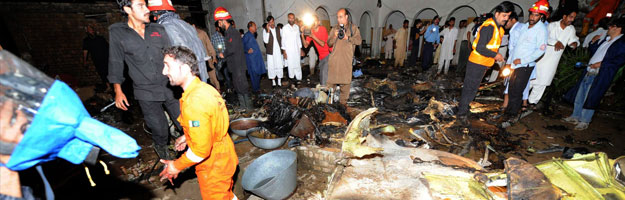
Rescue workers walked through mud at the crash site with flashlights or with the lights of their cellphones looking for passengers' remains. One held up a tattered e-ticket receipt.


Body parts, wallets and eyeglasses lay among wreckage strewn in a small settlement just outside Islamabad.


"It was as if the entire sky had burst into flames," said a resident of the area.


Parts of the aircraft smashed into electricity poles, blanketing the area in darkness, or into houses. There were no reports of casualties on the ground.


Bhoja Air said the airplane crashed during its approach in Islamabad due to bad weather. There was no indication from the government that it could have been the result of foul play.


A man who had been waiting at Islamabad's Benazir Bhutto International Airport for the flight yelled "my two daughters are dead" as tears streamed down his face.


In a state of shock, he then slumped on the floor and sat silently as other relatives of passengers crowded around lists of those on board.


The uncle of the sisters, 18 and 20, said they were supposed to return to Islamabad on Sunday but flew early to see an aunt who is visiting from London.


"We don't even know when or where we will get to see their bodies," said the uncle, Qamar Abbas, who kept mumbling "no, no, no" to himself.


Headed for honeymoon:

When Sajjad Rizvi and Sania Abbas boarded the flight, they were looking forward to their honeymoon in a hill resort near Islamabad. "We had a joint wedding on March 28," said Sania's brother Zeeshan at the airport.


Nearby, relatives of passengers hugged each other and sobbed. One man cried "my kids, my kids".


The last major aviation accident in Pakistan was in July 2010, when a commercial airliner operated by AirBlue with 152 people on board crashed into the hills overlooking Islamabad.


In 2006, a Pakistan International Airlines aircraft crashed near the central city of Multan, killing 45 people.


State television reported that all hospitals in Islamabad and the nearby city of Rawalpindi had been put on high alert after Friday's crash.


At the capital's main hospital, rescue workers brought in remains of the passengers placed under white sheets soaked in blood.


"Two years later the same story is being repeated in my house again," said Nasreen Mubasher, who was at the hospital waiting for the remains of her brother-in-law, who was a passenger. Another brother-in-law died in the AirBlue crash.


As the police struggled to keep order, trying to keep the distraught calm and television cameras away, Mohammad Nasir hoped somehow that his brother's body would be intact despite the horrific force of the crash.


He approached other relatives of passengers and hospital workers. He kept asking "have you seen any whole bodies?"


The Boeing Company said in a statement on its website that it "wishes to extend its profound condolences to the families and friends" of the Bhoja Air passengers.


At Karachi airport, Asim Hashmi complained the airline's counter was shut and he had no way of obtaining information on his aunt and cousin, who were on flight B4-213.


"We don't know anything," he said. "Just pray for the souls of the departed. That is all we can do now."

Comments

Add new comment

  • Coastaldigest.com reserves the right to delete or block any comments.
  • Coastaldigset.com is not responsible for its readers’ comments.
  • Comments that are abusive, incendiary or irrelevant are strictly prohibited.
  • Please use a genuine email ID and provide your name to avoid reject.
News Network
July 11,2020

Singapore, Jul 11: Singapore Prime Minister Lee Hsien Loong has secured a “clear mandate” with his ruling People’s Action Party (PAP) winning 83 of the 93 contested parliamentary seats in the general election held amidst the Covid-19 pandemic, with the Opposition gaining ground by winning a record 10 seats.

The ruling party, in power since independence in 1965, secured 61.24 percent of the total votes cast in the election, down from 69.9 percent in 2015. About 2.6 million Singaporeans voted on Friday.

“We have a clear mandate, but the percentage of the popular vote is not as high as I had hoped for,” 68-year old Lee told a PAP’s post-results press conference on Saturday morning.

The opposition Workers’ Party secured 10 seats and defeated a team in the Group Representation Constituency of Sengkang led by former Minister in the Prime Minister’s Office Ng Chee Meng who is also the Secretary-General of the power National Trades Union Congress (NTUC).

The Prime Minister assured it is “only right” that Workers’ Party’s Indian-origin secretary-general Pritam Singh be “formally designated” as the Leader of the Opposition, and that he will be provided with “appropriate staff support and resources to perform his duties”.

Lee took the results in “these circumstances” as an “endorsement” of the party’s policies and plans as he had called the elections amidst Covid-19 pandemic.

For latest updates and live news on coronavirus, click here

“We’ll take this forward and work with Singapore to realise those plans and solve the problems which we have,” Channel News Asia quoted the premier as saying.

Lee, who leads the PAP as secretary-general, said, “Singaporeans understand what’s at stake and why we must come together to uphold our national interests.”

He pledged to use this mandate “responsibly” to deal with the Covid-19 situation and economic downturn, to take Singapore “safely through the crisis and beyond”.

“The results reflect the pain and uncertainty that Singaporeans feel in this crisis, the loss of income, the anxiety about jobs, the disruption caused by the circuit breaker and the safe distancing restrictions,” he said.

This was not a “feel-good” election, said Lee, Singapore’s third prime minister who faces the city state’s worst recession with the economy projected to shrink between 7 and 4 per cent.

Lee acknowledged that the result also showed a “clear desire” for a diversity of voices in Parliament.

“Singaporeans want the PAP to form the government, but they, and especially the younger voters, also want to see more opposition presence in parliament,” he noted.

Lee added that he looks forward to the participation and contribution of the Opposition in parliament.

Singh, whose Workers’ Party team retained Aljunied Group Representation Constituency (GRC), will have 10 elected MPs now, up from six previously. His fellow member also retained the Hougang single-member constituency seat.

“Whether it works out… and whether it’s seen as a strengthening of Singapore will depend not only on what the PAP does but also on what the Opposition does because the Opposition now has 10 MPs elected from constituencies,” said Lee.

He assured that the ruling party will listen to Singaporeans and do its best to address their concerns, and “try to win” their support, whether or not they voted for the PAP.

When asked by the media if the party had lost the youth vote, he noted that different generations have different life experiences, and the young have significantly different life aspirations and priorities compared to the older generations.

“That’ll have to be reflected in our political process and in the government’s policies because, in the end, the government’s policies must be to achieve the aspirations of every generation of Singaporeans,” Lee said, assuring Singaporeans.

He hoped that the new generations of Singaporeans “look critically, but with an open mind” at what previous generations have done, “examine what’s relevant and what continues to make sense to them in a new environment” and “learn from these experiences hard-won by their parents and grandparents”.

This is so that they do not have to “learn them all over again and pay a high price which has already been paid”.

Lee added that he was, naturally, disappointed at the loss of the newly formed Sengkang GRC, which the Workers’ Party won with 52.13 percent of the valid votes.

“Ng Chee Meng and his team -- Lam Pin Min, Amrin Amin and Raymond Lye -- always knew it was going to be a tough fight,” he said.

“They gave it their all, but Sengkang voters have spoken, and we respect their decision.”

Lee described it as a “major loss to my team” and to the fourth-generation leaders, especially as Ng is the secretary-general of the Labour Movement, the NTUC.

Singh, 43, told a press conference following the results that his team would “continue to endeavour for good outcomes on the ground” and to represent voters “faithfully in parliament”.

“Today’s results are positive, but we have to hit the ground running. We should not get over our head with the results. There’s much work to do. And I can assure you this Workers’ Party team is committed to serve Singapore,” he stressed.

The PAP contested all 93 seats and the Workers’ Party 21 seats. Nine other political parties also contested the elections.

A total of 192 candidates contested for seats through 17 Group Representation Constituencies (GRCs).

Comments

Add new comment

  • Coastaldigest.com reserves the right to delete or block any comments.
  • Coastaldigset.com is not responsible for its readers’ comments.
  • Comments that are abusive, incendiary or irrelevant are strictly prohibited.
  • Please use a genuine email ID and provide your name to avoid reject.
News Network
April 12,2020

Apr 12: Pope Francis called on Sunday for an "immediate" ceasefire in global conflict and urged European nations to show "solidarity" in the face of a coronavirus pandemic that has claimed more than 109,000 lives worldwide.

"May Christ our peace enlighten all who have responsibility in conflicts, that they may have the courage to support the appeal for an immediate global ceasefire in all corners of the world," the pope said in a livestreamed Easter message.

Francis added that it was time for Europe, which he described as his "beloved continent", to "rise again, thanks to a concrete spirit of solidarity" similar to that shown after World War II.

Christians around the world are marking a solitary Easter, forced to celebrate the most joyful day in the Christian calendar largely alone amid the sorrowful reminders of the devastation wrought by the coronavirus pandemic

Comments

Add new comment

  • Coastaldigest.com reserves the right to delete or block any comments.
  • Coastaldigset.com is not responsible for its readers’ comments.
  • Comments that are abusive, incendiary or irrelevant are strictly prohibited.
  • Please use a genuine email ID and provide your name to avoid reject.
News Network
July 27,2020

Tokyo, Jul 27: Gold hit an all-time high on Monday as tit-for-tat consulate closures in China and the United States rattled investors, boosting the allure of safe-haven assets, although sentiment was mixed with tech gains supporting some Asian stocks.

MSCI's ex-Japan Asia-Pacific index rose 1.3 percent as Taiwan's TSMC, Asia's third-largest company by market capitalisation, rose almost 10 percent.

The chipmaker's gains boosted other tech stocks in the region and came after rival Intel signalled it may give up manufacturing its own components due to delays in new 7-nanometer chip technology.

Also soothing sentiment, Chinese shares eked out gains after big falls late last week, with CSI300 index rising 0.5 percent.

S&P500 futures were last up 0.4 percent in choppy trade while Japan's Nikkei fell 0.5 percent, resuming trade after a long weekend and catching up with falls in global shares late last week.

Global shares had lost steam last week after Washington ordered China's consulate in Houston to close, prompting Beijing to react in kind by closing the US consulate in Chengdu.

US Secretary of State Mike Pompeo took fresh aim at China last week, saying Washington and its allies must use "more creative and assertive ways" to press the Chinese Communist Party to change its ways.

"US President (Donald) Trump used to say China's President Xi Jinping is a great leader. But now Pompeo's wording is becoming so aggressive that markets are starting to worry about further escalation," said Norihiro Fujito, chief investment strategist at Mitsubishi Securities.

Gold rose 1.0 percent to a record high of $1,920.9 per ounce, surpassing a peak touched in September 2011, as Sino-US tensions boosted the allure of safe-haven assets, especially those not tied to any specific country.

The yellow metal is also helped by aggressive monetary easing adopted by many central banks around the world since the pandemic plunged the global economy into a recession.

Some investors fret such an unprecedented level of money-printing could eventually lead to inflation.

MORE STIMULUS

Hopes of a quick US economic recovery are fading as coronavirus infections showed few signs of slowing.

That means the economy could capitulate without fresh support from the government, with some of earlier steps such as enhanced jobless benefits due to expire this month.

Investors hope US Congress will agree on a deal before its summer recess but there are some sticking points including the size of the stimulus and enhanced unemployment benefits.

US Treasury Secretary Steve Mnuchin said the package will contain extended unemployment benefits with 70 percent "wage replacement".

Democrats, who control the House of Representatives, want enhanced benefits of $600 per week to be extended and look to much bigger stimulus compared with the Republicans' $1 trillion plan.

Investors are looking to corporate earnings from around the world for hints on the pace of recovery in the global economy.

"It looks like rising coronavirus cases are starting to slow down recovery in many countries," said Masahiro Ichikawa, senior strategist at Sumitomo Mitsui DS Asset Management.

Concerns about the US economic outlook started to weigh on the dollar, reversing its inverse correlation with the economic well-being over the past few months.

The dollar index dropped 0.3 percent to its lowest level in nearly two years.

The euro gained 0.3 percent to $1.1693, hitting a 22-month high of $1.16590 as sentiment on the common currency improved after European leaders reached a deal on a recovery fund in a major step towards more fiscal co-operation.

Against the yen, the dollar slipped 0.5 percent to 105.605 yen, a four-month low while the British pound hit a 4 1/2-month high of $1.2832.

Oil prices dipped on worries about the worsening Sino-US relations.

Brent futures fell 0.46 percent to $43.14 per barrel while US crude futures lost 0.44 percent to $41.11.

Comments

Add new comment

  • Coastaldigest.com reserves the right to delete or block any comments.
  • Coastaldigset.com is not responsible for its readers’ comments.
  • Comments that are abusive, incendiary or irrelevant are strictly prohibited.
  • Please use a genuine email ID and provide your name to avoid reject.