



Air crash: Bhoja Air owner barred from leaving Pakistan

[email protected] (PTI, Photos by AFP)
April 21, 2012

Bojha2


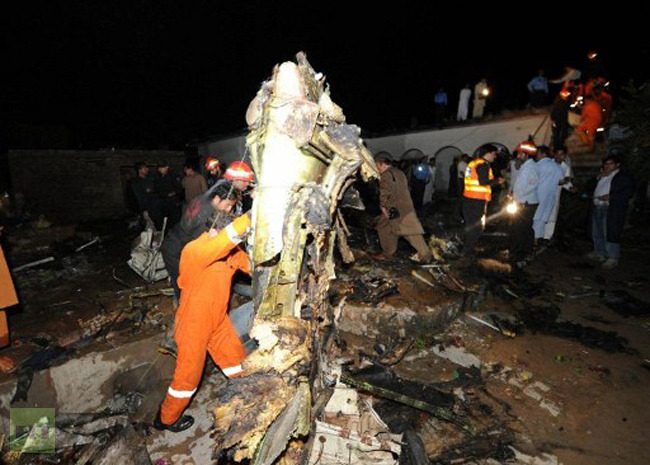
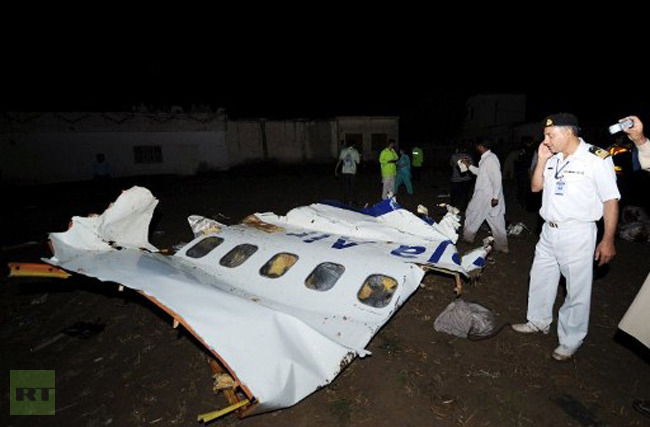
Islamabad, April 21: A total of 127 people were killed when a Boeing 737-200 of Bhoja Air crashed a short distance from the international airport in the Pakistani garrison city of Rawalpindi, the second such accident in less than two years.

Bhoja Air's flight B4-213 from Karachi to Islamabad lost contact with air traffic control shortly after 6.30 pm on Friday as it was coming in to land at the Benazir Bhutto International Airport, which serves both Islamabad and Rawalpindi, amidst bad weather.


The plane slammed into the ground at Hussainabad village, located less than 10 km from the airport.


Debris was scattered over an area of over one kilometre and parts of the aircraft fell on some houses in the village though there were no reports of casualties on the ground.


All 121 passengers, including 11 children and infants, and six crew members were killed instantly, officials said.


Mohammad Asif Majeed, director of the Disaster Management Directorate, confirmed there were no survivors.


He said the airliner had crashed on a "cluth of houses in a village".


The civil aviation authority ordered an investigation to ascertain the cause of Friday's crash. Search teams that fanned out across the crash site faced problems in the initial stage due to rain and lack of electricity.


Authorities later sent generators and search lights to the site and investigators located the Bhoja Air airliner's "black box" or flight data recorder late in the night.


Bodies and body parts were taken from the crash site to the state-run Pakistan Institute of Medical Sciences in Islamabad, where authorities began conducting DNA tests to hand over the remains to the next of kin.


Interior Minister Rehman Malik said the remains of at least 120 people had been brought to PIMS early this morning.

Malik said Farooq Bhoja, a member of the family that owns Bhoja Air, was included on the interior ministry's exit control list, a document with the names of people barred from travelling out of Pakistan.


An FIR had been registered and the ongoing investigation would determine whether aircraft was "technically capable", Malik said.


The interior minister, who visited the crash site last night, told reporters that the wings of the aircraft were on fire before it crashed.


Islamabad and Rawalpindi had experienced bad weather, including rain and lightning, at the time of the accident, and several witnesses told TV news channels that they had seen the aircraft burst into flames after being hit by lightning shortly before it crashed.


However, there was no official confirmation of reports of a lightning strike.


Capt Arshad Mehmood, a Pakistan Navy pilot who lives near the site of the crash, told reporters that he had seen the aircraft stall and descend rapidly before it hit the ground.


Mehmood said he believed the pilot had "probably lost control" of the aircraft in "very rough weather".


This was the second major air disaster in the vicinity of the Pakistani capital since July 28, 2010, when an Air Blue airliner slammed into the Margalla Hills in cloudy weather, killing all 152 people on board.


Anxious people gathered at the airports in Karachi and Rawalpindi to get information about the crash.


Many broke down and cried. Among the passengers were a newly wed couple, Sania Abbas and Sajjad Ali Rizvi, who were on their way to Islamabad for their honeymoon.


Bhoja Air was revived recently after being closed for over a decade since it ran into financial problems in 2001.


Media reports said the airline had a fleet of ageing aircraft, mostly Boeing 737-200s.
Bojha1

Bojha3


Comments

Add new comment

  • Coastaldigest.com reserves the right to delete or block any comments.
  • Coastaldigset.com is not responsible for its readers’ comments.
  • Comments that are abusive, incendiary or irrelevant are strictly prohibited.
  • Please use a genuine email ID and provide your name to avoid reject.
News Network
July 24,2020

Kathmandu, Jul 24: At least 132 people lost their lives as a result of heavy rains triggering landslides, and flash floods in Nepal.

"132 people dead, 128 injured, 53 missing and 998 families affected due to rainfall, landslides and floods in the country as of 23rd July," Nepal Disaster Risk Reduction and Management Authority Within the last two weeks, the Myagdi district of western Nepal was the worst affected with 27 reported deaths.

Search and rescue operations are being conducted continuously with officials and police personnel who are looking through the debris to find missing people.

Monsoon-induced disasters are common in Nepal owing to the country's mountainous topography. Hundreds have been displaced as landslides have swept away their homes. They ended up taking refuge in local schools and community centers.

Nepal's Meteorological Forecasting Division earlier last week had predicted heavy downpour across the country. The Division had warned of monsoon winds being near the low-pressure line in the Terai belt, which would consequently cause more rainfall.

Comments

Add new comment

  • Coastaldigest.com reserves the right to delete or block any comments.
  • Coastaldigset.com is not responsible for its readers’ comments.
  • Comments that are abusive, incendiary or irrelevant are strictly prohibited.
  • Please use a genuine email ID and provide your name to avoid reject.
Agencies
August 5,2020

Ninety per cent of a sample group of coronavirus-recovered patients from a prominent hospital in China's Wuhan city where the pandemic broke out have reported lung damage and five per cent of them are again in quarantine after testing positive for the virus, according to a media report on Wednesday.

A team at the Zhongnan Hospital of Wuhan University led by Peng Zhiyong, director of the hospital's Intensive Care Unit, has been conducting follow-up visits with '100 recovered patients' since April.

The first phase of this one-year programme finished in July. The average age of the patients in the study is 59.

According to the first phase results, 90 per cent of the patients' lungs are still in a damaged state, which means their lungs ventilation and gas exchange functions have not recovered to the level of healthy people, state-run Global Times reported.

Peng's team conducted a six-minute walking test with the patients. They found that the recovered patients could only walk 400 metres in six minutes while their healthy peers could walk 500 metres in the same period.

Some recovered patients have to rely on oxygen machines even three months after being discharged from the hospital, Liang Tengxiao, a doctor from the Dongzhimen Hospital, Beijing University of Chinese Medicine, was quoted as saying by the report.

Liang's team is also conducting follow-up visits with recovered patients aged above 65.

The results also showed that antibodies against the novel coronavirus in 10 per cent of the 100 patients have disappeared.

Five per cent of them received negative results in Covid-19 nucleic acid tests but positive results in Immunoglobulin M (IgM) tests, and thus have to be quarantined again, the report said.

IgM is usually the first antibody produced by the immune system when a virus attacks. A positive result in an IgM test usually means that a person has just been infected by the virus.

It is still unclear if this means these people have been infected again.

The 100 patients' immune systems have not fully recovered as they showed a low level of B cells -- - a primary force for killing viruses in the human body -- but a high level of T cells which only recognise viral antigens outside infected cells.

"The results revealed that the patients’ immune systems are still recovering," Peng said.

The patients also suffered from depression and a sense of stigma. Most of the recovered patients told the team that their families were not willing to have dinner with them at the same table, the report said.

Less than half of the recovered patients have returned to work, it said.

The findings are significant as the coronavirus first emerged in Wuhan city.

Hubei province for which Wuhan is the provincial capital has reported a total of 68,138 confirmed Covid-19 cases till now. The disease has claimed 4,512 lives in the province, according to the official data.

China reported 27 new confirmed Covid-19 cases on Tuesday, including 22 locally-transmitted cases, the National Health Commission (NHC) said on Wednesday.

Comments

Add new comment

  • Coastaldigest.com reserves the right to delete or block any comments.
  • Coastaldigset.com is not responsible for its readers’ comments.
  • Comments that are abusive, incendiary or irrelevant are strictly prohibited.
  • Please use a genuine email ID and provide your name to avoid reject.
Agencies
January 20,2020

For the first time in the 15 years of the Global Risks Report, the climate change and environment risk has occupied all the top five slots.

According to the 15th edition of the World Economic Forum's (WEF) Global Risks Report, the top five risks in terms of likelihood are extreme weather, climate action failure, natural disasters, biodiversity loss and human-made environmental disasters. They all fall in the one category of climate change and related environmental disasters.

WEF President Borge Brende said the world was feeling long-mounting and interconnected risks.

The report also points to how citizens are protesting across the world as discontent rises with failed systems that are creating inequality. The citizens' discontent had hardened with systems that had failed to promote advancement, it said.

"Disapproval of how governments are addressing profound economic and social issues has sparked protests throughout the world, potentially weakening the ability of governments to take decisive action should a downturn occur. Without economic and social stability, countries could lack the financial resources, fiscal margin, political capital or social support needed to confront key global risks," it said.

Listing the grim scenario, Borge said the global economy was faced with "synchronised slowdown", the past five years had been the warmest on record and cyber attacks were expected to increase this year.

The report warns that while the myriad risks were rising, time was running out on how to prevent them.

Borge said the growing palpability of shared economic, environmental and societal risks indicated that the horizon had shortened for preventing "or even mitigating" some of the direst consequences of global risks.

"It's sobering that in the face of this development, when the challenges before us demand immediate collective action, fractures within the global community appear to only be widening," he said.

The report points to grave concern about the consequences of continued environmental degradation, including the record pace of species decline.

Pointing to an unsettled geopolitical environment, the report said today's risk landscape was one in which new centres of power and influence were forming and old alliance structures and global institutions were being tested.

"While these changes can create openings for new partnership structures in the immediate term, they are putting stress on systems of coordination and challenging norms around shared responsibility. Unless stakeholders adapt multilateral mechanisms for this turbulent period, the risks that were once on the horizon will continue to arrive," it said.

Calling it a "an unsettled world", the WEF report notes that powerful economic, demographic and technological forces were shaping a new balance of power. "The result is an unsettled geopolitical landscape in which states are increasingly viewing opportunities and challenges through unilateral lenses," it said.

"What were once givens regarding alliance structures and multilateral systems no longer hold as states question the value of long-standing frameworks, adopt more nationalist postures in pursuit of individual agendas and weigh the potential geopolitical consequences of economic decoupling. Beyond the risk of conflict, if stakeholders concentrate on immediate geo-strategic advantage and fail to re-imagine or adapt mechanisms for coordination during this unsettled period, opportunities for action on key priorities may slip away," the WEF said.

In a chapter on risks to economic stability and social cohesion, it said a challenging economic climate might persist this year and members of the multi-stakeholder community saw "economic confrontations" and "domestic political polarisation" as the top risks in 2020.

The report also warned of downward pressure on the global economy from macroeconomic fragilities and financial inequality. These pressures continued to intensify in 2019, increasing the risk of economic stagnation.

Low trade barriers, fiscal prudence and strong global investment, once seen as fundamentals for economic growth, are fraying as leaders advance nationalist policies. The margins for monetary and fiscal stimuli are also narrower than before the 2008-2009 financial crisis, creating uncertainty about how well countercyclical policies will work.

The strategic partners for the WEF report included Marsh & McLennan and Zurich Insurance Group. The academic advisers were National University of Singapore, Oxford Martin School, University of Oxford and Wharton Risk Management and Decision Processes Center, University of Pennsylvania.

Comments

Add new comment

  • Coastaldigest.com reserves the right to delete or block any comments.
  • Coastaldigset.com is not responsible for its readers’ comments.
  • Comments that are abusive, incendiary or irrelevant are strictly prohibited.
  • Please use a genuine email ID and provide your name to avoid reject.
