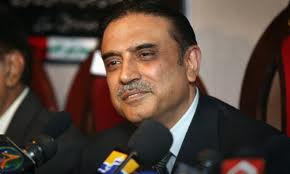
Zardari rules out any unilateral withdrawal from Siachen

April 21, 2012

zardari


Lahore, April 21: Pakistan President Asif Ali Zardari has ruled out any unilateral withdrawal of Pakistani soldiers from Siachen, saying troops could be called back from the Himalayan glacier only if India agrees to do the same.

"The withdrawal of Pakistani troops is possible provided India also agrees. It will not be a unilateral decision," he said while addressing a convention of workers of his Pakistan People's Party in Okara district, 100 km from Lahore, yesterday.

Speaking almost a fortnight after an avalanche slammed into a high-altitude Pakistan Army camp in Siachen sector and buried 138 people, Zardari said he was worried by the problems of Pakistani soldiers and India too would be concerned for its troops on Siachen.

"There is no doubt that Siachen is the most difficult battlefield in the world... We are aware of the extreme climate and other difficulties at one of the world's most difficult terrains but the withdrawal can only take place if the two governments decide to pull out from the area jointly," he said.

"Pakistan wants to solve its issues with India through talks," Zardari said. Islamabad is willing to hold a dialogue with New Delhi on all subjects, he added.

The President, who is the supreme commander of Pakistan's armed forces, offered prayers for the soldiers buried by the avalanche that hit the battalion headquarters at Gyari on April 7.

Referring to the normalisation of relations with India, Zardari said the federal government would consider proposals for opening a crossing along the border at Head Sulemanki and constructing a road between Multan in Pakistan's Punjab province and New Delhi to boost trade and economic activities.

He said when he met Prime Minister Manmohan Singh during a daylong private visit to India on April 8, the first point which was discussed was bilateral trade.

"I believe trade will bring prosperity for the people of the two countries," he said.

Continuing his tirade against PML-N leaders Nawaz Sharif and Shahbaz Sharif, Zardari said Shahbaz, the Chief Minister of Punjab, acted like a "Mughal prince".

The President said he and the PPP had delegated powers to the provinces but Shahbaz was not ready to hand over 17 provincial ministries to his legislators.

Zardari further said Shahbaz had no powers because his elder brother Nawaz controlled the PML-N.

He said Shahbaz always heaped slurs on the PPP and its leadership but the PPP talked about reconciliation.

He said that when he assumed office in 2008, all powers were concentrated in the office of the President but he had transferred these powers to the real representatives of the people to make parliament stronger and to empower the people.


Comments

Add new comment

  • Coastaldigest.com reserves the right to delete or block any comments.
  • Coastaldigset.com is not responsible for its readers’ comments.
  • Comments that are abusive, incendiary or irrelevant are strictly prohibited.
  • Please use a genuine email ID and provide your name to avoid reject.
News Network
April 2,2020

United Nations, Apr 2: The global economy could shrink by up to one per cent in 2020 due to the coronavirus pandemic, a reversal from the previous forecast of 2.5 per cent growth, the UN has said, warning that it may contract even further if restrictions on the economic activities are extended without adequate fiscal responses.

The analysis by the UN Department of Economic and Social Affairs (DESA) said the COVID-19 pandemic is disrupting global supply chains and international trade. With nearly 100 countries closing national borders during the past month, the movement of people and tourism flows have come to a screeching halt.

"Millions of workers in these countries are facing the bleak prospect of losing their jobs. Governments are considering and rolling out large stimulus packages to avert a sharp downturn of their economies which could potentially plunge the global economy into a deep recession. In the worst-case scenario, the world economy could contract by 0.9 per cent in 2020," the DESA said, adding that the world economy had contracted by 1.7 per cent during the global financial crisis in 2009.

It added that the contraction could be even higher if governments fail to provide income support and help boost consumer spending.

The analysis noted that before the outbreak of the COVID-19, world output was expected to expand at a modest pace of 2.5 per cent in 2020, as reported in the World Economic Situation and Prospects 2020.

Taking into account rapidly changing economic conditions, the UN DESA's World Economic Forecasting Model has estimated best and worst-case scenarios for global growth in 2020.

In the best-case scenario with moderate declines in private consumption, investment and exports and offsetting increases in government spending in the G-7 countries and China global growth would fall to 1.2 per cent in 2020.

"In the worst-case scenario, the global output would contract by 0.9 per cent instead of growing by 2.5 per cent in 2020," it said, adding that the scenario is based on demand-side shocks of different magnitudes to China, Japan, South Korea, the US and the EU, as well as an oil price decline of 50 per cent against our baseline of USD 61 per barrel.

The severity of the economic impact will largely depend on two factors - the duration of restrictions on the movement of people and economic activities in major economies; and the actual size and efficacy of fiscal responses to the crisis.

A well-designed fiscal stimulus package, prioritising health spending to contain the spread of the virus and providing income support to households most affected by the pandemic would help to minimise the likelihood of a deep economic recession, it said.

According to the forecast, lockdowns in Europe and North America are hitting the service sector hard, particularly industries that involve physical interactions such as retail trade, leisure and hospitality, recreation and transportation services. Collectively, such industries account for more than a quarter of all jobs in these economies.

The DESA said as businesses lose revenue, unemployment is likely to increase sharply, transforming a supply-side shock to a wider demand-side shock for the economy.

Against this backdrop, the UN-DESA is joining a chorus of voices across the UN system calling for well-designed fiscal stimulus packages which prioritize health spending and support households most affected by the pandemic.

Urgent and bold policy measures are needed, not only to contain the pandemic and save lives, but also to protect the most vulnerable in our societies from economic ruin and to sustain economic growth and financial stability, Under-Secretary-General for Economic and Social Affairs Liu Zhenmin said.

The analysis also warns that the adverse effects of prolonged economic restrictions in developed economies will soon spill over to developing countries via trade and investment channels.

A sharp decline in consumer spending in the European Union and the United States will reduce imports of consumer goods from developing countries.

Developing countries, particularly those dependent on tourism and commodity exports, face heightened economic risks. Global manufacturing production could contract significantly, and the plummeting number of travellers is likely to hurt the tourism sector in small island developing States, which employs millions of low-skilled workers, it said.

Meanwhile, the decline in commodity-related revenues and a reversal of capital flows are increasing the likelihood of debt distress for many nations. Governments may be forced to curtail public expenditure at a time when they need to ramp up spending to contain the pandemic and support consumption and investment.

UN Chief Economist and Assistant Secretary-General for Economic Development Elliot Harris said the collective goal must be a resilient recovery which puts the planet back on a sustainable track. We must not lose sight how it is affecting the most vulnerable population and what that means for sustainable development, he said.

The alarms raised by UN-DESA echo another report, released on March 31, in which UN experts issued a broad appeal for a large-scale, coordinated, comprehensive multilateral response amounting to at least 10 per cent of global gross domestic product (GDP).

According to estimates by the Johns Hopkins University, confirmed coronavirus cases across the world now stand at over 932,600 and over 42,000 deaths.


Comments

Add new comment

  • Coastaldigest.com reserves the right to delete or block any comments.
  • Coastaldigset.com is not responsible for its readers’ comments.
  • Comments that are abusive, incendiary or irrelevant are strictly prohibited.
  • Please use a genuine email ID and provide your name to avoid reject.
News Network
February 4,2020

Feb 4: Americans on Monday kicked off the first vote of the 2020 presidential race as the midwestern state of Iowa began its caucuses, the closely-watched first step in deciding which Democrat will face incumbent Donald Trump in November's election.

The two frontrunners, left-wing Senator Bernie Sanders and former Vice President Joe Biden face a key test in the sparsely populated state, with a handful of others looking to make their mark to give their campaigns momentum.

The Iowa vote is a critical early look at the viability of the 11 Democratic candidates still in the race - even though just 41 Iowa delegates are up for grabs, a fraction of the 1,991 needed to secure the party nomination in July.

Iowa Democrats filed into nearly 1,700 caucus sites - schools, libraries, churches, mosques and meeting halls with Sanders and Biden in the lead in the state, followed by former South Bend, Indiana mayor Pete Buttigieg and Senator Elizabeth Warren, who is also on the left of the party.

But polling has fluctuated and Iowa's quirky caucus system - where voting is not by secret ballot but by public declaration for a candidate - makes the night hard to predict.

Luke Elzinga, a volunteer for Sanders, appeared early at Lincoln High School in Des Moines which was converted into a caucus location.

"I think he really inspires a lot of young people, a lot of disaffected voters who might not otherwise turn out," Elzinga, 28, told AFP news agency shortly before the caucusing began.

"And so I think he's the best candidate to beat Trump."

Three candidates - Sanders, Warren and Amy Klobuchar - have faced the unprecedented scenario of spending much of the past two weeks tethered to Washington for the impeachment trial of Trump instead of on the campaign trail in Iowa.

Even as candidates sought to make 11th-hour impressions on undecided voters, the senators were obligated to return to Washington for the trial's closing arguments on Monday.

Defeating Trump

In a vote scheduled for Wednesday, Trump is almost certain to be acquitted by the Republican-led upper house on charges of abuse of power and obstruction of Congress.

For Democrats, second-tier hopefuls Klobuchar and tech entrepreneur Andrew Yang look to outpace expectations and seize momentum heading into the next contest in New Hampshire on February 11.

Earlier on Monday Biden - who still holds the lead in national polls - brought pizza to a field office in a strip mall near Des Moines to thank volunteers.

"I'm feeling good about today," he said.

Like many candidates, Biden spent the weekend crisscrossing Iowa in a final push to convince undecided voters he is best placed to accomplish Democrats' number one goal: defeating Trump.

The president has not stood idly by. On Sunday he branded Biden "Sleepy Joe" and described Sanders as "a communist," previewing a likely line of attack were Sanders to win the nomination.

Unlike secret ballot voting, caucus-goers publicly declare their presidential choice by standing together with other supporters of a candidate.

Candidates who reach 15 percent support earn delegates for the nomination race while supporters of candidates who fall short can shift their allegiance to others.

Turnout is critical, and candidates and their representatives will seek to persuade voters on issues including healthcare, taxes and ending Washington corruption.

One key candidate who has opted not to contest in Iowa is billionaire businessman Michael Bloomberg, who entered the race in November but has surged into fourth place in RealClearPolitics' national polling average.

The former New York mayor, who has spent more than $300m on advertising, according to Advertising Analytics, is focused on running a national campaign with particular emphasis on states that vote on "Super Tuesday," on March 3.

Comments

Add new comment

  • Coastaldigest.com reserves the right to delete or block any comments.
  • Coastaldigset.com is not responsible for its readers’ comments.
  • Comments that are abusive, incendiary or irrelevant are strictly prohibited.
  • Please use a genuine email ID and provide your name to avoid reject.
Agencies
June 8,2020

China is aggressively pursuing a diverse range of tactics -- from cyber-attacks to recruiting insiders for economic espionage, Indian security agencies have warned. The specific alert circulated among key stakeholders suggests that Chinese operatives are not only planning to steal classified cutting-edge defense technology but also eyeing to recruit best academicians and researchers around the globe, especially from the US.

Sources said they have noticed that China has authorized an "aggressive program of stealing US science and technology information by recruiting Americans in the technology sector with access to trade secrets".

In the technology sector of the US, many Indians scientists are working at the forefront. "This is a serious matter for Indian government and security establishments," said a top source further adding that Chinese always pursue economic espionage because it suits their low cost manufacturing sector on the basis of stolen research and costly design developed by top companies across the globe.

"An alert was also issued in early January about Chinese cyber intrusion attempts at several companies where Indian researchers are working. The espionage attempt was to target UAV technology and certain top-end military equipment designs. After stealing the techniques and design, China starts producing these equipment domestically and sells at a cheaper rate, inflicting irreparable damage to the original equipment manufacturers," the sources in the security establishment observed.

Recently, the US accused China for targeting academia by sending researchers to American labs and using talent recruitment programme to steal scientific analysis. The US has also found that young recruits of the People's Liberation Army posing as students are entering into various universities across the globe to get research papers and recruit academia.

Earlier this year, the US charged a former Boston University student of visa fraud for failing to disclose the status as a lieutenant in the China's People's Liberation Army.

The US intelligence agencies have found that their "universities have become a soft target in the global espionage war with China".

In January this year, the US Department of Justice charged a leading academician at the Harvard University for hiding his alleged role in a Chinese government programme.

In July last year, the Federal Bureau of Investigation (FBI) Director Christopher Wray had revealed that the FBI is probing nearly 1,000 cases of economic espionage and attempted intellectual property theft, nearly all of them leading back to China.

Accordingly, Indian Missions have been informed about the threats being posed by Chinese spies and attempts to recruit Indian scientists and technologists working in the US and other parts of the world.

Sources further stated that security establishments in India have informed the scientist fraternity to be on alert amid threat posed by Chinese spies.

The Chinese had earlier recruited a personnel, Dongfan Chung, working at Boeing for economic espionage. Chung had stolen secret technology to benefit Chinese government and during the raid at his house more than 2.5 lakh classified pages related to Boeing were recovered.

"There has been intense debate on the international platforms regarding Chinese-sponsored theft of intellectual property. American agencies have gone on record to say that China was targeting trade secrets. In the backdrop of pandemic and global health crisis, Indian establishments in defence and technology sectors have been told to be extra cautious as China is planning to become the most advanced economy while the other countries are crippled by the highly contagious virus," the sources further added.

Comments

Add new comment

  • Coastaldigest.com reserves the right to delete or block any comments.
  • Coastaldigset.com is not responsible for its readers’ comments.
  • Comments that are abusive, incendiary or irrelevant are strictly prohibited.
  • Please use a genuine email ID and provide your name to avoid reject.