Zardari rules out any unilateral withdrawal from Siachen

April 21, 2012

zardari


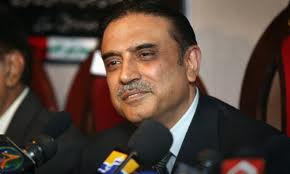
Lahore, April 21: Pakistan President Asif Ali Zardari has ruled out any unilateral withdrawal of Pakistani soldiers from Siachen, saying troops could be called back from the Himalayan glacier only if India agrees to do the same.

"The withdrawal of Pakistani troops is possible provided India also agrees. It will not be a unilateral decision," he said while addressing a convention of workers of his Pakistan People's Party in Okara district, 100 km from Lahore, yesterday.

Speaking almost a fortnight after an avalanche slammed into a high-altitude Pakistan Army camp in Siachen sector and buried 138 people, Zardari said he was worried by the problems of Pakistani soldiers and India too would be concerned for its troops on Siachen.

"There is no doubt that Siachen is the most difficult battlefield in the world... We are aware of the extreme climate and other difficulties at one of the world's most difficult terrains but the withdrawal can only take place if the two governments decide to pull out from the area jointly," he said.

"Pakistan wants to solve its issues with India through talks," Zardari said. Islamabad is willing to hold a dialogue with New Delhi on all subjects, he added.

The President, who is the supreme commander of Pakistan's armed forces, offered prayers for the soldiers buried by the avalanche that hit the battalion headquarters at Gyari on April 7.

Referring to the normalisation of relations with India, Zardari said the federal government would consider proposals for opening a crossing along the border at Head Sulemanki and constructing a road between Multan in Pakistan's Punjab province and New Delhi to boost trade and economic activities.

He said when he met Prime Minister Manmohan Singh during a daylong private visit to India on April 8, the first point which was discussed was bilateral trade.

"I believe trade will bring prosperity for the people of the two countries," he said.

Continuing his tirade against PML-N leaders Nawaz Sharif and Shahbaz Sharif, Zardari said Shahbaz, the Chief Minister of Punjab, acted like a "Mughal prince".

The President said he and the PPP had delegated powers to the provinces but Shahbaz was not ready to hand over 17 provincial ministries to his legislators.

Zardari further said Shahbaz had no powers because his elder brother Nawaz controlled the PML-N.

He said Shahbaz always heaped slurs on the PPP and its leadership but the PPP talked about reconciliation.

He said that when he assumed office in 2008, all powers were concentrated in the office of the President but he had transferred these powers to the real representatives of the people to make parliament stronger and to empower the people.


Comments

Add new comment

  • Coastaldigest.com reserves the right to delete or block any comments.
  • Coastaldigset.com is not responsible for its readers’ comments.
  • Comments that are abusive, incendiary or irrelevant are strictly prohibited.
  • Please use a genuine email ID and provide your name to avoid reject.
News Network
June 11,2020

Jun 11: The total death toll in the US from the novel coronavirus pandemic could hit the grim figure of 200,000 by September and expecting a dramatic decrease in COVID-19 cases in the country will be a "wishful thinking , an eminent Indian-American professor has warned.

Ashish Jha, the head of Harvard's Global Health Institute, told CNN on Wednesday that he is not trying to scare people to stay at home rather urged everyone to wear masks, adhere to the social distancing rules and called for ramping up testing and tracing infrastructure.

Anybody who's expecting a dramatic decrease in cases is almost surely engaging in wishful thinking. And if it (COVID numbers) stays just flat for the next three months, we're going to hit 200,000 deaths sometime in September and that is just awful, Jha said.

Jha said the 200,000 death toll is not just a guess . Currently 800-1000 people are dying daily in America from the virus and all data suggest that the situation is going to get worse.

We're gonna have increases, but even if we assume that it's going to be flat all summer, that nothing is going to get worse... even if we pick that low number of 800 a day, that is 25,000 (deaths) a month in three and a half months. We're going to add another 88,000 people and we will hit 200,000 sometime in September, Jha said.

The United States is by far the hardest-hit country in the global pandemic, in terms of both confirmed infections and deaths.

According to data by the Johns Hopkins University, the number of coronavirus cases in the US currently is nearly two million and about 112,900 people have died in the country, the most in the world.

When asked about an improvement in states like New York, which had been the epicenter of the COVID19 pandemic in the US, Jha said while coronavirus cases are declining in New York, New Jersey, Connecticut and Massachusetts, the numbers are increasing in states such as Arizona, Florida, Texas, North and South Carolina while the country as a whole is pretty flat.

He said, people should take measures as that will help suppress the virus and ensure people could get back outside safely but he voiced concern that this was not the situation in reality.

We're not doing that and so we're going to unfortunately have another 25,000 deaths a month until September, and then it'll keep going. It's not going to magically disappear. We've got a turn around. This is not the future I want, he said.

Jha said he had expected the situation to improve in the summer months but on the contrary the numbers have continued to rise even in the warm weather.

Summer was supposed to be our better months - warmer weather, people outside, a little less transmission. This is not the time (summer) I was expecting a lot more cases. We're seeing a lot more cases, especially in states like Arizona where the numbers look really scary, he said.

Jha added that he was hopeful that maybe the summer months would give us more of a break. I think I may have been too optimistic on that.

Comments

Add new comment

  • Coastaldigest.com reserves the right to delete or block any comments.
  • Coastaldigset.com is not responsible for its readers’ comments.
  • Comments that are abusive, incendiary or irrelevant are strictly prohibited.
  • Please use a genuine email ID and provide your name to avoid reject.
News Network
January 7,2020

Dubai/Washington, Jan 7: Iran's Supreme Leader Ayatollah Ali Khamenei wept in grief with hundreds of thousands of mourners thronging Tehran's streets on Monday for the funeral of military commander Qassem Soleimani, killed by a U.S. drone on U.S. President Donald Trump's orders.

The coffins of General Qassem Soleimani and Iraqi militia leader Abu Mahdi al-Muhandis, who also died in Friday's attack in Baghdad, were draped in their national flags and passed from hand to hand over the heads of mourners in central Tehran.

Responding to Trump's threats to hit 52 Iranian sites if Tehran retaliates for the drone strike, Iran's President Hassan Rouhani pointedly wrote on Twitter: "Never threaten the Iranian nation." And Soleimani's successor vowed to expel U.S. forces from the Middle East in revenge.

Khamenei, 80, led prayers at the funeral, pausing as his voice cracked with emotion. Soleimani, 62, was a national hero in Iran, even to many who do not consider themselves supporters of Iran's clerical rulers.

Aerial footage showed people, many clad in black, packing thoroughfares and side streets in the Iranian capital, chanting "Death to America!" - a show of national unity after anti-government protests in November in which many demonstrators were killed.

The crowd, which state media said numbered in the millions, recalled the masses of people that gathered in 1989 for the funeral of the Islamic Republic's founder, Ayatollah Ruhollah Khomeini. Soleimani, architect of Iran's drive to extend its influence across the Middle East, was widely seen as Iran's second most powerful figure behind Khamenei.

His killing of Soleimani has prompted concern around the world that a broader regional conflict could flare.

Trump on Saturday vowed to strike 52 Iranian targets, including cultural sites, if Iran retaliates with attacks on Americans or U.S. assets, and stood by his threat on Sunday, though American officials sought to downplay his reference to cultural targets. The 52 figure, Trump noted, matched the number of U.S. Embassy hostages held for 444 days after the 1979 Iranian Revolution.

Rouhani, regarded as a moderate, responded to Trump on Twitter.

"Those who refer to the number 52 should also remember the number 290. #IR655," Rouhani wrote, referring to the 1988 shooting down of an Iranian airline by a U.S. warship in which 290 were killed.

Trump also took to Twitter to reiterate the White House stance that "Iran will never have a nuclear weapon" but gave no other details.

'ACTIONS WILL BE TAKEN'

General Esmail Ghaani, Soleimani's successor as commander of the Quds Force, the elite unit of Iran's Revolutionary Guards charged with overseas operations, promised to "continue martyr Soleimani's cause as firmly as before with the help of God, and in return for his martyrdom we aim to rid the region of America."

"God the Almighty has promised to take martyr Soleimani's revenge," he told state television. "Certainly, actions will be taken."

Other political and military leaders have made similar, unspecific threats. Iran, which lies at the mouth of the key Gulf oil shipping route, has a range of proxy forces in the region through which it could act.

Iran's demand for U.S. forces to withdraw from the region gained traction on Sunday when Iraq's parliament passed a resolution calling for all foreign troops to leave the country.

Iraqi caretaker Prime Minister Abdel Abdul Mahdi told the U.S. ambassador to Baghdad on Monday that both nations needed to implement the resolution, the premier's office said in a statement. It did not give a timeline.

The United States has about 5,000 troops in Iraq.

Soleimani built a network of proxy militia that formed a crescent of influence - and a direct challenge to the United States and its regional allies led by Saudi Arabia - stretching from Lebanon through Syria and Iraq to Iran. Outside the crescent, Iran nurtured allied Palestinian and Yemeni groups.

He notably mobilised Shi'ite Muslim militia forces in Iraq that helped to crush ISIS, the Sunni militant group that had seized control of swathes of Syria and Iraq in 2014.

Washington, however, blames Soleimani for attacks on U.S. forces and their allies.

The funeral moves to Soleimani's southern home city of Kerman on Tuesday. Zeinab Soleimani, his daughter, told mourners in Tehran that the United States would face a "dark day" for her father's death, adding, "Crazy Trump, don't think that everything is over with my father's martyrdom."

NUCLEAR DEAL

Iran stoked tensions on Sunday by dropping all limitations on its uranium enrichment, another step back from commitments under a landmark deal with major powers in 2015 to curtail its nuclear programme that Trump abandoned in 2018.

In response, European signatories may launch a dispute resolution process against Iran this week that could lead to a renewal of the United Nations sanctions that were lifted as part of the deal, European diplomats said on Monday.

Diplomats said France, Britain and Germany could make a decision ahead of an EU foreign ministers' meeting on Friday that would assess whether there were any ways to salvage the deal.

After quitting the deal, the United States imposed new sanctions on Iran, saying it wanted to halt Iranian oil exports, the main source of government revenues. Iran's economy has been in freefall as the currency has plunged.

Trump adviser Kellyanne Conway said on Monday that he was still confident he could renegotiate a new nuclear agreement "if Iran wants to start behaving like a normal country."

Tehran has said Washington must return to the existing nuclear pact and lift sanctions before any talks can take place.

The United States advised American citizens in Israel and the Palestinian territories to be vigilant, citing the risk of rocket fire amid heightened tensions. As a U.S. ally against Iran, Israel is concerned about possible rocket attacks from Gaza, ruled by Iranian-backed Palestinian Islamists, or major Iran proxy Hezbollah in Lebanon.

Democratic critics of Trump have said the Republican president was reckless in authorising the strike, with some saying his threat to hit cultural sites amounted to a vow to commit war crimes. Trump also threatened sanctions against Iraq and said Baghdad would have to pay Washington for an air base in Iraq if U.S. troops were required to leave.


Comments

Add new comment

  • Coastaldigest.com reserves the right to delete or block any comments.
  • Coastaldigset.com is not responsible for its readers’ comments.
  • Comments that are abusive, incendiary or irrelevant are strictly prohibited.
  • Please use a genuine email ID and provide your name to avoid reject.
Agencies
January 9,2020

Washington, Jan 9: The U.S. and Iran stepped back from the brink of possible war Wednesday as President Donald Trump signaled he would not retaliate militarily for Iran's missile strikes on Iraqi bases housing U.S. troops. No one was harmed in the strikes, but U.S. forces in the region remained on high alert.

Speaking from the White House, Trump seemed intent on deescalating the crisis, which spiralled after he authorized the assassination of Iran's top general, Qassem Soleimani. Iran responded overnight by firing more than a dozen missiles at two installations in Iraq, its most direct assault on America since the 1979 seizure of the U.S. Embassy in Tehran.

Trump's takeaway was that “Iran appears to be standing down, which is a good thing for all parties concerned and a very good thing for the world.”

The region remained on edge, however, and American troops including a quick-reaction force dispatched over the weekend were on high alert. Hours after Trump spoke, an ‘incoming’ siren went off in Baghdad's Green Zone after what seemed to be small rockets “impacted” the diplomatic area, a Western official said. There were no reports of casualties.

Iran's Supreme Leader Ayatollah Ali Khamenei said the overnight strike was not necessarily the totality of Iran's response. “Last night they received a slap,” Khamenei said. “These military actions are not sufficient (for revenge). What is important is that the corrupt presence of America in this region comes to an end.”

The strikes had pushed Tehran and Washington perilously close to all-out conflict and left the world waiting to see whether the American president would respond with more military force. Trump, in his nine-minute, televised address, spoke of a robust U.S. military with missiles that are “big, powerful, accurate, lethal and fast.'' But then he added: “We do not want to use it."

Iran for days had been promising to respond forcefully to Soleimani's killing, but its limited strike on two bases--one in the northern Iraqi city of Irbil and the other at Ain al-Asad in western Iraq--appeared to signal that it too was uninterested in a wider clash with the U.S. Foreign minister Mohammad Javad Zarif tweeted that the country had “concluded proportionate measures in self-defence.”

Trump said the U.S. was “ready to embrace peace with all who seek it.” That marked a sharp change in tone from his warning a day earlier that “if Iran does anything that they shouldn't be doing, they're going to be suffering the consequences, and very strongly.”

Trump opened his remarks at the White House by reiterating his promise that “Iran will never be allowed to have a nuclear weapon.” Iran had announced in the wake of Soleimani's killing that it would no longer comply with any of the limits on uranium enrichment in the 2015 nuclear deal crafted to keep it from building a nuclear device.

The president, who had earlier pulled the U.S. out of the deal, seized on the moment of calm to call for negotiations toward a new agreement that would do more to limit Iran's ballistic missile programmes and constrain regional proxy campaigns like those led by Soleimani.

Trump spoke of new sanctions on Iran, but it was not immediately clear what those would be.

Comments

Add new comment

  • Coastaldigest.com reserves the right to delete or block any comments.
  • Coastaldigset.com is not responsible for its readers’ comments.
  • Comments that are abusive, incendiary or irrelevant are strictly prohibited.
  • Please use a genuine email ID and provide your name to avoid reject.