


Gaddafi ‘aid' adds to Sarkozy's woes

April 30, 2012

sarj_fund


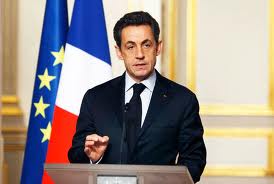
Paris, April 30: The French presidential race entered the home straight on Sunday with both incumbent right-winger Nicolas Sarkozy and Socialist frontrunner Francois Hollande battling to shake off the taint of scandal.

Sarkozy accused Hollande supporters in the media of mounting a "despicable" smear against him by publishing a document purporting to show Muammar Gaddafi's former Libyan regime agreed to fund his previous presidential campaign in 2007.

Meanwhile, the Socialists were embarrassed when several senior figures in Hollande's campaign attended an ally's birthday party and found that disgraced former IMF head Dominique Strauss-Kahn had also been invited.

Both events revived interest in these long-running scandals just one week before France goes back to the polls and just days before Hollande and Sarkozy were to face off in a televised debate which could prove decisive. The latest opinion poll published by the LH2 institute for web portal Yahoo! forecast that Hollande would comfortably win the May 6 run-off by 54% of the vote to Sarkozy's 46%, a smaller gap than in LH2's last estimate. But polling has yet to take into account the effects, if any, of the latest controversies, neither of which appear fatal to either campaign, but which may reinforce the voters' disdain for the political class.

On Saturday, investigative news website Mediapart published a copy of an internal Libyan regime document recording an alleged 2006 illegal funding deal between Tripoli and Sarkozy's 2007 campaign. According to the note, which Mediapart claims to have obtained from former Libyan regime figures, Tripoli agreed to pay Sarkozy's 2007 campaign $66 million.

"It's despicable. It's a forgery . Mediapart is well used to dishonesty. It's an agency in the service of the left," Sarkozy said.

And the man to whom the memo was supposedly addressed - Bashir Saleh, Gaddafi's former chief of staff and head of Libya's 40-billion-dollar sovereign wealth fund - denied ever receiving such a communication. Meanwhile, Socialist figure Julien Dray invited Hollande's campaign director Pierre Moscovici, communications director Manuel Valls and former partner Segolene Royal to a drinks party to celebrate his birthday.

But he apparently failed to tell them he had also invited Strauss-Kahn , who is now a political pariah and under judicial investigation for his alleged ties to a prostitution network. Royal said she had left as soon as she heard Strauss-Kahn was coming, without seeing him.


Comments

Add new comment

  • Coastaldigest.com reserves the right to delete or block any comments.
  • Coastaldigset.com is not responsible for its readers’ comments.
  • Comments that are abusive, incendiary or irrelevant are strictly prohibited.
  • Please use a genuine email ID and provide your name to avoid reject.
News Network
July 4,2020

Maryland, Jul 4: The total number of coronavirus cases worldwide has touched 11 million, according to the latest data by the Johns Hopkins University on Saturday.
More than 523,613 people have died globally due to the infection, according to the data compiled by the university.

Though the virus is believed to have emerged from the Chinese city of Wuhan, the United States is the worst-hit country from COVID-19, which was declared as a pandemic by the WHO on March 11.

At least 129,275 people have died in the US from the coronavirus, according to Johns Hopkins University's latest tally.
There are at least 2,786,178 cases of the disease in the country. The US has the highest number of cases in the world.

The second worst-hit country is Brazil, which has reported 1,496,858 lakh cases. The country's death toll stands at 61,884.

The countries around the world including the US, India, Denmark, and Italy have started the process of lifting the lockdown by easing restrictions despite the number of cases continues to rise.

Comments

Add new comment

  • Coastaldigest.com reserves the right to delete or block any comments.
  • Coastaldigset.com is not responsible for its readers’ comments.
  • Comments that are abusive, incendiary or irrelevant are strictly prohibited.
  • Please use a genuine email ID and provide your name to avoid reject.
Agencies
July 15,2020

Huawei will be completely removed from the UK's 5G networks by the end of 2027, the UK government announced on Tuesday after a review by the country's National Cyber Security Centre (NCSC) on the impact of US sanctions against the Chinese telecommunications giant.

In the lead up to this complete removal of all Huawei kit from UK networks, there will be a total ban on the purchase of any new 5G kit after December 31, 2020.

The decision was taken at a meeting of the UK's National Security Council (NSC) chaired by Prime Minister Boris Johnson, in response to new US sanctions against the telecom major imposed in May which removed the firm's access to products which have been built based on US semiconductor technology.

5G will be transformative for our country, but only if we have confidence in the security and resilience of the infrastructure it is built upon, said Oliver Dowden, UK Secretary of State for Digital, Culture, Media and Sport (DCMS).

Following US sanctions against Huawei and updated technical advice from our cyber experts, the government has decided it necessary to ban Huawei from our 5G networks. No new kit is to be added from January 2021, and UK 5G networks will be Huawei free by the end of 2027. This decisive move provides the industry with the clarity and certainty it needs to get on with delivering 5G across the UK, he said.

The minister, who laid out the details of the UK's ban on Huawei in the House of Commons, said the government will now seek to legislate with a new Telecoms Security Bill to put in place the powers necessary to implement the tough new telecoms security framework.

By the time of the next election (2024) we will have implemented in law an irreversible path for the complete removal of Huawei equipment from our 5G networks, said Dowden.

The new law will give the government the national security powers to impose these new controls on high risk vendors and create extensive security duties on network operators to drive up standards, DCMS said.

Technical experts at the NCSC reviewed the consequences of the US sanctions and concluded that Huawei will need to do a major reconfiguration of its supply chain as it will no longer have access to the technology on which it currently relies and there are no alternatives which we have sufficient confidence in.

They found the new restrictions make it impossible to continue to guarantee the security of Huawei equipment in the future.

After a ban on the purchase of new Huawei kit for 5G from next year, the aim is to completely remove the Chinese vendor's influence on 5G networks across the UK by the end of 2027.

The DCMS said Tuesday's decision takes into account the UK's specific national circumstances and how the risks from these sanctions are manifested in the country.

The existing restrictions on Huawei in sensitive and critical parts of the network remain in place, it highlighted.

The DCMS said the US action also affects Huawei products used in the UK's full fibre broadband networks. However, the UK has managed Huawei's presence in the UK's fixed access networks since 2005 and we also need to avoid a situation where broadband operators are reliant on a single supplier for their equipment.

As a result, following security advice from experts, DCMS is advising full fibre operators to transition away from purchasing new Huawei equipment. A technical consultation will determine the transition timetable, but it is expect this period to last no longer than two years.

The government said its new approach strikes the right balance by recognising full fibre's established presence and supporting the connections that the public relies on, while fully addressing the security concerns.

It stressed that its new policy in relation to high risk vendors has not been designed around one company, one country or one threat but as an enduring and flexible policy that will enable the UK to manage the risks to the network, now and in the future.

Comments

Add new comment

  • Coastaldigest.com reserves the right to delete or block any comments.
  • Coastaldigset.com is not responsible for its readers’ comments.
  • Comments that are abusive, incendiary or irrelevant are strictly prohibited.
  • Please use a genuine email ID and provide your name to avoid reject.
News Network
July 2,2020

Naypyitaw, Jul 2: A landslide at a jade mine in northern Myanmar has killed at least 113 people, officials say, warning the death toll is likely to rise further.

The incident took place early on Thursday in the jade-rich Hpakant area of Kachin state after a bout of heavy rainfall, the Myanmar Fire Services Department said on Facebook.

"The jade miners were smothered by a wave of mud," the statement said. "A total of 113 bodies have been found so far," it added, raising the death toll from at least 50.

Photos posted on the Facebook page showed a search and rescue team wading through a valley apparently flooded by the mudslide.

'No one could help them'

Maung Khaing, a 38-year-old miner from the area, said he saw a towering pile of waste that looked on the verge of collapse and was about to take a picture when people began shouting "run, run!"

"Within a minute, all the people at the bottom [of the hill] just disappeared," he told Reuters news agency by phone.

"I feel empty in my heart. I still have goosebumps ... There were people stuck in the mud shouting for help, but no one could help them."

Tar Lin Maung, a local official with the information ministry, said authorities had recovered more than 100 bodies.

"Other bodies are in the mud. The numbers are going to rise," he told Reuters.

Fatal landslides are common in the poorly regulated mines of Hpakant, the victims often from impoverished communities who risk their lives hunting the translucent green gemstone.

The government of Myanmar leader Aung San Suu Kyi pledged to clean up the industry when it took power in 2016, but activists say little has changed.

Official sales of jade in Myanmar were worth $750.4m in 2016-2017, according to data published by the government as part of the Extractive Industries Transparency Initiative.

But experts believe the true value of the industry, which mainly exports to China, is much larger.

Northern Myanmar's abundant natural resources - including jade, timber, gold and amber - have also helped finance both sides of a decades-long conflict between ethnic Kachin and the military.

The fight to control the mines and the revenues they bring frequently traps local civilians in the middle.

Comments

Add new comment

  • Coastaldigest.com reserves the right to delete or block any comments.
  • Coastaldigset.com is not responsible for its readers’ comments.
  • Comments that are abusive, incendiary or irrelevant are strictly prohibited.
  • Please use a genuine email ID and provide your name to avoid reject.