


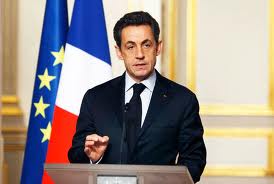
Gaddafi ‘aid' adds to Sarkozy's woes

April 30, 2012

sarj_fund


Paris, April 30: The French presidential race entered the home straight on Sunday with both incumbent right-winger Nicolas Sarkozy and Socialist frontrunner Francois Hollande battling to shake off the taint of scandal.

Sarkozy accused Hollande supporters in the media of mounting a "despicable" smear against him by publishing a document purporting to show Muammar Gaddafi's former Libyan regime agreed to fund his previous presidential campaign in 2007.

Meanwhile, the Socialists were embarrassed when several senior figures in Hollande's campaign attended an ally's birthday party and found that disgraced former IMF head Dominique Strauss-Kahn had also been invited.

Both events revived interest in these long-running scandals just one week before France goes back to the polls and just days before Hollande and Sarkozy were to face off in a televised debate which could prove decisive. The latest opinion poll published by the LH2 institute for web portal Yahoo! forecast that Hollande would comfortably win the May 6 run-off by 54% of the vote to Sarkozy's 46%, a smaller gap than in LH2's last estimate. But polling has yet to take into account the effects, if any, of the latest controversies, neither of which appear fatal to either campaign, but which may reinforce the voters' disdain for the political class.

On Saturday, investigative news website Mediapart published a copy of an internal Libyan regime document recording an alleged 2006 illegal funding deal between Tripoli and Sarkozy's 2007 campaign. According to the note, which Mediapart claims to have obtained from former Libyan regime figures, Tripoli agreed to pay Sarkozy's 2007 campaign $66 million.

"It's despicable. It's a forgery . Mediapart is well used to dishonesty. It's an agency in the service of the left," Sarkozy said.

And the man to whom the memo was supposedly addressed - Bashir Saleh, Gaddafi's former chief of staff and head of Libya's 40-billion-dollar sovereign wealth fund - denied ever receiving such a communication. Meanwhile, Socialist figure Julien Dray invited Hollande's campaign director Pierre Moscovici, communications director Manuel Valls and former partner Segolene Royal to a drinks party to celebrate his birthday.

But he apparently failed to tell them he had also invited Strauss-Kahn , who is now a political pariah and under judicial investigation for his alleged ties to a prostitution network. Royal said she had left as soon as she heard Strauss-Kahn was coming, without seeing him.


Comments

Add new comment

  • Coastaldigest.com reserves the right to delete or block any comments.
  • Coastaldigset.com is not responsible for its readers’ comments.
  • Comments that are abusive, incendiary or irrelevant are strictly prohibited.
  • Please use a genuine email ID and provide your name to avoid reject.
News Network
April 16,2020

Brussels/Amsterdam, Apr 16: As the novel coronavirus continues to wreak havoc in the western world since its outbreak in Wuhan last December, researchers believe that the Chinese leadership is trying to absolve President Xi Jinping by using a section of the western media to influence public opinion globally.

"There are clear indications that China is conducting activities in a persistent and systematic manner to influence public opinion-making, academia, think tanks and political decision-making among the member states of the Belt and Road Initiative (BRI) in general and western capital cities in particular," Siegfried O Wolf, Director of Research at Brussels-based think tank South Asia Democratic Front, said.

Some western media say some Chinese officials were secretly aware that they were facing a pandemic from the new coronavirus but allowed Wuhan to host a mass banquet for tens of thousands of people and millions began their annual trip home for the Lunar New Year celebrations.

The pandemic has since then affected 210 countries and territories around the world. Over 2 million people have been declared positive in which over 134,000 lost their lives.

"The frequency and extra-ordinary large scale of Chinese sponsored events in European political hubs, like in Brussels, and the subsequent media coverage can be seen as evidence for Beijing's public diplomacy efforts. However, the rising skepticism within the EU regarding Xi Jinping's development projects and the emerging questioning of Chinese sources funding Free Universities, like the one in Berlin, shows that this strategy produced mixed results so far," Wolf said.

He added, "However, one must also state that these efforts helped China to gain certain leverage among many non-Chinese media, western as well as non-western ones. Today, we can observe that China's political leadership tries to instrumentalise this influence for a major image campaign to distract from the fact that it carries the initial responsibility for the dramatic spread of COVID-19 by holding back key information."

Wolf also said that the current internal dynamics in China, like the shirking of responsibilities by the local authorities, are most-likely part of a twofold strategy. Firstly, there is the strategic component - namely, to reaffirm to the general public that the Communist Party of China is still in full control of the situation. The second strategic pillar is one of 'whitewashing'.

"Concretely, Beijing's obvious aim is to distract the domestic and international attention from the real, but hidden causes of the Coronavirus outbreak and its potential reputational and political consequences for Xi Jinping and his BRI," he stated.

Yoana Barakova, a Research Analyst at European Foundation for South Asian Studies (EFSAS), an Amsterdam-based think-tank, said, "The death of Dr. Li Wenliang, one of the very few medical professionals who tried to warn the world in December 2019 about the looming threat, sparked widespread condemnation around the international community in early February. Yet, little did he know that his legacy would continue much later after his demise, with the emboldened Chinese government trying to cover up its missteps through hardcore censorship after being exposed for undermining and underestimating the initial danger."

The researchers believe that the deterioration in press freedom under Jinping's regime has become more evident in recent days, with local authorities trying to control the state narrative by cosmetically placing media's focus on government's superficial attempts to tackle the crisis.

Comments

Add new comment

  • Coastaldigest.com reserves the right to delete or block any comments.
  • Coastaldigset.com is not responsible for its readers’ comments.
  • Comments that are abusive, incendiary or irrelevant are strictly prohibited.
  • Please use a genuine email ID and provide your name to avoid reject.
News Network
May 8,2020

May 8: Thousands of migrants have been stranded “all over the world” where they face a heightened risk of COVID-19 infection, the head of the UN migration agency International Organization for Migration (IOM) has said.

IOM Director-General António Vitorino said that more onerous health-related travel restrictions might discriminate disproportionately against migrant workers in future.

“Health is the new wealth,” Vitorino said, citing proposals by some countries to introduce the so-called immunity passports and use mobile phone apps designed to prevent the spread of the new coronavirus.

“In lots of countries in the world, we already have a system of screening checks to identify the health of migrants, above all malaria, tuberculosis… HIV-AIDS, and now I believe that there will be increased demands in health controls for regular migrants,” he said on Thursday.

Travel restrictions to try to limit the spread of the pandemic has left people on the move more vulnerable than ever and unable to work to support themselves, Vitorino told journalists via videoconference.

“There are thousands of stranded migrants all over the world.

 “In South-East Asia, in East Africa, in Latin America, because of the closing of the borders and with the travel restrictions, lots of migrants who were on the move; some of them wanted to return precisely because of the pandemic,” he said.

They are blocked, some in large groups, some in small, in the border areas, in very difficult conditions without access to minimal care, especially health screening, Vitorino said.

“We have been asking the governments to allow the humanitarian workers and the health workers to have access to (them),” he said.

Turning to Venezuelan migrants, who are believed to number around five million amidst a worsening economic crisis in the country, the IOM chief said “thousands… have lost their jobs in countries like Ecuador and Colombia and are returning back to Venezuela in large crowds without any health screening and being quarantined when they go back”.

In a statement, the IOM highlighted the plight of migrants left stranded in the desert in west, central and eastern Africa, either after having been deported without the due process, or abandoned by the smugglers.

The IOM’s immediate priorities for migrants include ensuring that they have access to healthcare and other basic social welfare assistance in their host country.

Among the UN agency’s other immediate concerns is preventing the spread of new coronavirus infection in more than 1,100 camps that it manages across the world.

They include the Cox’s Bazar complex in Bangladesh, home to around one million mainly ethnic Rohingya from Myanmar, the majority having fled persecution.

So far, no cases of infection have been reported there, the IOM chief said, adding that preventative measures have been communicated to the hundreds of thousands of camp residents, while medical capacity has been boosted.

Beyond the immediate health threat of COVID-19 infection, migrants also face growing stigmatization from which they need protection, Vitorino said.

Allowing hate speech and xenophobic narratives to thrive unchallenged also threatens to undermine the public health response to COVID-19, he said, before noting that migrant workers make up a significant percentage of the health sector in many developed countries including the UK, the US and Switzerland.

Populist narratives targeting migrants as carriers of disease could also destabilise national security through social upheaval and countries’ post-COVID economic recovery by removing critical workers in agriculture and service industries, he said.

Remittances have already seen a 30 per cent drop during the pandemic, Vitorino said, citing the World Bank data, meaning that some USD 20 billion has not been sent home to families in countries where up to 15 per cent of their gross domestic product comes from pay packets earned abroad.

Vitorino, in a plea, urged to give the health of migrants as much attention as that of the host populations in all countries.

“It is quite clear that health is the new wealth and that health concerns will be introduced in the mobility systems - not just for migration - but as a whole; where travelling for business or professional reasons, health will be the new gamechanger in town.

“If the current pandemic leads to a two or even three-tier mobility system, then we will have to try to solve the problem – the problem of the pandemic - but at the same time we have created a new problem of deepening the inequalities,” he said.

Comments

Add new comment

  • Coastaldigest.com reserves the right to delete or block any comments.
  • Coastaldigset.com is not responsible for its readers’ comments.
  • Comments that are abusive, incendiary or irrelevant are strictly prohibited.
  • Please use a genuine email ID and provide your name to avoid reject.
News Network
April 15,2020

Wuhan, Apr 15: In the six days after top Chinese officials secretly determined they likely were facing a pandemic from a new coronavirus, the city of Wuhan at the epicenter of the disease hosted a mass banquet for tens of thousands of people; millions began traveling through for Lunar New Year celebrations.

President Xi Jinping warned the public on the seventh day, Janaury 20. But by that time, more than 3,000 people had been infected during almost a week of public silence, according to internal documents obtained by The Associated Press and expert estimates based on retrospective infection data.

That delay from Jan 14 to Jan. 20 was neither the first mistake made by Chinese officials at all levels in confronting the outbreak, nor the longest lag, as governments around the world have dragged their feet for weeks and even months in addressing the virus.

But the delay by the first country to face the new coronavirus came at a critical time — the beginning of the outbreak. China's attempt to walk a line between alerting the public and avoiding panic set the stage for a pandemic that has infected almost 2 million people and taken more than 126,000 lives.

A This is tremendous, a said Zuo-Feng Zhang, an epidemiologist at the University of California, Los Angeles. If they took action six days earlier, there would have been much fewer patients and medical facilities would have been sufficient. We might have avoided the collapse of Wuhan's medical system.

Other experts noted that the Chinese government may have waited on warning the public to stave off hysteria, and that it did act quickly in private during that time.

But the six-day delay by China's leaders in Beijing came on top of almost two weeks during which the national Center for Disease Control did not register any cases from local officials, internal bulletins obtained by the AP confirm. Yet during that time, from Jan 5 to Jan 17, hundreds of patients were appearing in hospitals not just in Wuhan but across the country.

It's uncertain whether it was local officials who failed to report cases or national officials who failed to record them. It's also not clear exactly what officials knew at the time in Wuhan, which only opened back up last week with restrictions after its quarantine.

But what is clear, experts say, is that China's rigid controls on information, bureaucratic hurdles and a reluctance to send bad news up the chain of command muffled early warnings. The punishment of eight doctors for rumor-mongering, broadcast on national television on Jan. 2, sent a chill through the city's hospitals.

Doctors in Wuhan were afraid, said Dali Yang, a professor of Chinese politics at the University of Chicago. It was truly intimidation of an entire profession. Without these internal reports, it took the first case outside China, in Thailand on Jan 13, to galvanize leaders in Beijing into recognising the possible pandemic before them. It was only then that they launched a nationwide plan to find cases distributing CDC-sanctioned test kits, easing the criteria for confirming cases and ordering health officials to screen patients, all without telling the public.

The Chinese government has repeatedly denied suppressing information in the early days, saying it immediately reported the outbreak to the World Health Organization.

Allegations of a cover-up or lack of transparency in China are groundless, said foreign ministry spokesman Zhao Lijian at a Thursday press conference.

The documents show that the head of China's National Health Commission, Ma Xiaowei, laid out a grim assessment of the situation on Jan. 14 in a confidential teleconference with provincial health officials.

A memo states that the teleconference was held to convey instructions on the coronavirus from President Xi Jinping, Premier Li Keqiang and Vice Premier Sun Chunlan, but does not specify what those instructions were.

The epidemic situation is still severe and complex, the most severe challenge since SARS in 2003, and is likely to develop into a major public health event, the memo cites Ma as saying.

The National Health Commission is the top medical agency in the country. In a faxed statement, the Commission said it had organised the teleconference because of the case reported in Thailand and the possibility of the virus spreading during New Year travel. It added that China had published information on the outbreak in an open, transparent, responsible and timely manner," in accordance with important instructions repeatedly issued by President Xi.

The documents come from an anonymous source in the medical field who did not want to be named for fear of retribution. The AP confirmed the contents with two other sources in public health familiar with the teleconference. Some of the memo's contents also appeared in a public notice about the teleconference, stripped of key details and published in February.

Under a section titled sober understanding of the situation, the memo said that clustered cases suggest that human-to-human transmission is possible. It singled out the case in Thailand, saying that the situation had changed significantly because of the possible spread of the virus abroad.

With the coming of the Spring Festival, many people will be traveling, and the risk of transmission and spread is high, the memo continued.

Comments

Add new comment

  • Coastaldigest.com reserves the right to delete or block any comments.
  • Coastaldigset.com is not responsible for its readers’ comments.
  • Comments that are abusive, incendiary or irrelevant are strictly prohibited.
  • Please use a genuine email ID and provide your name to avoid reject.