



Eight die in Kabul attack after Obama trip

May 2, 2012

kanul

Kabul, May 2: Eight people were killed and 17 injured in an audacious Taliban attack in the Afghan capital Wednesday, hours after US President Barack Obama's Kabul visit that came exactly a year after Al Qaeda chief Osama bin Laden was gunned down in Pakistan.


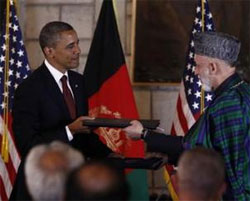
The brazen attacks were mounted after Obama left Kabul following a previously unannounced visit during which he signed a strategic partnership agreement with his Afghan counterpart Hamid Karzai.

Taliban militants resorted to suicide bombings and fought a pitched battle with security forces.

Two blasts took place inside a fortified residential compound used by the foreign staff of international organizations in eastern part of Afghan capital of Kabul.

A suicide car bomb targeted the entrance gate of the compound called Green Village in Pul-i-Charkhi area at about 6.15 a.m., enabling other heavily-armed militants to enter the complex, a police officer near the site told Xinhua.

An intense gunfight broke out in the area.At least one Nepalese security guard and five civilians have been killed and 17 injured in the attack, according to officials. The dead include suicide bombers.

The Pul-i-Charkhi area where the attack occurred is located on Jalalabad road, the main way out of the capital to the east till the border with Pakistan. Several US and NATO military camps are located nearby.

The area was cordoned off by security forces and police were on high alert across Kabul while several helicopters hovered over the area.

This is the second coordinated attack in the insurgency-hit country over the past two weeks.

A total of 51 people including 36 attackers were killed and 74 injured when Taliban launched a major attack in Kabul and three other eastern cities April 15.

Obama signed a cooperation agreement with Afghanistan as he paid an unannounced visit to the war-torn country Tuesday.

"Afghanistan has a friend and a partner in the United States," said Obama before he and Karzai signed the Strategic Partnership Agreement outlining cooperation between their countries once the US-led international force withdraws in 2014, CNN reported.

Obama, on his third trip to Afghanistan since taking office, also addressed troops at Bagram Air Field.

During the signing ceremony, the US president said neither country asked for the war which began over a decade earlier, but now they would work in partnership for a peaceful future.

Addressing concerns in Afghanistan that the US would abandon the country once its troops leave, Obama said: "With this agreement, I am confident that the Afghan people will understand that the United States will stand by them."

"We came here with a very clear mission to destroy Al Qaeda," he said as the day marked a year after Osama was gunned down by US commandos in Pakistan's Abbottabad town.

Obama's visit to Afghanistan came a week after the Afghan and US governments finalised the US-Afghan strategic pact's draft.

The agreement, which paves the way for long-term US military presence in Afghanistan after the withdrawal of the NATO-led coalition force from the country by 2014, has been welcomed by local analysts as a security stabilising factor in Afghanistan.

At present, there are over 90,000 US troops in Afghanistan and the US is expected to draw down that number to 65,000 by the end of 2012 and to less than 20,000 by the end of 2014.



Comments

Add new comment

  • Coastaldigest.com reserves the right to delete or block any comments.
  • Coastaldigset.com is not responsible for its readers’ comments.
  • Comments that are abusive, incendiary or irrelevant are strictly prohibited.
  • Please use a genuine email ID and provide your name to avoid reject.
News Network
January 31,2020

Wuhan, Jan 31: The World Health Organization declared a global emergency over the new coronavirus, as China reported Friday the death toll had climbed to 213 with nearly 10,000 infections.

The UN health agency based in Geneva had initially downplayed the threat posed by the disease, but revised its risk assessment after crisis talks.

suspended or reduced service to China include British Airways, German flag carrier Lufthansa, American Airlines, KLM and United.

Chinese efforts to halt the virus have included the suspension of classes nationwide and an extension of the Lunar New Year holiday.

All football matches across the country also will be postponed, the Chinese Football Association said on Thursday, including games in the top-tier Chinese Super League.

World stock markets tumbled again Thursday on fears that trouble in the "world's factory" would upset global supply chains and dent profits.

Toyota, IKEA, Starbucks, Tesla, McDonald's and tech giant Foxconn were among the corporate giants temporarily freezing production or closing large numbers of outlets in China.

Volkswagen announced Thursday its China joint-venture plants would not start production again before February 9.

US Federal Reserve Chairman Jerome Powell said the coronavirus posed a fresh risk to the world economy.

Throughout China, signs of paranoia multiplied, with residents of some Beijing residential compounds erecting makeshift barriers to their premises.

In one of many similar photos posted online, a man wearing a surgical mask and brandishing a traditional martial arts weapon squatted on a barricade outside a Chinese village, near a sign saying: "Outsiders forbidden from entering".

The crisis has caused food prices to spike, and the central government on Thursday blamed this partly on overzealous preventive measures, issuing a directive banning any roadblocks or other hindrances to food shipments.

Comments

Add new comment

  • Coastaldigest.com reserves the right to delete or block any comments.
  • Coastaldigset.com is not responsible for its readers’ comments.
  • Comments that are abusive, incendiary or irrelevant are strictly prohibited.
  • Please use a genuine email ID and provide your name to avoid reject.
Agencies
June 16,2020

India continues to remain ranked 43rd on an annual World Competitiveness Index compiled by Institute for Management Development (IMD) with some traditional weaknesses like poor infrastructure and insufficient education investment keeping its ranking low, the international business school said on Tuesday.

Singapore has retained its top position on the 63-nation list.

Denmark has moved up to the second position (from 8th last year), Switzerland has gained one place to rank 3rd, the Netherlands has retained its 4th place and Hong Kong has slipped to the fifth place (from 2nd in 2019).

The US has moved down to 10th place (from 3rd last year), while China has also slipped from 14th to 20th place. Among the BRICS nations, India is ranked second after China, followed by Russia (50th), Brazil (56th) and South Africa (59th).

India was ranked 41st on the IMD World Competitiveness Ranking, being produced by the business school based in Switzerland and Singapore every year since 1989, but had slipped to 45th in 2017 before improving to 44th in 2018 and then to 43rd in 2019.

While its overall position has remained unchanged in the 2020 list, it has recorded improvements in areas like long-term employment growth, current account balance, high-tech exports, foreign currency reserves, public expenditure on education, political stability and overall productivity, the IMD said.

However, it has moved down in areas like exchange rate stability, real GDP growth, competition legislation and taxes.

Arturo Bris, Head of Competitiveness Center at IMD Business School, said India continues to struggle on the list and the recent country rating downgrade by Moody’s reflects the uncertainties regarding the economy’s future.

"In our ranking this year, we again emphasize the traditional weaknesses of India -- poor infrastructure, an important deficit in education investment, and a health system that does not reach everybody. For India to follow the path of China, it must stress its intangible infrastructure," Bris said.

"In a less global world, with China, USA, and Europe looking inwards, currencies like the rupee (and the Brazilian real for instance) are going to suffer and display high volatilities.

"Moody’s has threatened the country with a downgrade to junk and that would put India in a terrible position to attract foreign capital. So the urgency for the government should be to fix the short-term problems—and this requires to improve the credibility of the government itself," Bris added.

With the exception of Singapore, the Philippines, Taiwan and the Korean Republic, most Asian economies dropped in rankings this year, the IMD said.

The reason for the Asian economies’ less stellar performance as a region, this year is partly the result of the trade frictions between China and the US, particularly because these economies are highly dependent on trade with China.

About Singapore, which moved to the top rank last year, the IMD said its position is largely driven by the relative ease of setting up business, availability of skilled labour and its cutting-edge technological infrastructure.

The IMD said the impact of COVID-19 on the competitiveness ranking has partially been captured by executives’ opinions about the effectiveness of the different health systems.

In the ASEAN countries included in the survey, only Singapore and Thailand have a positive performance in the effectiveness of the health infrastructure.

Comments

Add new comment

  • Coastaldigest.com reserves the right to delete or block any comments.
  • Coastaldigset.com is not responsible for its readers’ comments.
  • Comments that are abusive, incendiary or irrelevant are strictly prohibited.
  • Please use a genuine email ID and provide your name to avoid reject.
News Network
July 11,2020

Singapore, Jul 11: Singapore Prime Minister Lee Hsien Loong has secured a “clear mandate” with his ruling People’s Action Party (PAP) winning 83 of the 93 contested parliamentary seats in the general election held amidst the Covid-19 pandemic, with the Opposition gaining ground by winning a record 10 seats.

The ruling party, in power since independence in 1965, secured 61.24 percent of the total votes cast in the election, down from 69.9 percent in 2015. About 2.6 million Singaporeans voted on Friday.

“We have a clear mandate, but the percentage of the popular vote is not as high as I had hoped for,” 68-year old Lee told a PAP’s post-results press conference on Saturday morning.

The opposition Workers’ Party secured 10 seats and defeated a team in the Group Representation Constituency of Sengkang led by former Minister in the Prime Minister’s Office Ng Chee Meng who is also the Secretary-General of the power National Trades Union Congress (NTUC).

The Prime Minister assured it is “only right” that Workers’ Party’s Indian-origin secretary-general Pritam Singh be “formally designated” as the Leader of the Opposition, and that he will be provided with “appropriate staff support and resources to perform his duties”.

Lee took the results in “these circumstances” as an “endorsement” of the party’s policies and plans as he had called the elections amidst Covid-19 pandemic.

For latest updates and live news on coronavirus, click here

“We’ll take this forward and work with Singapore to realise those plans and solve the problems which we have,” Channel News Asia quoted the premier as saying.

Lee, who leads the PAP as secretary-general, said, “Singaporeans understand what’s at stake and why we must come together to uphold our national interests.”

He pledged to use this mandate “responsibly” to deal with the Covid-19 situation and economic downturn, to take Singapore “safely through the crisis and beyond”.

“The results reflect the pain and uncertainty that Singaporeans feel in this crisis, the loss of income, the anxiety about jobs, the disruption caused by the circuit breaker and the safe distancing restrictions,” he said.

This was not a “feel-good” election, said Lee, Singapore’s third prime minister who faces the city state’s worst recession with the economy projected to shrink between 7 and 4 per cent.

Lee acknowledged that the result also showed a “clear desire” for a diversity of voices in Parliament.

“Singaporeans want the PAP to form the government, but they, and especially the younger voters, also want to see more opposition presence in parliament,” he noted.

Lee added that he looks forward to the participation and contribution of the Opposition in parliament.

Singh, whose Workers’ Party team retained Aljunied Group Representation Constituency (GRC), will have 10 elected MPs now, up from six previously. His fellow member also retained the Hougang single-member constituency seat.

“Whether it works out… and whether it’s seen as a strengthening of Singapore will depend not only on what the PAP does but also on what the Opposition does because the Opposition now has 10 MPs elected from constituencies,” said Lee.

He assured that the ruling party will listen to Singaporeans and do its best to address their concerns, and “try to win” their support, whether or not they voted for the PAP.

When asked by the media if the party had lost the youth vote, he noted that different generations have different life experiences, and the young have significantly different life aspirations and priorities compared to the older generations.

“That’ll have to be reflected in our political process and in the government’s policies because, in the end, the government’s policies must be to achieve the aspirations of every generation of Singaporeans,” Lee said, assuring Singaporeans.

He hoped that the new generations of Singaporeans “look critically, but with an open mind” at what previous generations have done, “examine what’s relevant and what continues to make sense to them in a new environment” and “learn from these experiences hard-won by their parents and grandparents”.

This is so that they do not have to “learn them all over again and pay a high price which has already been paid”.

Lee added that he was, naturally, disappointed at the loss of the newly formed Sengkang GRC, which the Workers’ Party won with 52.13 percent of the valid votes.

“Ng Chee Meng and his team -- Lam Pin Min, Amrin Amin and Raymond Lye -- always knew it was going to be a tough fight,” he said.

“They gave it their all, but Sengkang voters have spoken, and we respect their decision.”

Lee described it as a “major loss to my team” and to the fourth-generation leaders, especially as Ng is the secretary-general of the Labour Movement, the NTUC.

Singh, 43, told a press conference following the results that his team would “continue to endeavour for good outcomes on the ground” and to represent voters “faithfully in parliament”.

“Today’s results are positive, but we have to hit the ground running. We should not get over our head with the results. There’s much work to do. And I can assure you this Workers’ Party team is committed to serve Singapore,” he stressed.

The PAP contested all 93 seats and the Workers’ Party 21 seats. Nine other political parties also contested the elections.

A total of 192 candidates contested for seats through 17 Group Representation Constituencies (GRCs).

Comments

Add new comment

  • Coastaldigest.com reserves the right to delete or block any comments.
  • Coastaldigset.com is not responsible for its readers’ comments.
  • Comments that are abusive, incendiary or irrelevant are strictly prohibited.
  • Please use a genuine email ID and provide your name to avoid reject.