



Eight die in Kabul attack after Obama trip

May 2, 2012

kanul

Kabul, May 2: Eight people were killed and 17 injured in an audacious Taliban attack in the Afghan capital Wednesday, hours after US President Barack Obama's Kabul visit that came exactly a year after Al Qaeda chief Osama bin Laden was gunned down in Pakistan.


The brazen attacks were mounted after Obama left Kabul following a previously unannounced visit during which he signed a strategic partnership agreement with his Afghan counterpart Hamid Karzai.

Taliban militants resorted to suicide bombings and fought a pitched battle with security forces.

Two blasts took place inside a fortified residential compound used by the foreign staff of international organizations in eastern part of Afghan capital of Kabul.

A suicide car bomb targeted the entrance gate of the compound called Green Village in Pul-i-Charkhi area at about 6.15 a.m., enabling other heavily-armed militants to enter the complex, a police officer near the site told Xinhua.

An intense gunfight broke out in the area.At least one Nepalese security guard and five civilians have been killed and 17 injured in the attack, according to officials. The dead include suicide bombers.

The Pul-i-Charkhi area where the attack occurred is located on Jalalabad road, the main way out of the capital to the east till the border with Pakistan. Several US and NATO military camps are located nearby.

The area was cordoned off by security forces and police were on high alert across Kabul while several helicopters hovered over the area.

This is the second coordinated attack in the insurgency-hit country over the past two weeks.

A total of 51 people including 36 attackers were killed and 74 injured when Taliban launched a major attack in Kabul and three other eastern cities April 15.

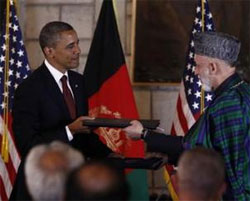
Obama signed a cooperation agreement with Afghanistan as he paid an unannounced visit to the war-torn country Tuesday.

"Afghanistan has a friend and a partner in the United States," said Obama before he and Karzai signed the Strategic Partnership Agreement outlining cooperation between their countries once the US-led international force withdraws in 2014, CNN reported.

Obama, on his third trip to Afghanistan since taking office, also addressed troops at Bagram Air Field.

During the signing ceremony, the US president said neither country asked for the war which began over a decade earlier, but now they would work in partnership for a peaceful future.

Addressing concerns in Afghanistan that the US would abandon the country once its troops leave, Obama said: "With this agreement, I am confident that the Afghan people will understand that the United States will stand by them."

"We came here with a very clear mission to destroy Al Qaeda," he said as the day marked a year after Osama was gunned down by US commandos in Pakistan's Abbottabad town.

Obama's visit to Afghanistan came a week after the Afghan and US governments finalised the US-Afghan strategic pact's draft.

The agreement, which paves the way for long-term US military presence in Afghanistan after the withdrawal of the NATO-led coalition force from the country by 2014, has been welcomed by local analysts as a security stabilising factor in Afghanistan.

At present, there are over 90,000 US troops in Afghanistan and the US is expected to draw down that number to 65,000 by the end of 2012 and to less than 20,000 by the end of 2014.



Comments

Add new comment

  • Coastaldigest.com reserves the right to delete or block any comments.
  • Coastaldigset.com is not responsible for its readers’ comments.
  • Comments that are abusive, incendiary or irrelevant are strictly prohibited.
  • Please use a genuine email ID and provide your name to avoid reject.
News Network
February 18,2020

Beijing, Feb 18: Police in China have arrested a prominent activist who had been a fugitive for weeks and criticised President Xi Jinping's handling of the coronavirus epidemic while in hiding, a rights group said Tuesday.

Anti-corruption activist Xu Zhiyong was arrested on Saturday after being on the run since December, according to Amnesty International.

China's ruling Communist Party has severely curtailed civil liberties since Xi took power in 2012, rounding up rights lawyers, labour activists and even Marxist students.

The death this month of a whistleblowing doctor who was reprimanded by police for raising the alarm about the deadly new virus before dying of it himself triggered rare calls for political reform and freedom of speech.

The "Chinese government's battle against the coronavirus has in no way diverted it from its ongoing general campaign to crush all dissenting voices," said Patrick Poon, China researcher at Amnesty International, in an emailed statement.

Another source, who spoke to news agency on the condition of anonymity, said Xu had been arrested in the southern city of Guangzhou.

Guangzhou police did not respond to requests for comment.

Xu went into hiding after authorities broke up a December gathering of intellectuals discussing political reform in the eastern coastal city of Xiamen in Fujian province, prior to the coronavirus crisis.

Over a dozen lawyers and activists were detained or disappeared after the Xiamen gathering, according to rights groups -- and Xu's detention appears linked to his presence at the meeting, explained Poon.

But while on the run, Xu continued to post information on Twitter about rights issues.

On February 4 Xu released an article calling on Xi to step down and criticised his leadership across a range of issues including the US-China trade war, Hong Kong's pro-democracy protests and the coronavirus epidemic, which has now killed nearly 1,900 people.

"Medical supplies are tight, hospitals are filled with patients, and a large number of infected people have no way to be diagnosed," he wrote. "It's a mess."

"The coronavirus outbreak shows just how important values like freedom of expression and transparency are -- the exact values that Xu has long advocated," Yaqiu Wang, China researcher at Human Rights Watch, told news agency.

But the disappearance of Xu illustrates how the Chinese state "persists in its old ways" by "silencing its critics", she said.

Xu -- who founded a movement calling for greater transparency among high-ranking officials -- previously served a four-year prison sentence from 2013 to 2017 for organising an "illegal gathering".

"That he was a fugitive for so many days while continuing to speak out, that in itself was... a kind of challenge to (Chinese authorities)," said Hua Ze, a long-time friend of Xu who told AFP she lost contact with the Chinese activist on Saturday morning.

Comments

Add new comment

  • Coastaldigest.com reserves the right to delete or block any comments.
  • Coastaldigset.com is not responsible for its readers’ comments.
  • Comments that are abusive, incendiary or irrelevant are strictly prohibited.
  • Please use a genuine email ID and provide your name to avoid reject.
News Network
July 1,2020

Jul 1: Hong Kong police moved swiftly on Wednesday against protesters gearing up for the first rally since the introduction of sweeping security legislation, making their first arrest under it and warning of punishment for pro-independence material.

Beijing on Tuesday unveiled the details of the much-anticipated law after weeks of uncertainty, pushing China's freest city and one of the world's most glittering financial hubs onto a more authoritarian path.

As hundreds of protesters gathered downtown for an annual rally marking the 23rd anniversary of the former British colony's handover to China, riot police used pepper spray to arrest at least two people, while one metro station closed.

Police, who earlier banned the rally, cited the law for the first time in confronting protesters and they also made their first arrest under it - a man holding a flag advocating independence.

"You are displaying flags or banners/chanting slogans/or conducting yourselves with an intent such as secession or subversion, which may constitute offences under the ... national security law," police said in a message displayed on a purple banner.

The law will punish crimes of secession, subversion, terrorism and collusion with foreign forces with up to life in prison, heralding a more authoritarian era for the Asian financial hub.

China's parliament adopted it in response to months of pro-democracy protests last year triggered by fears that Beijing was stifling the city's freedoms, guaranteed by a "one country, two systems" formula agreed when it returned to Chinese rule.

Authorities in Beijing and Hong Kong have repeatedly said the legislation is aimed at a few "troublemakers" and will not affect rights and freedoms, nor investor interests.

But critics fear it will crush the freedoms that are seen as key to Hong Kong's success as a financial centre.

"With the release of the full detail of the law, it should be clear to those in any doubt that this is not the Hong Kong they grew up in," said Hasnain Malik, head of equity research, Tellimer in Dubai.

"The difference is that U.S. and China relations are far worse and this could be used as a pretext to impede the role of Hong Kong as a finance hub."

In Beijing, Zhang Xiaoming, executive deputy director of Beijing's Hong Kong and Macau Affairs Office, told reporters suspects arrested by Beijing's new security office in Hong Kong could be tried on the mainland.

He said the mainland's national security office abided by Chinese law and that Hong Kong's legal system could not be expected to implement the laws of the mainland. Article 55 of the law states that Beijing's national security office in Hong Kong could exercise jurisdiction over "complex" or "serious" cases.

Mainland security agencies will also be based in Hong Kong officially for the first time, with powers that go beyond city laws.

"The law is a birthday gift to (Hong Kong) and will show its precious value in the future," Zhang said, adding the law would not be applied retroactively.

On July 1 last year, hundreds of protesters stormed and vandalised the city's legislature to protest against a now-scrapped bill that would have allowed extraditions to mainland China.

Those protests evolved into calls for greater democracy, paralysing parts of the city and paving the way for Beijing's imposition of the law this week.

'INEVITABLE'

Speaking at a flag-raising ceremony to mark the handover anniversary, the city's Beijing-backed leader, Carrie Lam, said the law was the most important development since the city's return to Chinese rule.

"It is also an inevitable and prompt decision to restore stability," Lam said at the same harbour-front venue where 23 years ago the last colonial governor, Chris Patten, a staunch critic of the security law, tearfully handed back Hong Kong to Chinese rule.

Some pro-Beijing officials and political commentators say the law is aimed at sealing Hong Kong's "second return" to the motherland after the first failed to bring residents to heel.

Luo Huining, the head of Beijing's top representative office in Hong Kong, said at the ceremony the law was a "common aspiration" of Hong Kong citizens.

Critics denounced the lack of transparency surrounding the details of the legislation until it was unveiled. It came into force at 11 p.m. (1500 GMT) on Tuesday.

Some pro-democracy activists gave up membership of their groups just before the law came into force, though calling for the campaign for democracy to go on offshore.

"I saw this morning there are celebrations for Hong Kong's handover, but to me it is a funeral, a funeral for 'one country two systems'," said democracy lawmaker Kwok Ka-ki.

Comments

Add new comment

  • Coastaldigest.com reserves the right to delete or block any comments.
  • Coastaldigset.com is not responsible for its readers’ comments.
  • Comments that are abusive, incendiary or irrelevant are strictly prohibited.
  • Please use a genuine email ID and provide your name to avoid reject.
News Network
April 26,2020

Apr 26: The Chinese city of Wuhan, where the global coronavirus pandemic began, now has no remaining cases in its hospitals, a health official told reporters on Sunday.

"The latest news is that by April 26, the number of new coronavirus patients in Wuhan was at zero, thanks to the joint efforts of Wuhan and medical staff from around the country," National Health Commission spokesman Mi Feng said at a briefing.

The city had reported 46,452 cases, 56% of the national total. It saw 3,869 fatalities, or 84% of China's total.

Comments

Add new comment

  • Coastaldigest.com reserves the right to delete or block any comments.
  • Coastaldigset.com is not responsible for its readers’ comments.
  • Comments that are abusive, incendiary or irrelevant are strictly prohibited.
  • Please use a genuine email ID and provide your name to avoid reject.