Eight die in Kabul attack after Obama trip

May 2, 2012

kanul

Kabul, May 2: Eight people were killed and 17 injured in an audacious Taliban attack in the Afghan capital Wednesday, hours after US President Barack Obama's Kabul visit that came exactly a year after Al Qaeda chief Osama bin Laden was gunned down in Pakistan.


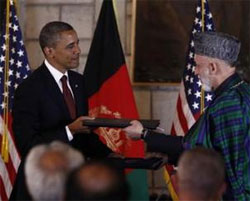
The brazen attacks were mounted after Obama left Kabul following a previously unannounced visit during which he signed a strategic partnership agreement with his Afghan counterpart Hamid Karzai.

Taliban militants resorted to suicide bombings and fought a pitched battle with security forces.

Two blasts took place inside a fortified residential compound used by the foreign staff of international organizations in eastern part of Afghan capital of Kabul.

A suicide car bomb targeted the entrance gate of the compound called Green Village in Pul-i-Charkhi area at about 6.15 a.m., enabling other heavily-armed militants to enter the complex, a police officer near the site told Xinhua.

An intense gunfight broke out in the area.At least one Nepalese security guard and five civilians have been killed and 17 injured in the attack, according to officials. The dead include suicide bombers.

The Pul-i-Charkhi area where the attack occurred is located on Jalalabad road, the main way out of the capital to the east till the border with Pakistan. Several US and NATO military camps are located nearby.

The area was cordoned off by security forces and police were on high alert across Kabul while several helicopters hovered over the area.

This is the second coordinated attack in the insurgency-hit country over the past two weeks.

A total of 51 people including 36 attackers were killed and 74 injured when Taliban launched a major attack in Kabul and three other eastern cities April 15.

Obama signed a cooperation agreement with Afghanistan as he paid an unannounced visit to the war-torn country Tuesday.

"Afghanistan has a friend and a partner in the United States," said Obama before he and Karzai signed the Strategic Partnership Agreement outlining cooperation between their countries once the US-led international force withdraws in 2014, CNN reported.

Obama, on his third trip to Afghanistan since taking office, also addressed troops at Bagram Air Field.

During the signing ceremony, the US president said neither country asked for the war which began over a decade earlier, but now they would work in partnership for a peaceful future.

Addressing concerns in Afghanistan that the US would abandon the country once its troops leave, Obama said: "With this agreement, I am confident that the Afghan people will understand that the United States will stand by them."

"We came here with a very clear mission to destroy Al Qaeda," he said as the day marked a year after Osama was gunned down by US commandos in Pakistan's Abbottabad town.

Obama's visit to Afghanistan came a week after the Afghan and US governments finalised the US-Afghan strategic pact's draft.

The agreement, which paves the way for long-term US military presence in Afghanistan after the withdrawal of the NATO-led coalition force from the country by 2014, has been welcomed by local analysts as a security stabilising factor in Afghanistan.

At present, there are over 90,000 US troops in Afghanistan and the US is expected to draw down that number to 65,000 by the end of 2012 and to less than 20,000 by the end of 2014.


Comments

Add new comment

  • Coastaldigest.com reserves the right to delete or block any comments.
  • Coastaldigset.com is not responsible for its readers’ comments.
  • Comments that are abusive, incendiary or irrelevant are strictly prohibited.
  • Please use a genuine email ID and provide your name to avoid reject.
Arab News
February 9,2020

London, Feb 9: A US court has rejected a Turkish attempt to dismiss civil cases brought by protesters who were violently attacked in Washington by Recep Tayyip Erdogan’s security officers.

The incident took place in May 2017 during a visit to the US by the Turkish president. About a dozen bodyguards beat-up a group demonstrating outside the Turkish ambassador’s residence in Washington.

The attack, which was caught on video, left nine people injured and further strained US relations with Turkey.

While criminal charges against the security guards were dropped within a year, around the same time Turkey released a US pastor, the victims pressed ahead with a civil case.

On Thursday, a federal court denied Turkey’s request to have the two cases thrown out on the grounds that it should have sovereign immunity from legal proceedings.

US District Judge Colleen Kollar-Kotelly said the protesters had not posed a threat and were merely gathered on a sidewalk outside the residence at Sheridan Circle when Erdogan’s security burst through a police line and attacked them.

“The Turkish security forces did not have the discretion to violently physically attack the protesters, with the degree and nature of force which was used, when the protesters were standing, protesting on a public sidewalk,” she said. “And, Turkish security forces did not have the discretion to continue violently physically attacking the protesters after the protesters had fallen to the ground or otherwise attempted to flee.”

The judge said Turkey “has not met its burden of persuasion to show that it is immune from suit in these cases.”

The ruling was welcomed by the victims of the attack, which Erdogan stopped to watch as he made his way from his car to inside the residence.

Comments

Add new comment

  • Coastaldigest.com reserves the right to delete or block any comments.
  • Coastaldigset.com is not responsible for its readers’ comments.
  • Comments that are abusive, incendiary or irrelevant are strictly prohibited.
  • Please use a genuine email ID and provide your name to avoid reject.
News Network
February 2,2020

Feb 2: The Philippines on Sunday reported the first death from a new virus outside of China, where authorities delayed the opening of schools in the worst-hit province and tightened quarantine measures in a city that allow only one family member to venture out to buy supplies.

The Philippine Department of Health said a 44-year-old Chinese man from Wuhan was admitted on Jan. 25 after experiencing a fever, cough, and sore throat. He developed severe pneumonia, and in his last few days, “the patient was stable and showed signs of improvement, however, the condition of the patient deteriorated within his last 24 hours resulting in his demise.”

The man’s 38-year-old female companion, also from Wuhan, also tested positive for the virus and remains in hospital isolation in Manila.

President Rodrigo Duterte approved a temporary ban on all travelers, except Filipinos, from China and its autonomous regions. The U.S., Japan, Singapore and Australia have imposed similar restrictions despite criticism from China and an assessment from the World Health Organization that they were unnecessarily hurting trade and travel.

The death toll in China climbed by 45 to 304 and the number of cases by 2,590 to 14,380, according to the National Health Commission, well above the number of those infected in in the 2002-03 outbreak of SARS, or severe acute respiratory syndrome, which broke out in southern China and spread worldwide.

Meanwhile, six officials in the city of Huanggang, neighboring the epicenter of Wuhan in Hubei province, have been fired over “poor performance” in handling the outbreak, the official Xinhua News Agency reported.

It cited the mayor as saying the city’s “capabilities to treat the patients remained inadequate and there is a severe shortage in medical supplies such as protective suits and medical masks.”

After Huanggang, the trading center of Wenzhou in coastal Zhejiang province also confined people to homes, allowing only one family member to venture out every other day to buy necessary supplies.

With the outbreak showing little sign of abating, authorities in Hubei and elsewhere have extended the Lunar New Year holiday, due to end this week, well into February. The annual travel crunch of millions of people returning from their hometowns to the cities is thought to pose a major threat of secondary infection at a time when authorities are encouraging people to avoid public gatherings.

All Hubei schools will postpone the opening of the new semester until further notice and students from elsewhere who visited over the holiday will also be excused from classes.

Far away on China’s southeast coast, the manufacturing hub of Wenzhou put off the opening of government offices until Feb. 9, private businesses until Feb. 17 and schools until March 1.

With nearly 10 million people, Wenzhou has reported 241 confirmed cases of the virus, one of the highest levels outside Hubei. Similar measures have been announced in the provinces and cities of Heilongjiang, Shandong, Guizhou, Hebei and Hunan, while the major cities of Shanghai and Beijing were on indefinite leave pending developments.

Despite imposing drastic travel restrictions at home, China has chafed at those imposed by foreign governments, criticizing Washington’s order barring entry to most non-citizens who visited China in the past two weeks. Apart from dinging China’s international reputation, such steps could worsen a domestic economy already growing at its lowest rate in decades.

The crisis is the latest to confront Chinese leader Xi Jinping, who has been beset by months of anti-government protests in the semi-autonomous Chinese city of Hong Kong, the reelection of Taiwan’s pro-independence president and criticism over human rights violations in the traditionally Muslim northwestern territory of Xinjiang. Economically, Xi faces lagging demand and dramatically slower growth at home while the tariff war with the U.S. remains largely unresolved.

Among a growing number of airlines suspending flights to mainland China was Qatar Airways. The Doha-based carrier said on its website that its flights would stop Monday. It blamed “significant operational challenges caused by entry restrictions imposed by a number of countries” for the suspension of flights.

Oman also halted flights to China, as did Saudi Arabia’s flagship national carrier, Saudia.

Saudi Arabia’s state-run TV reported that 10 Saudi students were evacuated from Wuhan on a special flight. It said the students would be screened upon arrival, but did not say whether they would be quarantined for 14 days.

This weekend, South Korea and India flew hundreds of their citizens out of Wuhan. They went into a two-week quarantine.

On Sunday, South Korea reported three more cases for a total of 15. They include an evacuee, a Chinese relative of a man who tested positive and a man who returned from Wuhan. India reported a second case, also in southern Kerala state.

South Korea also barred foreigners who have stayed or traveled to Hubei province within the last 14 days from entering the country.

Indonesia flew back 241 nationals from Wuhan on Sunday and quarantined them on the remote Natuna Islands for two weeks. Several hundred residents protested the move, with one saying, “This is not because we do not have a sense of solidarity with fellow nationals. But because we fear they could infect us with the deadly virus from China.”

A Turkish military transport plane carrying 42 people arrived in Ankara from Wutan Saturday night. The 32 Turkish, six Azerbaijani, three Georgian nationals and an Albanian will remain under observation for 14 days, together with 20 personnel who participated in the evacuation, Health Minister Fahrettin Koca said.

Vietnam counted its seventh case, a Vietnamese-American man who had a two-hour layover in Wuhan on his way from the U.S. to Ho Chi Minh City.

The virus’ rapid spread in two months prompted the WHO on Thursday to declare it a global emergency.

That declaration “flipped the switch” from a cautious attitude to recommending governments prepare for the possibility the virus might spread, said the WHO representative in Beijing, Gauden Galea. Most cases reported so far have been people who visited China or their family members.

WHO said it was especially concerned that some cases abroad involved human-to-human transmission.

“Countries need to get ready for possible importation in order to identify cases as early as possible and in order to be ready for a domestic outbreak control, if that happens,” Galea told The Associated Press.

Both the new virus and SARS are from the coronavirus family, which also includes those that cause the common cold.

The death rate in China is falling, but the number of confirmed cases will keep growing because thousands of specimens from suspected cases have yet to be tested, Galea said.

“The case fatality ratio is settling out at a much lower level than we were reporting three, now four, weeks ago,” he said.

Although scientists expect to see limited transmission of the virus between people with family or other close contact, they are concerned about cases of infection spreading to people who might have less exposure.


Comments

Add new comment

  • Coastaldigest.com reserves the right to delete or block any comments.
  • Coastaldigset.com is not responsible for its readers’ comments.
  • Comments that are abusive, incendiary or irrelevant are strictly prohibited.
  • Please use a genuine email ID and provide your name to avoid reject.
News Network
April 15,2020

Wuhan, Apr 15: In the six days after top Chinese officials secretly determined they likely were facing a pandemic from a new coronavirus, the city of Wuhan at the epicenter of the disease hosted a mass banquet for tens of thousands of people; millions began traveling through for Lunar New Year celebrations.

President Xi Jinping warned the public on the seventh day, Janaury 20. But by that time, more than 3,000 people had been infected during almost a week of public silence, according to internal documents obtained by The Associated Press and expert estimates based on retrospective infection data.

That delay from Jan 14 to Jan. 20 was neither the first mistake made by Chinese officials at all levels in confronting the outbreak, nor the longest lag, as governments around the world have dragged their feet for weeks and even months in addressing the virus.

But the delay by the first country to face the new coronavirus came at a critical time — the beginning of the outbreak. China's attempt to walk a line between alerting the public and avoiding panic set the stage for a pandemic that has infected almost 2 million people and taken more than 126,000 lives.

A This is tremendous, a said Zuo-Feng Zhang, an epidemiologist at the University of California, Los Angeles. If they took action six days earlier, there would have been much fewer patients and medical facilities would have been sufficient. We might have avoided the collapse of Wuhan's medical system.

Other experts noted that the Chinese government may have waited on warning the public to stave off hysteria, and that it did act quickly in private during that time.

But the six-day delay by China's leaders in Beijing came on top of almost two weeks during which the national Center for Disease Control did not register any cases from local officials, internal bulletins obtained by the AP confirm. Yet during that time, from Jan 5 to Jan 17, hundreds of patients were appearing in hospitals not just in Wuhan but across the country.

It's uncertain whether it was local officials who failed to report cases or national officials who failed to record them. It's also not clear exactly what officials knew at the time in Wuhan, which only opened back up last week with restrictions after its quarantine.

But what is clear, experts say, is that China's rigid controls on information, bureaucratic hurdles and a reluctance to send bad news up the chain of command muffled early warnings. The punishment of eight doctors for rumor-mongering, broadcast on national television on Jan. 2, sent a chill through the city's hospitals.

Doctors in Wuhan were afraid, said Dali Yang, a professor of Chinese politics at the University of Chicago. It was truly intimidation of an entire profession. Without these internal reports, it took the first case outside China, in Thailand on Jan 13, to galvanize leaders in Beijing into recognising the possible pandemic before them. It was only then that they launched a nationwide plan to find cases distributing CDC-sanctioned test kits, easing the criteria for confirming cases and ordering health officials to screen patients, all without telling the public.

The Chinese government has repeatedly denied suppressing information in the early days, saying it immediately reported the outbreak to the World Health Organization.

Allegations of a cover-up or lack of transparency in China are groundless, said foreign ministry spokesman Zhao Lijian at a Thursday press conference.

The documents show that the head of China's National Health Commission, Ma Xiaowei, laid out a grim assessment of the situation on Jan. 14 in a confidential teleconference with provincial health officials.

A memo states that the teleconference was held to convey instructions on the coronavirus from President Xi Jinping, Premier Li Keqiang and Vice Premier Sun Chunlan, but does not specify what those instructions were.

The epidemic situation is still severe and complex, the most severe challenge since SARS in 2003, and is likely to develop into a major public health event, the memo cites Ma as saying.

The National Health Commission is the top medical agency in the country. In a faxed statement, the Commission said it had organised the teleconference because of the case reported in Thailand and the possibility of the virus spreading during New Year travel. It added that China had published information on the outbreak in an open, transparent, responsible and timely manner," in accordance with important instructions repeatedly issued by President Xi.

The documents come from an anonymous source in the medical field who did not want to be named for fear of retribution. The AP confirmed the contents with two other sources in public health familiar with the teleconference. Some of the memo's contents also appeared in a public notice about the teleconference, stripped of key details and published in February.

Under a section titled sober understanding of the situation, the memo said that clustered cases suggest that human-to-human transmission is possible. It singled out the case in Thailand, saying that the situation had changed significantly because of the possible spread of the virus abroad.

With the coming of the Spring Festival, many people will be traveling, and the risk of transmission and spread is high, the memo continued.

Comments

Add new comment

  • Coastaldigest.com reserves the right to delete or block any comments.
  • Coastaldigset.com is not responsible for its readers’ comments.
  • Comments that are abusive, incendiary or irrelevant are strictly prohibited.
  • Please use a genuine email ID and provide your name to avoid reject.