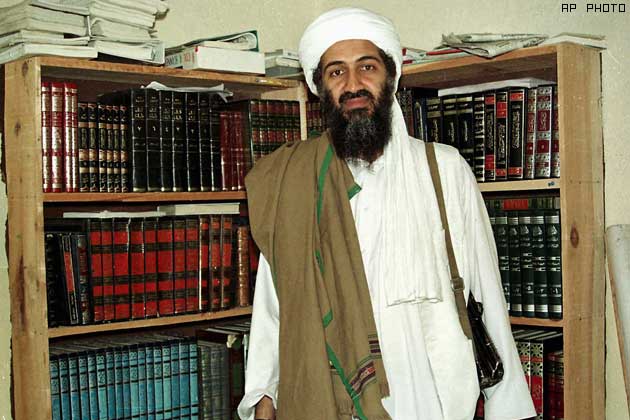
Osama wanted Ilyas Kashmiri to kill Obama

May 4, 2012
osamabinladen6a

Washington, May 4: Osama bin Laden had planned to kill US President Barack Obama and General David Petraeus, who was then top US commander in Afghanistan, and had issued instructions to Ilyas Kashmiri to set up two units to target planes carrying them.

According to the documents seized from the Abbottabad safe-house of bin Laden , the then al-Qaida leader wanted to target only Obama and Petraeus. Some of the documents were released by the Combating Terrorism Center at West Point on Thursday.

"Bin Ladin had asked Atiyya's predecessor, Mustafa Abu al-Yazid , to task Ilyas, presumably Ilyas Kashmiri, to set up two units, one in Pakistan and another in Bagram, Afghanistan , to target airplanes known to be carrying president Obama and/or general Petraeus on their visits to these areas," CTC said in its report.

He explained that the death of Obama would see the "utterly unprepared" Vice President Joe Biden automatically assume the presidency, which would cause the US to enter into crisis mode, and "the killing of Petraeus would have a serious impact on the course of the war" , as bin Ladin considered him to be "the man of this (critical) phase" , CTC said.

Bin Laden did not explain, however, why he did not want "secretary of defense (Robert) Gates or the joint chiefs of staff (Admiral Mike) Mullen or the special envoy to Pakistan and Afghanistan (Richard ) Holbrooke" targeted.

It is possible that bin Laden had prepared a more detailed plan in a previous letter, which might explain why the brief description available reads as an amateurish plot or just wishful thinking, CTC West Point said.

In a letter asking Ilyas to carry out the killings, Osama also said, "It would be good if you coordinate with our brothers of Pakistan and Afghanistan Taliban so that there is complete cooperation between us, and tell them that we started planning work inside America many years ago, and gained experience in that field, and we and they are brothers so we should not fall into the error that hurts the Muslims and benefits the enemy , due to lack of coordination between us."


Comments

Add new comment

  • Coastaldigest.com reserves the right to delete or block any comments.
  • Coastaldigset.com is not responsible for its readers’ comments.
  • Comments that are abusive, incendiary or irrelevant are strictly prohibited.
  • Please use a genuine email ID and provide your name to avoid reject.
News Network
February 9,2020

Beijing, Feb 9: After making sure everyone's face mask is on and sanitizer is to hand, the Qiao family heads out to Jingshan Park, a former royal sanctuary beside the Forbidden City in China's capital Beijing.

Snow has fallen for a second day, a rare event in the city of 21.5 million that would normally bring hundreds of thousands of people out to take photos and play. But the streets are empty and the parks are so quiet the only sound is of birds chirping.

It's not just Beijing. Shanghai, China's financial hub, and other cities in the world's most populous nation have turned into ghost towns after the government extended a holiday and asked residents not to go out because of the coronavirus.

"We know the situation of the coronavirus is severe. But the epicentre is far away, so we think it should be fine here ... It's a God-given chance to enjoy this family moment with snow and without work," said Mr Qiao, who has an 11-year-old daughter.

The epidemic has killed 722 people and infected nearly 32,000 in China as of February 8. More than three-quarters of the cases are in the central Hubei province where the virus originated - more than 1,000 km (620 miles) from Beijing.

Only a few people are brave enough to come out. A security guard at Jingshan Park said there were less than a third of the number of tourists than usual, even with the rare snowfall.

Even at one of the best spots for snapping photos of snowy Beijing just outside the Forbidden City, there's barely a crowd, while the usual tour buses and groups of people speaking different dialects are nowhere to be seen.

"Last year when it snowed, I took a few hours off work to come down here to take a picture and the crowd was several layers deep," said a man in his 30s who gave his surname as Yang. "But this year, I am not at all worried about finding a space to take a photo. The virus is keeping people indoors."

Security guards along Wangfujing street, a popular pedestrianised shopping area in downtown Beijing, said it was normally so crowded during the holiday period that it was hard to move around.

"Look at it now, there are more security guards and street cleaners than tourists!" said one of the guards.

Businesses, including shops, bars and restaurants, have been severely hit by the epidemic as the government has banned mass gatherings and even group meals in an effort to curb the spread of the coronavirus.

"You would have to wait outside for a table on a normal day," said a waitress at a restaurant with more than 50 tables. Just five were taken at the peak lunch hour.

Only a handful of the more than 100 restaurants along Beijing's famous food street, Guijie, were open, and the remaining outlets were wondering how long they can hold out.

Comments

Add new comment

  • Coastaldigest.com reserves the right to delete or block any comments.
  • Coastaldigset.com is not responsible for its readers’ comments.
  • Comments that are abusive, incendiary or irrelevant are strictly prohibited.
  • Please use a genuine email ID and provide your name to avoid reject.
News Network
May 30,2020

May 30: Warning of the tightrope walk ahead as governments battle the coronavirus crisis, Nobel laureate Peter Charles Doherty has expressed concern about densely populated countries such as India relaxing lockdown norms while also describing a complete shutdown as “an economic and social impossibility”.

The Australian immunologist, who cautioned that the number of COVID-19 cases will rise in the coming days, said the earliest time frame for an effective vaccine “going into large numbers of people” is nine to 12 months.

"If all goes well with testing, we could know if some of the candidate vaccines are both safe and effective as early as September/October. Then, rolling a vaccine out will depend on the type of product and how quickly it can be made, put in vials and so forth," Doherty told PTI in an email interview from Melbourne.

The novel coronavirus, he added, does not change fast like influenza and, from what is known so far, “the same vaccine should work everywhere”.

Doherty, who is with the Department of Microbiology and Immunology at the Doherty Institute, University of Melbourne, won the Nobel Prize for Medicine in 1996 for his discovery of how the body’s immune system distinguishes virus-infected cells from normal ones.

Discussing the lockdown, he said, "If it was purely a matter of hard science, everywhere should stay locked down. But that’s pretty much an economic and social impossibility.”

The expectation, he said, is the numbers will rise and limiting spread will depend on people acting responsibly and the capacity for rapid response and extensive contact testing.

“And in a densely populated country like India I think that it will be very difficult," the scientist said.

Several countries, including India, began relaxing lockdown norms in mid-May despite the WHO’s warning about a second wave. India’s lockdown began on March 25 and has since been extended. The fourth phase ends on Sunday.

Asked whether there are any alternatives to a lockdown, the 79-year-old said, "There is no other option other than closing borders. South Korea, for example, conducted massive, intensive testing and contact tracing in a wealthy country with a very disciplined population. Otherwise, not till we have effective vaccines."

He added that he personally doesn’t see the point of closing borders for people coming in if there’s already a high incidence of disease in the community, “unless it’s to avoid the need to care for them and use scarce hospital beds".

According to Doherty, the coronavirus "is a new virus which has come straight out of nature".

“It (the virus) has moved so rapidly across the world because of people travelling on international planes as well as tourist ships," he added.

The immunologist also warned against the use of hydroxychloroquine to treat COVID-19, and said current and planned trials of the anti-malaria drug should be stopped.

“My understanding is that the use of the drug in severe disease is definitely contra-indicated, but it’s not yet clear whether, if taken under medical supervision, it could have some useful effect if taken early on, or as a preventive. Those trials just haven’t been done properly," Doherty noted.

The Indian Council of Medical Research (ICMR) has backed the use of hydroxychloroquine as a preventive against COVID-19 even after the WHO suspended clinical trials of the drug citing safety concerns.

Asked whether plasma therapy can be an effective treatment for COVID-19, Doherty said, "We lack good properly controlled trials but, especially if the plasma has been tested for antibody levels and there’s evidence of good activity, it could be helpful. If I had the disease and was offered plasma therapy I would certainly accept, but I would not take hydroxychloroquine."

Doherty is also very optimistic about herd immunity developing against the SARS-CoV-2 infection.

"We think that (herd immunity) will cut in and have an obvious effect when, say, 60 per cent of people have been infected. Best hope is to boost herd immunity with a vaccine," he stated.

Herd immunity is a form of indirect protection from infectious disease that occurs when a large percentage of a population has become immune to an infection, whether through vaccination or previous infections.

The number of COVID-19 cases have crossed 5.9 million and the fatalities 3,65,000, according to the Johns Hopkins University on Saturday. 

In India, the death toll has risen to 4,971 and the number of cases to 1,73,763, according to the Union Health Ministry on Saturday.

Several states, including Bihar, Uttar Pradesh, Madhya Pradesh, Jharkhand and Chhattisgarh, have reported a rise in number since lockdown norms were relaxed in early May and migrant workers reached home.

In Uttar Pradesh, for instance, the number of infections rose from around 3,000 on May 4 to 6,532 on May 26. Similarly, Bihar’s numbers increased from around 500 to over 2,700 in the period.

Comments

Add new comment

  • Coastaldigest.com reserves the right to delete or block any comments.
  • Coastaldigset.com is not responsible for its readers’ comments.
  • Comments that are abusive, incendiary or irrelevant are strictly prohibited.
  • Please use a genuine email ID and provide your name to avoid reject.
Agencies
March 24,2020

Beijing, Mar 24:  China reported 78 new confirmed cases, including 74 imported infections, while the death toll from the novel coronavirus increased to 3,277 after seven more fatalities were confirmed from the COVID-19, health officials said on Tuesday.

The overall confirmed cases on the Chinese mainland have reached 81,171 by the end of Monday. This included 3,277 people who died of the disease, 4,735 patients who were still being treated and 73,159 patients discharged after recovery, the National Health Commission (NHC) said on Tuesday.

The NHC said, 78 new confirmed COVID-19 cases were reported on the Chinese mainland on Monday, of which 74 were imported from abroad taking the number of overseas cases to 427.

Also on Monday, seven deaths and 35 new suspected cases were reported on the mainland with all the deaths in Hubei Province.

The total COVID-19 cases in Beijing climbed to 522 with eight deaths prompting local governments of Beijing as well as Shanghai to announce that all overseas arrivals will be subjected to nucleic acid tests to ensure proper detection.

Of the 74 newly imported cases, 31 were reported in Beijing, 14 in Guangdong, nine in Shanghai, five in Fujian, four in Tianjin, three in Jiangsu, two in Zhejiang and Sichuan respectively, and one in Shanxi, Liaoning, Shandong and Chongqing respectively, the NHC said.

Beijing is already diverting all international flights to different cities where the passengers will be quarantined for 14 days before arriving in the city.

The NHC said 132 people were still suspected of being infected with the virus.

Coronavirus epicentre Wuhan has reported one confirmed case after a gap of five days prompting officials to begin to ease restrictions.

Wuhan also reported seven new deaths, bringing the total number of deaths in the city and Hubei province for which Wuhan is the capital to 3,160.

The province also saw 444 patients discharged from hospital after recovery on Monday. Among the 4,200 patients being treated in hospital, 1,203 were still in severe condition and another 336 in critical condition, the local health commission said.

By the end of Monday, 356 confirmed cases, including four deaths have been reported in Hong Kong, which has restricted the entry of foreigners into the city. Also a total of 25 confirmed cases were reported in Macao and 195 in Taiwan including two deaths, state-run Xinhua news agency reporrted.

After days of decline in coronavirus cases, China on Monday said that COVID-19 has effectively been "stemmed" in the country and it started easing severe restrictions imposed on Wuhan's 11 million people who were under lockdown since January 23.

The authorities began relaxing restrictions in Wuhan as it reported no new case for the fifth consecutive day on Monday.

Significantly, the Central Leading Group (CLP), headed by Premier Li Keqiang which is coordinating efforts to contain the virus since January 23, said the virus has been curtailed in the country as well as in Wuhan.

"The meeting noted that the spread of the virus nationwide, particularly in the epicentre of Wuhan, has been effectively stemmed," an official statement said on Monday.

The meeting, however, warned that the risks for sporadic infections and localised outbreaks have not gone away. With the pandemic rampaging across the world, the situation remains complex and challenging.

"Wuhan city and Hubei province should stay focused on medical treatment and community-level containment as the two key priorities. They should continue to treat the severe cases, promptly admit new cases, and advance epidemiological investigations," the meeting said.

In Wuhan, officials said people are allowed to go back to work while restrictions on the public transport are gradually being eased.

The Hubei province and its capital Wuhan with over 56 million people were under lockdown since January 23. The vicious virus broke out in city, reportedly at a live animal market in December last year and became virulent inflicting thousands of people in the city and province catching the government off guard.

As the country saw a surge in imported infections, the Chinese government announced that all international flights scheduled to arrive in Beijing will be redirected to airports in 12 other Chinese cities from Monday.

International passengers flying to Beijing will instead land at airports in 12 cities including Shanghai, Tianjin, Nanjing and Shenyang as their first points of entry, the Civil Aviation Administration of China (CAAC) said in a statement.

On Monday, China said international travellers should "think twice" about choosing Beijing for flight transfer in view of the restrictions.

Starting from Monday, all international flights scheduled to arrive in Beijing will be redirected to airports in 12 other Chinese cities, Liu Haitao, an official with China's National Immigration Administration said.

Passengers would go through entry procedures and quarantine measures at the designated cities' airports before they continue their flights to Beijing, Liu said, urging travellers to reserve enough time for their next flights to make sure that they do not miss their outbound flights.


Comments

Add new comment

  • Coastaldigest.com reserves the right to delete or block any comments.
  • Coastaldigset.com is not responsible for its readers’ comments.
  • Comments that are abusive, incendiary or irrelevant are strictly prohibited.
  • Please use a genuine email ID and provide your name to avoid reject.