



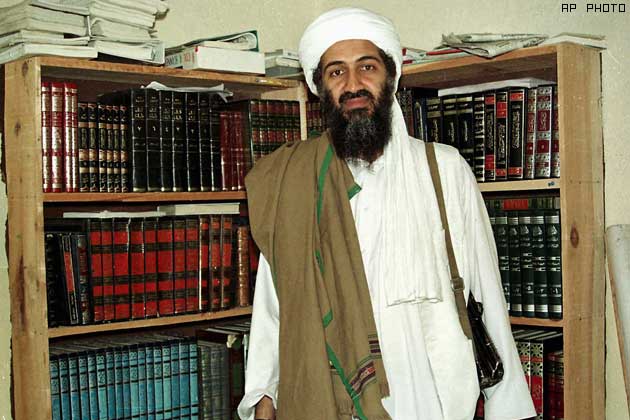
Osama wanted Ilyas Kashmiri to kill Obama

May 4, 2012
osamabinladen6a

Washington, May 4: Osama bin Laden had planned to kill US President Barack Obama and General David Petraeus, who was then top US commander in Afghanistan, and had issued instructions to Ilyas Kashmiri to set up two units to target planes carrying them.

According to the documents seized from the Abbottabad safe-house of bin Laden , the then al-Qaida leader wanted to target only Obama and Petraeus. Some of the documents were released by the Combating Terrorism Center at West Point on Thursday.

"Bin Ladin had asked Atiyya's predecessor, Mustafa Abu al-Yazid , to task Ilyas, presumably Ilyas Kashmiri, to set up two units, one in Pakistan and another in Bagram, Afghanistan , to target airplanes known to be carrying president Obama and/or general Petraeus on their visits to these areas," CTC said in its report.

He explained that the death of Obama would see the "utterly unprepared" Vice President Joe Biden automatically assume the presidency, which would cause the US to enter into crisis mode, and "the killing of Petraeus would have a serious impact on the course of the war" , as bin Ladin considered him to be "the man of this (critical) phase" , CTC said.

Bin Laden did not explain, however, why he did not want "secretary of defense (Robert) Gates or the joint chiefs of staff (Admiral Mike) Mullen or the special envoy to Pakistan and Afghanistan (Richard ) Holbrooke" targeted.

It is possible that bin Laden had prepared a more detailed plan in a previous letter, which might explain why the brief description available reads as an amateurish plot or just wishful thinking, CTC West Point said.

In a letter asking Ilyas to carry out the killings, Osama also said, "It would be good if you coordinate with our brothers of Pakistan and Afghanistan Taliban so that there is complete cooperation between us, and tell them that we started planning work inside America many years ago, and gained experience in that field, and we and they are brothers so we should not fall into the error that hurts the Muslims and benefits the enemy , due to lack of coordination between us."


Comments

Add new comment

  • Coastaldigest.com reserves the right to delete or block any comments.
  • Coastaldigset.com is not responsible for its readers’ comments.
  • Comments that are abusive, incendiary or irrelevant are strictly prohibited.
  • Please use a genuine email ID and provide your name to avoid reject.
Agencies
June 16,2020

Washington, Jun 16: The United States will reduce its troop strength in Germany from the nearly 52,000 at present to 25,000, President Donald Trump has said in Washington.

In an interaction with reporters at the White House on Monday, Trump attributed the move to high costs and Germany being "delinquent" in its payment to NATO.

"We have 52,000 soldiers in Germany. That's a tremendous amount of soldiers. It's a tremendous cost to the United States and Germany, as you know, is very delinquent in their payments to NATO.

"They are paying one per cent and they're supposed to be a two per cent. And then two percent is very low. It should be much more than that. So they are delinquent of billions of dollars," Trump alleged.

"So, we're putting the number down to 25,000 soldiers. We'll see what happens, but Germany has not been making payments. In addition to that, I was the one that brought it up. Everybody talks about Trump with Russia. Well, I brought this up a long time ago. Why is Germany paying Russia billions of dollars for energy and then we're supposed to protect Germany from Russia? How does that work? It doesn't work," the US president said.

US soldiers, he said, are paid well. "They live in Germany. They spend vast amounts of money in Germany. Everywhere around those bases is very prosperous for Germany. So, Germany takes. And then on top of it, they treat us very badly on trade. We have trade with the EU, Germany being the biggest member, and very, very badly on trade and we are negotiating with them on that. But right now, I'm not satisfied with the deal they want to make," Trump said.

"They've cost the United States hundreds of billions of dollars over the years on trade," he said.

The US protects them and then they take advantage of America on trade, the president said.

"So we are working on a deal with them, but it's very unfair and I would say by far, the worst abuser is Germany," he said.

Comments

Add new comment

  • Coastaldigest.com reserves the right to delete or block any comments.
  • Coastaldigset.com is not responsible for its readers’ comments.
  • Comments that are abusive, incendiary or irrelevant are strictly prohibited.
  • Please use a genuine email ID and provide your name to avoid reject.
News Network
June 25,2020

Jun 25: Tencent Holdings Ltd.'s $40 billion surge this week and the recent ascent of Pinduoduo Inc. have reshuffled the ranking of China's richest people.

The country's largest game developer has surpassed Alibaba Group Holding Ltd. as Asia's most-valuable company, with its shares rising above HK$500 in intraday trading Wednesday for the first time. Pinduoduo, a Groupon-like shopping app also known as PDD, has more than doubled this year.

The rallies have propelled the wealth of their founders, with an added twist: Tencent's Pony Ma, worth $50 billion, has surpassed Jack Ma's $48 billion fortune, becoming China's richest person. And Colin Huang of PDD, whose net worth stands at $43 billion, has squeezed real estate mogul Hui Ka Yan of China Evergrande Group out of the top three earlier this year, according to the Bloomberg Billionaires Index.

The coronavirus pandemic has accelerated the digitization of the workplace and changed consumers' habits, boosting shares of many internet companies. Now tech tycoons are dominating the ranks of China's richest people. They occupy four of the top five spots: Ding Lei of Tencent peer NetEase Inc. follows China Evergrande's Hui.

‘Perform Strongly'

Tencent has come a long way since hitting a low in 2018, when China froze the approval process for new games. Since then, the stock has almost doubled, and last month the tech giant reported a 26 per cent jump in first-quarter revenue.

“Tencent's online games segment will probably perform strongly through the Covid-19 pandemic, and most of its other businesses are relatively unscathed,” said Vey-Sern Ling, a Bloomberg Intelligence analyst.

That has been a boon for Pony Ma, 48, who owns a 7 per cent stake in the company and pocketed about $757 million from selling some 14.6 million of his Tencent shares this year, data complied by Bloomberg show.

The native of China's southern Guangdong province studied computer science at Shenzhen University and was a software developer at a supplier of telecom services and products before co-founding Tencent with four others in the late 1990s. At the time, the company focused on instant-messaging services.

It has been a long comeback for Pony Ma. He overtook real estate tycoon Wang Jianlin as China's second-richest person in 2013 and topped Baidu Inc.'s Robin Li as the wealthiest in early 2014. Later that year, Alibaba went public in the U.S., catapulting Jack Ma's fortune.

Bloomberg Intelligence's Ling notes, however, that Tencent's jump this year has lagged behind some internet peers, especially those in e-commerce, games and online entertainment. Just consider: Tencent shares have climbed 31 per cent in 2020, while PDD's American depositary receipts have more than doubled. Alibaba, meanwhile, has advanced just 6.9 per cent.

Comments

Add new comment

  • Coastaldigest.com reserves the right to delete or block any comments.
  • Coastaldigset.com is not responsible for its readers’ comments.
  • Comments that are abusive, incendiary or irrelevant are strictly prohibited.
  • Please use a genuine email ID and provide your name to avoid reject.
News Network
April 12,2020

Apr 12: India and other South Asian countries are likely to record their worst growth performance in four decades this year due to the coronavirus outbreak, the World Bank said on Sunday.

The South Asian region, comprising eight countries, is likely to show economic growth of 1.8 per cent to 2.8 per cent this year, the World Bank said in its South Asia Economic Focus report, well down from the 6.3 per cent it projected six months ago.

India's economy, the region's biggest, is expected to grow 1.5 per cent to 2.8 per cent in the fiscal year that started on April 1. The World Bank has estimated it will grow 4.8 per cent to 5 per cent in the fiscal year that ended on March 31.

"The green shoots of a rebound that were observable at the end of 2019 have been overtaken by the negative impacts of the global crisis," the World Bank report said.

Other than India, the World Bank forecast that Sri Lanka, Nepal, Bhutan and Bangladesh will also see sharp falls in economic growth.

Three other countries - Pakistan, Afghanistan and the Maldives - are expected to fall into recession, the World Bank said in the report, which was based on country-level data available as of April 7.

Measures taken to counter the coronavirus have disrupted supply chains across South Asia, which has recorded more than 13,000 cases so far - still lower than many parts of the world.

India's lockdown of 1.3 billion people has also left millions out of work, disrupted big and small businesses and forced an exodus of migrant workers from the cities to their homes in villages.

In the event of prolonged and broad national lockdowns, the report warned of a worst-case scenario in which the entire region would experience an economic contraction this year.

To minimize short-term economic pain, the Bank called for countries in the region to announce more fiscal and monetary steps to support unemployed migrant workers, as well as debt relief for businesses and individuals.

India has so far unveiled a $23 billion economic plan to offer direct cash transfers to millions of poor people hit by its lockdown. In neighbouring Pakistan, the government has announced a $6 billion plan to support the economy.

"The priority for all South Asian governments is to contain the virus spread and protect their people, especially the poorest who face considerable worse health and economic outcomes," said senior World Bank official Hartwig Schafer.

Comments

Add new comment

  • Coastaldigest.com reserves the right to delete or block any comments.
  • Coastaldigset.com is not responsible for its readers’ comments.
  • Comments that are abusive, incendiary or irrelevant are strictly prohibited.
  • Please use a genuine email ID and provide your name to avoid reject.