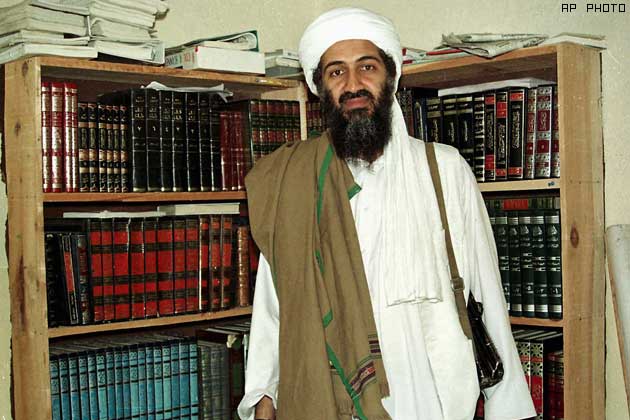
Osama wanted Ilyas Kashmiri to kill Obama

May 4, 2012
osamabinladen6a

Washington, May 4: Osama bin Laden had planned to kill US President Barack Obama and General David Petraeus, who was then top US commander in Afghanistan, and had issued instructions to Ilyas Kashmiri to set up two units to target planes carrying them.

According to the documents seized from the Abbottabad safe-house of bin Laden , the then al-Qaida leader wanted to target only Obama and Petraeus. Some of the documents were released by the Combating Terrorism Center at West Point on Thursday.

"Bin Ladin had asked Atiyya's predecessor, Mustafa Abu al-Yazid , to task Ilyas, presumably Ilyas Kashmiri, to set up two units, one in Pakistan and another in Bagram, Afghanistan , to target airplanes known to be carrying president Obama and/or general Petraeus on their visits to these areas," CTC said in its report.

He explained that the death of Obama would see the "utterly unprepared" Vice President Joe Biden automatically assume the presidency, which would cause the US to enter into crisis mode, and "the killing of Petraeus would have a serious impact on the course of the war" , as bin Ladin considered him to be "the man of this (critical) phase" , CTC said.

Bin Laden did not explain, however, why he did not want "secretary of defense (Robert) Gates or the joint chiefs of staff (Admiral Mike) Mullen or the special envoy to Pakistan and Afghanistan (Richard ) Holbrooke" targeted.

It is possible that bin Laden had prepared a more detailed plan in a previous letter, which might explain why the brief description available reads as an amateurish plot or just wishful thinking, CTC West Point said.

In a letter asking Ilyas to carry out the killings, Osama also said, "It would be good if you coordinate with our brothers of Pakistan and Afghanistan Taliban so that there is complete cooperation between us, and tell them that we started planning work inside America many years ago, and gained experience in that field, and we and they are brothers so we should not fall into the error that hurts the Muslims and benefits the enemy , due to lack of coordination between us."


Comments

Add new comment

  • Coastaldigest.com reserves the right to delete or block any comments.
  • Coastaldigset.com is not responsible for its readers’ comments.
  • Comments that are abusive, incendiary or irrelevant are strictly prohibited.
  • Please use a genuine email ID and provide your name to avoid reject.
News Network
April 11,2020

Apr 11: The number of global coronavirus deaths has increased to 102,753, while the total number of cases worldwide has surpassed 1.6 million, according to the latest update by the Washington-based Johns Hopkins University.

As of Saturday morning, the overall number of infections increased to 1,698,416, while the tally of those who recovered from the deadly disease stood at 376,677, according to the varsity's Center for Systems Science and Engineering (CSSE).

In terms of cases, the US had the highest in the world at 501,301, followed by Spain 158,273, Italy 147,577 and France 125,931.

Italy accounted for the highest death toll at 18,849, with the US in the second place with 18,769 fatalities.

Other countries with more than 10,000 deaths include Spain (16,081) and France (13,197).

Although the pandemic originated in China last December, it now only accounts for 3,343 deaths with 83,003 confirmed cases.

Comments

Add new comment

  • Coastaldigest.com reserves the right to delete or block any comments.
  • Coastaldigset.com is not responsible for its readers’ comments.
  • Comments that are abusive, incendiary or irrelevant are strictly prohibited.
  • Please use a genuine email ID and provide your name to avoid reject.
Agencies
January 20,2020

For the first time in the 15 years of the Global Risks Report, the climate change and environment risk has occupied all the top five slots.

According to the 15th edition of the World Economic Forum's (WEF) Global Risks Report, the top five risks in terms of likelihood are extreme weather, climate action failure, natural disasters, biodiversity loss and human-made environmental disasters. They all fall in the one category of climate change and related environmental disasters.

WEF President Borge Brende said the world was feeling long-mounting and interconnected risks.

The report also points to how citizens are protesting across the world as discontent rises with failed systems that are creating inequality. The citizens' discontent had hardened with systems that had failed to promote advancement, it said.

"Disapproval of how governments are addressing profound economic and social issues has sparked protests throughout the world, potentially weakening the ability of governments to take decisive action should a downturn occur. Without economic and social stability, countries could lack the financial resources, fiscal margin, political capital or social support needed to confront key global risks," it said.

Listing the grim scenario, Borge said the global economy was faced with "synchronised slowdown", the past five years had been the warmest on record and cyber attacks were expected to increase this year.

The report warns that while the myriad risks were rising, time was running out on how to prevent them.

Borge said the growing palpability of shared economic, environmental and societal risks indicated that the horizon had shortened for preventing "or even mitigating" some of the direst consequences of global risks.

"It's sobering that in the face of this development, when the challenges before us demand immediate collective action, fractures within the global community appear to only be widening," he said.

The report points to grave concern about the consequences of continued environmental degradation, including the record pace of species decline.

Pointing to an unsettled geopolitical environment, the report said today's risk landscape was one in which new centres of power and influence were forming and old alliance structures and global institutions were being tested.

"While these changes can create openings for new partnership structures in the immediate term, they are putting stress on systems of coordination and challenging norms around shared responsibility. Unless stakeholders adapt multilateral mechanisms for this turbulent period, the risks that were once on the horizon will continue to arrive," it said.

Calling it a "an unsettled world", the WEF report notes that powerful economic, demographic and technological forces were shaping a new balance of power. "The result is an unsettled geopolitical landscape in which states are increasingly viewing opportunities and challenges through unilateral lenses," it said.

"What were once givens regarding alliance structures and multilateral systems no longer hold as states question the value of long-standing frameworks, adopt more nationalist postures in pursuit of individual agendas and weigh the potential geopolitical consequences of economic decoupling. Beyond the risk of conflict, if stakeholders concentrate on immediate geo-strategic advantage and fail to re-imagine or adapt mechanisms for coordination during this unsettled period, opportunities for action on key priorities may slip away," the WEF said.

In a chapter on risks to economic stability and social cohesion, it said a challenging economic climate might persist this year and members of the multi-stakeholder community saw "economic confrontations" and "domestic political polarisation" as the top risks in 2020.

The report also warned of downward pressure on the global economy from macroeconomic fragilities and financial inequality. These pressures continued to intensify in 2019, increasing the risk of economic stagnation.

Low trade barriers, fiscal prudence and strong global investment, once seen as fundamentals for economic growth, are fraying as leaders advance nationalist policies. The margins for monetary and fiscal stimuli are also narrower than before the 2008-2009 financial crisis, creating uncertainty about how well countercyclical policies will work.

The strategic partners for the WEF report included Marsh & McLennan and Zurich Insurance Group. The academic advisers were National University of Singapore, Oxford Martin School, University of Oxford and Wharton Risk Management and Decision Processes Center, University of Pennsylvania.


Comments

Add new comment

  • Coastaldigest.com reserves the right to delete or block any comments.
  • Coastaldigset.com is not responsible for its readers’ comments.
  • Comments that are abusive, incendiary or irrelevant are strictly prohibited.
  • Please use a genuine email ID and provide your name to avoid reject.
Agencies
May 17,2020

Washington, May 17: The overall number of global coronavirus cases has increased to over 4.6 million, while the death toll has surpassed 311,000, according to the Johns Hopkins University.

As of Sunday morning, the total number of cases stood at 4,634,068, while the death toll increased to 311,781, the University's Center for Systems Science and Engineering (CSSE) revealed in its latest update.

The US currently accounts for the world's highest number of cases and deaths at 1,467,796 and 88,754, respectively.

In terms of cases, Russia has the second highest number of infections at 272,043, followed by the UK (241,461), Brazil (233,142), Spain (230,698), Italy (224,760), France (179,630), Germany (175,752), Turkey (148,067) and Iran (118,392), the CSSE figures showed.

Meanwhile, the UK accounted for the second highest COVID-19 deaths worldwide at 34,546.

The other countries with over 10,000 deaths are Italy (31,763), Spain (27,563), France (27,532), and Brazil (15,662).

Comments

Add new comment

  • Coastaldigest.com reserves the right to delete or block any comments.
  • Coastaldigset.com is not responsible for its readers’ comments.
  • Comments that are abusive, incendiary or irrelevant are strictly prohibited.
  • Please use a genuine email ID and provide your name to avoid reject.