


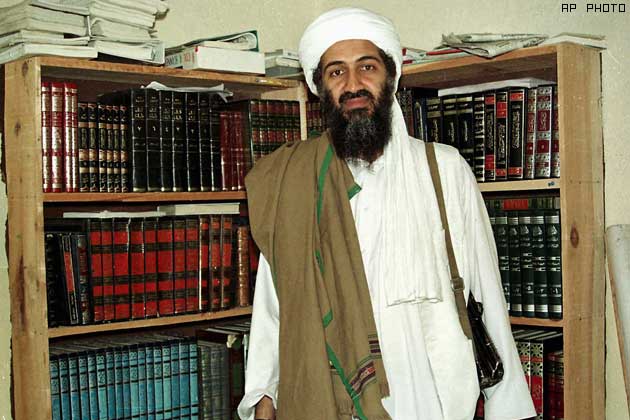
Osama wanted Ilyas Kashmiri to kill Obama

May 4, 2012
osamabinladen6a

Washington, May 4: Osama bin Laden had planned to kill US President Barack Obama and General David Petraeus, who was then top US commander in Afghanistan, and had issued instructions to Ilyas Kashmiri to set up two units to target planes carrying them.

According to the documents seized from the Abbottabad safe-house of bin Laden , the then al-Qaida leader wanted to target only Obama and Petraeus. Some of the documents were released by the Combating Terrorism Center at West Point on Thursday.

"Bin Ladin had asked Atiyya's predecessor, Mustafa Abu al-Yazid , to task Ilyas, presumably Ilyas Kashmiri, to set up two units, one in Pakistan and another in Bagram, Afghanistan , to target airplanes known to be carrying president Obama and/or general Petraeus on their visits to these areas," CTC said in its report.

He explained that the death of Obama would see the "utterly unprepared" Vice President Joe Biden automatically assume the presidency, which would cause the US to enter into crisis mode, and "the killing of Petraeus would have a serious impact on the course of the war" , as bin Ladin considered him to be "the man of this (critical) phase" , CTC said.

Bin Laden did not explain, however, why he did not want "secretary of defense (Robert) Gates or the joint chiefs of staff (Admiral Mike) Mullen or the special envoy to Pakistan and Afghanistan (Richard ) Holbrooke" targeted.

It is possible that bin Laden had prepared a more detailed plan in a previous letter, which might explain why the brief description available reads as an amateurish plot or just wishful thinking, CTC West Point said.

In a letter asking Ilyas to carry out the killings, Osama also said, "It would be good if you coordinate with our brothers of Pakistan and Afghanistan Taliban so that there is complete cooperation between us, and tell them that we started planning work inside America many years ago, and gained experience in that field, and we and they are brothers so we should not fall into the error that hurts the Muslims and benefits the enemy , due to lack of coordination between us."


Comments

Add new comment

  • Coastaldigest.com reserves the right to delete or block any comments.
  • Coastaldigset.com is not responsible for its readers’ comments.
  • Comments that are abusive, incendiary or irrelevant are strictly prohibited.
  • Please use a genuine email ID and provide your name to avoid reject.
Agencies
June 9,2020

Wuhan, Jun 9: China on Tuesday dismissed as "incredibly ridiculous" a Harvard study, which pointed to a surge in traffic outside Wuhan hospitals from August 2019 suggesting that the coronavirus hit the area far earlier than reported.

A whitepaper on coronavirus released by China on Sunday said the virus was first noticed on December 17 and Chinese virologists confirmed human-to-human transmission on January 19, prompting authorities to impose lockdown of Wuhan from January 23.

US President Donald Trump and leaders of several countries have accused China of not being transparent in reporting the deadly disease, leading to huge human casualties and economic crisis across the world.

The new study by Harvard researchers says satellite images show an increase in traffic outside five hospitals in Wuhan from late August to December.

The traffic spike coincided with a rise in online searches for information on symptoms like "cough" and "diarrhoea".

China said the study was "ridiculous" and based on "superficial" information, BBC reported.

It is believed that the virus first appeared in China some time in November. Authorities reported a cluster of pneumonia cases with an unknown cause to the World Health Organization (WHO) on December 31.

"Clearly, there was some level of social disruption taking place well before what was previously identified as the start of the novel coronavirus pandemic," Dr John Brownstein, who led the research, told ABC news.

The study has not been peer-reviewed.

The researchers examined commercial satellite data from outside five Wuhan hospitals, comparing data from late summer and autumn 2018 to the same time period in 2019.

In one case, researchers counted 171 cars parked at one of Wuhan''s largest hospitals, Tianyou Hospital, in October 2018.

Satellite data from the same time in 2019 showed 285 vehicles in the same place, an increase of 67 per cent.

A surge in online searches for words associated with the symptoms of coronavirus on the Chinese search engine Baidu seemed to emerge at the same time.

"This is all about a growing body of information pointing to something taking place in Wuhan at the time," Dr Brownstein said.

"Many studies are still needed to fully uncover what took place and for people to really learn about how these disease outbreaks unfold and emerge in populations. So this is just another point of evidence," he said.

Asked for her reaction at the media briefing, Chinese Foreign Ministry spokeswoman Hua Chunying dismissed the findings as "incredibly ridiculous".

"I think it is ridiculous, incredibly ridiculous, to come up with this conclusion based on superficial observations such as traffic volume," she said.

"(I have) Not seen the research you mentioned. If the conclusion is drawn based on traffic volumes (and) other superficial observations, it won’t be a sound conclusion," she said and referred to the allegations about the COVID-19 originating from the Wuhan Institute of Virology (WIV) by Trump.

"That allegation was proved to be wrong," she said.

When pointed out that China says it respects science based inquiry and Harvard is one of the top universities in the world, Hua said, "on the origin of virus there are lot of conspiracy theories against China”.

"That is very unfair. At the moment, the pressing task is to enhance coordination to contain the spread of the virus. Someday, I am sure the truth will be out. China deserves a fair and objective evaluation," she said and referred to the whitepaper released by the Chinese government detailing evolution of coronavirus in Wuhan and how Beijing handled the situation.

Recently, the World Health Assembly (WHA), the decision-making body of Geneva-based World Health Organization (WHO), passed a resolution to probe the origin of the virus. China also backed the resolution.

As of Monday, the overall confirmed cases on the mainland had reached 83,043, including 58 patients who were still being treated, with no one in severe condition, China’s National Health Commission, (NHC) said.

Altogether 78,351 people had been discharged after recovery and 4,634 people had died of the disease, it said.

Comments

Add new comment

  • Coastaldigest.com reserves the right to delete or block any comments.
  • Coastaldigset.com is not responsible for its readers’ comments.
  • Comments that are abusive, incendiary or irrelevant are strictly prohibited.
  • Please use a genuine email ID and provide your name to avoid reject.
News Network
May 3,2020

London, May 3: The British government had a contingency plan for prime minister Boris Johnson’s death as his condition deteriorated while he battled COVID-19 last month in intensive care, Johnson said in an interview with The Sun newspaper.

Johnson returned to work on Monday, a month after testing positive for COVID-19. Johnson, 55, spent 10 days in isolation in Downing Street from late March, but was then was taken to London’s St Thomas’ Hospital where he received oxygen treatment and spent three nights in intensive care.

“They had a strategy to deal with a ‘death of Stalin’-type scenario,” Johnson, 55, was quoted as saying by The Sun. “It was a tough old moment, I won’t deny it.”

After Johnson was discharged, St Thomas’ said it was glad to have cared for the prime minister, but the hospital has given no details about the gravity of his illness beyond stating that he was treated in intensive care.

Johnson and his fiancée, Carrie Symonds, on Saturday announced the name of their newly born son as Wilfred Lawrie Nicholas, partly as a tribute to two of the intensive care doctors who they said had saved Johnson’s life.

“The doctors had all sorts of arrangements for what to do if things went badly wrong,” Johnson said of his COVID-19 battle. “The bloody indicators kept going in the wrong direction.”

He said doctors discussed invasive ventilation.

“The bad moment came when it was 50-50 whether they were going to have to put a tube down my windpipe,” he said. “That was when it got a bit . . . they were starting to think about how to handle it presentationally.”

Comments

Add new comment

  • Coastaldigest.com reserves the right to delete or block any comments.
  • Coastaldigset.com is not responsible for its readers’ comments.
  • Comments that are abusive, incendiary or irrelevant are strictly prohibited.
  • Please use a genuine email ID and provide your name to avoid reject.
News Network
February 9,2020

Beijing, Feb 9: After making sure everyone's face mask is on and sanitizer is to hand, the Qiao family heads out to Jingshan Park, a former royal sanctuary beside the Forbidden City in China's capital Beijing.

Snow has fallen for a second day, a rare event in the city of 21.5 million that would normally bring hundreds of thousands of people out to take photos and play. But the streets are empty and the parks are so quiet the only sound is of birds chirping.

It's not just Beijing. Shanghai, China's financial hub, and other cities in the world's most populous nation have turned into ghost towns after the government extended a holiday and asked residents not to go out because of the coronavirus.

"We know the situation of the coronavirus is severe. But the epicentre is far away, so we think it should be fine here ... It's a God-given chance to enjoy this family moment with snow and without work," said Mr Qiao, who has an 11-year-old daughter.

The epidemic has killed 722 people and infected nearly 32,000 in China as of February 8. More than three-quarters of the cases are in the central Hubei province where the virus originated - more than 1,000 km (620 miles) from Beijing.

Only a few people are brave enough to come out. A security guard at Jingshan Park said there were less than a third of the number of tourists than usual, even with the rare snowfall.

Even at one of the best spots for snapping photos of snowy Beijing just outside the Forbidden City, there's barely a crowd, while the usual tour buses and groups of people speaking different dialects are nowhere to be seen.

"Last year when it snowed, I took a few hours off work to come down here to take a picture and the crowd was several layers deep," said a man in his 30s who gave his surname as Yang. "But this year, I am not at all worried about finding a space to take a photo. The virus is keeping people indoors."

Security guards along Wangfujing street, a popular pedestrianised shopping area in downtown Beijing, said it was normally so crowded during the holiday period that it was hard to move around.

"Look at it now, there are more security guards and street cleaners than tourists!" said one of the guards.

Businesses, including shops, bars and restaurants, have been severely hit by the epidemic as the government has banned mass gatherings and even group meals in an effort to curb the spread of the coronavirus.

"You would have to wait outside for a table on a normal day," said a waitress at a restaurant with more than 50 tables. Just five were taken at the peak lunch hour.

Only a handful of the more than 100 restaurants along Beijing's famous food street, Guijie, were open, and the remaining outlets were wondering how long they can hold out.

Comments

Add new comment

  • Coastaldigest.com reserves the right to delete or block any comments.
  • Coastaldigset.com is not responsible for its readers’ comments.
  • Comments that are abusive, incendiary or irrelevant are strictly prohibited.
  • Please use a genuine email ID and provide your name to avoid reject.