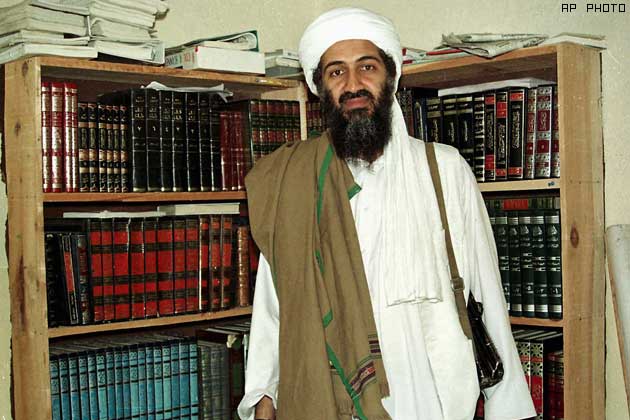
Osama wanted Ilyas Kashmiri to kill Obama

May 4, 2012
osamabinladen6a

Washington, May 4: Osama bin Laden had planned to kill US President Barack Obama and General David Petraeus, who was then top US commander in Afghanistan, and had issued instructions to Ilyas Kashmiri to set up two units to target planes carrying them.

According to the documents seized from the Abbottabad safe-house of bin Laden , the then al-Qaida leader wanted to target only Obama and Petraeus. Some of the documents were released by the Combating Terrorism Center at West Point on Thursday.

"Bin Ladin had asked Atiyya's predecessor, Mustafa Abu al-Yazid , to task Ilyas, presumably Ilyas Kashmiri, to set up two units, one in Pakistan and another in Bagram, Afghanistan , to target airplanes known to be carrying president Obama and/or general Petraeus on their visits to these areas," CTC said in its report.

He explained that the death of Obama would see the "utterly unprepared" Vice President Joe Biden automatically assume the presidency, which would cause the US to enter into crisis mode, and "the killing of Petraeus would have a serious impact on the course of the war" , as bin Ladin considered him to be "the man of this (critical) phase" , CTC said.

Bin Laden did not explain, however, why he did not want "secretary of defense (Robert) Gates or the joint chiefs of staff (Admiral Mike) Mullen or the special envoy to Pakistan and Afghanistan (Richard ) Holbrooke" targeted.

It is possible that bin Laden had prepared a more detailed plan in a previous letter, which might explain why the brief description available reads as an amateurish plot or just wishful thinking, CTC West Point said.

In a letter asking Ilyas to carry out the killings, Osama also said, "It would be good if you coordinate with our brothers of Pakistan and Afghanistan Taliban so that there is complete cooperation between us, and tell them that we started planning work inside America many years ago, and gained experience in that field, and we and they are brothers so we should not fall into the error that hurts the Muslims and benefits the enemy , due to lack of coordination between us."


Comments

Add new comment

  • Coastaldigest.com reserves the right to delete or block any comments.
  • Coastaldigset.com is not responsible for its readers’ comments.
  • Comments that are abusive, incendiary or irrelevant are strictly prohibited.
  • Please use a genuine email ID and provide your name to avoid reject.
Agencies
July 2,2020

Moscow, Jul 2: Russian voters approved changes to the constitution that will allow President Vladimir Putin to hold power until 2036, but the weeklong plebiscite that concluded Wednesday was tarnished by widespread reports of pressure on voters and other irregularities.

With most of the nation's polls closed and 20% of precincts counted, 72% voted for the constitutional amendments, according to election officials.

For the first time in Russia, polls were kept open for a week to bolster turnout without increasing crowds casting ballots amid the coronavirus pandemic a provision that Kremlin critics denounced as an extra tool to manipulate the outcome.

A massive propaganda campaign and the opposition's failure to mount a coordinated challenge helped Putin get the result he wanted, but the plebiscite could end up eroding his position because of the unconventional methods used to boost participation and the dubious legal basis for the balloting.

By the time polls closed in Moscow and most other parts of Western Russia, the overall turnout was at 65%, according to election officials. In some regions, almost 90% of eligible voters cast ballots.

On Russia's easternmost Chukchi Peninsula, nine hours ahead of Moscow, officials quickly announced full preliminary results showing 80% of voters supported the amendments, and in other parts of the Far East, they said over 70% of voters backed the changes.

Kremlin critics and independent election observers questioned the turnout figures.

We look at neighboring regions, and anomalies are obvious there are regions where the turnout is artificially (boosted), there are regions where it is more or less real, Grigory Melkonyants, co-chair of the independent election monitoring group Golos, told The Associated Press.

Putin voted at a Moscow polling station, dutifully showing his passport to the election worker. His face was uncovered, unlike most of the other voters who were offered free masks at the entrance.

The vote completes a convoluted saga that began in January, when Putin first proposed the constitutional changes.

He offered to broaden the powers of parliament and redistribute authority among the branches of government, stoking speculation he might seek to become parliamentary speaker or chairman of the State Council when his presidential term ends in 2024.

His intentions became clear only hours before a vote in parliament, when legislator Valentina Tereshkova, a Soviet-era cosmonaut who was the first woman in space in 1963, proposed letting him run two more times.

The amendments, which also emphasize the primacy of Russian law over international norms, outlaw same-sex marriages and mention a belief in God as a core value, were quickly passed by the Kremlin-controlled legislature.

Putin, who has been in power for more than two decades longer than any other Kremlin leader since Soviet dictator Josef Stalin said he would decide later whether to run again in 2024.

He argued that resetting the term count was necessary to keep his lieutenants focused on their work instead of darting their eyes in search for possible successors.

Analyst Gleb Pavlovsky, a former Kremlin political consultant, said Putin's push to hold the vote despite the fact that Russia has thousands of new coronavirus infections each day reflected his potential vulnerabilities.

Putin lacks confidence in his inner circle and he's worried about the future, Pavlovsky said.

He wants an irrefutable proof of public support.

Even though the parliament's approval was enough to make it law, the 67-year-old Russian president put his constitutional plan to voters to showcase his broad support and add a democratic veneer to the changes.

But then the coronavirus pandemic engulfed Russia, forcing him to postpone the April 22 plebiscite.

The delay made Putin's campaign blitz lose momentum and left his constitutional reform plan hanging as the damage from the virus mounted and public discontent grew.

Plummeting incomes and rising unemployment during the outbreak have dented his approval ratings, which sank to 59%, the lowest level since he came to power, according to the Levada Center, Russia's top independent pollster.

Moscow-based political analyst Ekaterina Schulmann said the Kremlin had faced a difficult dilemma: Holding the vote sooner would have brought accusations of jeopardizing public health for political ends, while delaying it raised the risks of defeat.

Holding it in the autumn would have been too risky, she said.

In Moscow, several activists briefly lay on Red Square, forming the number 2036 with their bodies in protest before police stopped them.

Some others in Moscow and St. Petersburg staged one-person pickets and police didn't intervene.

Several hundred opposition supporters rallied in central Moscow to protest the changes, defying a ban on public gatherings imposed for the coronavirus outbreak. Police didn't intervene and even handed masks to the participants.

Authorities mounted a sweeping effort to persuade teachers, doctors, workers at public sector enterprises and others who are paid by the state to cast ballots. Reports surfaced from across the vast country of managers coercing people to vote.

The Kremlin has used other tactics to boost turnout and support for the amendments.

Comments

Add new comment

  • Coastaldigest.com reserves the right to delete or block any comments.
  • Coastaldigset.com is not responsible for its readers’ comments.
  • Comments that are abusive, incendiary or irrelevant are strictly prohibited.
  • Please use a genuine email ID and provide your name to avoid reject.
Agencies
August 4,2020

Washington, Aug 4: US President Donald Trump gave popular Chinese-owned video app TikTok six weeks to sell its US operations to an American company, saying Monday it would be "out of business" otherwise, and that the government wanted a financial benefit from the deal.

"It's got to be an American company... it's got to be owned here," Trump said. "We don't want to have any problem with security."

Trump said that Microsoft was in talks to buy TikTok, which has as many as one billion worldwide users who make quirky 60-second videos with its smartphone app.

But US officials say the app constitutes a national security risk because it could share millions of Americans' personal data with Chinese intelligence.

Trump gave the company's Chinese parent ByteDance until mid-September to strike a deal.

"I set a date of around September 15, at which point it's going to be out of business in the United States," he said.

Whatever the price is, he said, "the United States should get a very large percentage of that price because we're making it possible."

Trump compared the demand for a piece of the pie to a landlord demanding under-the-table "key money" from a new tenant, a practice widely illegal including in New York, where the billionaire president built his real estate empire.

"TikTok is a big success, but a big portion of it is in the country," he said. "I think it's very fair."

But Trump also threw a surprise new condition in any deal, saying the sale of TikTok's US business would have to result in a significant payout to the US Treasury for initiating it.

"A very substantial portion of that price is going to have to come into the Treasury of the United States, because we're making it possible for this deal to happen," Trump told reporters.

"They don't have any rights unless we give it to them," he said.

Sell or shut down

The pressure for a sale of TikTok's US and international business, based in Los Angeles, left the company and ByteDance facing tough decisions.

Trump has made TikTok the latest front in the ongoing political and trade battles between Washington and Beijing.

The app has been under formal investigation on US national security grounds because it collects large amounts of personal data on all its users and is legally bound to share that with authorities in Beijing if they demand it.

Both its huge user base and its algorithm for collecting data make it hugely valuable.

But being forced by the US government to sell at least its US business or be shut down -- and to then split the sale price with the US Treasury as Trump is demanding -- was an almost unheard-of tactic.

Shutting down could force users to switch to competitors, and many content creators are already encouraging followers to follow them on other social media platforms.

"The most obvious beneficiaries are Snapchat, Facebook and Twitter, with Snapchat likely being the biggest beneficiary," said investment analysts at Lightshed Partners.

Earlier Monday, ByteDance founder Zhang Yiming acknowledged the hefty pressure and said in a letter to staff, reported by Chinese media, that they were working around-the-clock "for the best outcome."

"We have always been committed to ensuring user data security, as well as the platform neutrality and transparency," Zhang said.

However, he said, the company faces "mounting complexities across the geopolitical landscape and significant external pressure."

He said the company must confront the challenge from the United States, though "without giving up exploring any possibilities."

According to Britain's The Sun newspaper Monday, as a possible consequence of the pressure, ByteDance is planning to relocate TikTok's global operations to Britain.

Pushing back

China's foreign ministry pushed back Monday, calling Washington hypocritical for demanding TikTok be sold.

"The US is using an abused concept of national security and, without providing any evidence, is making presumptions of guilt and issuing threats to relevant companies," said spokesman Wang Wenbin.

"This goes against the principle of market economy and exposes the hypocrisy and typical double standards of the US in upholding so-called fairness and freedom," he added.

stm88 info live rtp slot

slot auto scatter hitam

Comments

Add new comment

  • Coastaldigest.com reserves the right to delete or block any comments.
  • Coastaldigset.com is not responsible for its readers’ comments.
  • Comments that are abusive, incendiary or irrelevant are strictly prohibited.
  • Please use a genuine email ID and provide your name to avoid reject.
News Network
April 26,2020

Apr 26: The Chinese city of Wuhan, where the global coronavirus pandemic began, now has no remaining cases in its hospitals, a health official told reporters on Sunday.

"The latest news is that by April 26, the number of new coronavirus patients in Wuhan was at zero, thanks to the joint efforts of Wuhan and medical staff from around the country," National Health Commission spokesman Mi Feng said at a briefing.

The city had reported 46,452 cases, 56% of the national total. It saw 3,869 fatalities, or 84% of China's total.

Comments

Add new comment

  • Coastaldigest.com reserves the right to delete or block any comments.
  • Coastaldigset.com is not responsible for its readers’ comments.
  • Comments that are abusive, incendiary or irrelevant are strictly prohibited.
  • Please use a genuine email ID and provide your name to avoid reject.