


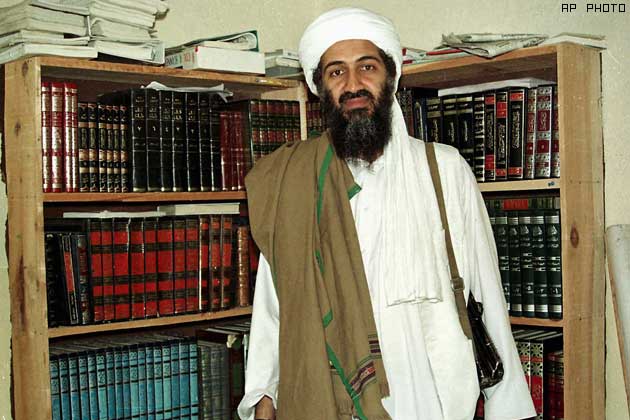
Osama wanted Ilyas Kashmiri to kill Obama

May 4, 2012
osamabinladen6a

Washington, May 4: Osama bin Laden had planned to kill US President Barack Obama and General David Petraeus, who was then top US commander in Afghanistan, and had issued instructions to Ilyas Kashmiri to set up two units to target planes carrying them.

According to the documents seized from the Abbottabad safe-house of bin Laden , the then al-Qaida leader wanted to target only Obama and Petraeus. Some of the documents were released by the Combating Terrorism Center at West Point on Thursday.

"Bin Ladin had asked Atiyya's predecessor, Mustafa Abu al-Yazid , to task Ilyas, presumably Ilyas Kashmiri, to set up two units, one in Pakistan and another in Bagram, Afghanistan , to target airplanes known to be carrying president Obama and/or general Petraeus on their visits to these areas," CTC said in its report.

He explained that the death of Obama would see the "utterly unprepared" Vice President Joe Biden automatically assume the presidency, which would cause the US to enter into crisis mode, and "the killing of Petraeus would have a serious impact on the course of the war" , as bin Ladin considered him to be "the man of this (critical) phase" , CTC said.

Bin Laden did not explain, however, why he did not want "secretary of defense (Robert) Gates or the joint chiefs of staff (Admiral Mike) Mullen or the special envoy to Pakistan and Afghanistan (Richard ) Holbrooke" targeted.

It is possible that bin Laden had prepared a more detailed plan in a previous letter, which might explain why the brief description available reads as an amateurish plot or just wishful thinking, CTC West Point said.

In a letter asking Ilyas to carry out the killings, Osama also said, "It would be good if you coordinate with our brothers of Pakistan and Afghanistan Taliban so that there is complete cooperation between us, and tell them that we started planning work inside America many years ago, and gained experience in that field, and we and they are brothers so we should not fall into the error that hurts the Muslims and benefits the enemy , due to lack of coordination between us."


Comments

Add new comment

  • Coastaldigest.com reserves the right to delete or block any comments.
  • Coastaldigset.com is not responsible for its readers’ comments.
  • Comments that are abusive, incendiary or irrelevant are strictly prohibited.
  • Please use a genuine email ID and provide your name to avoid reject.
News Network
May 20,2020

May 20: The novel coronavirus is behaving differently in patients in northeast China who have contracted it recently compared with early cases, indicating it is changing as it spreads, a prominent doctor said.

China, which has largely brought the virus under control, has found new clusters of infections in the northeastern border provinces of Jilin and Heilongjiang in recent weeks, raising concern about a second wave.

Qiu Haibo, an expert in critical care medicine who is part of a National Health Commission expert group, said the incubation period of the virus in patients in the northeast was longer than that of patients in Wuhan, the central city, where the virus emerged late last year.

COVID-19 Pandemic Tracker: 15 countries with the highest number of coronavirus cases, deaths

"This causes a problem, as they don't have any symptoms. So when they gather with their families they don't care about this issue and we see family cluster infections," Qiu told state broadcaster CCTV in a programme broadcast late on Tuesday.

Patients in the northeastern clusters were also carrying the virus for longer than earlier cases in Wuhan, and they were taking longer to recover, as defined by a negative nucleic acid test, he said.

Patients in the northeast also rarely exhibited fever and tended to suffer damage to the lungs rather than across multiple organs, he said.

He said the virus found in the northeastern clusters was probably imported from abroad, which could account for the differences.

He did not say where he though they might have come from but both Jilin and Heilongjiang border Russia.

China reported five new coronavirus cases on Wednesday, down from six a day earlier.

Four of the new cases were local transmissions and one was imported by a traveller coming from abroad, the commission said in a statement, compared with three imported cases reported the previous day.

China's total number of coronavirus infections stands at 82,965, while the death toll 4,634. 

Comments

Add new comment

  • Coastaldigest.com reserves the right to delete or block any comments.
  • Coastaldigset.com is not responsible for its readers’ comments.
  • Comments that are abusive, incendiary or irrelevant are strictly prohibited.
  • Please use a genuine email ID and provide your name to avoid reject.
News Network
July 3,2020

Jul 3: China under President Xi Jinping has stepped up its "aggressive" foreign policy toward India and "resisted" efforts to clarify the Line of Actual Control that prevented a lasting peace from being realised, according to a report released by a US Congress appointed commission.

The armies of India and China have been locked in a bitter standoff at multiple locations in eastern Ladakh for the last seven weeks, and the tension escalated after 20 Indian soldiers were killed in a violent clash in the Galwan Valley on June 15.

“Under General Secretary of the Chinese Communist Party (CCP) Xi Jinping, Beijing has stepped up its aggressive foreign policy toward New Delhi. Since 2013, China has engaged in five major altercations with India along the Line of Actual Control (LAC),” said a brief issued by US-China Economic and Security Review Commission.

"Beijing and New Delhi have signed a series of agreements and committed to confidence-building measures to stabilise their border, but China has resisted efforts to clarify the LAC, preventing a lasting peace from being realised,” said the report and was prepared at the request of the Commission to support its deliberations.

Authored by Will Green, a Policy Analyst on the Security and Foreign Affairs Team at the Commission, the report says that the Chinese government is particularly fearful of India’s growing relationship with the United States and its allies and partners.

“The latest border clash is part of a broader pattern in which Beijing seeks to warn New Delhi against aligning with Washington,” it said.

After Xi assumed power in 2012, there was a significant increase in clashes, despite the fact that he met Prime Minister Narendra Modi several times and Beijing and New Delhi have agreed to a series of confidence-building mechanisms designed to mitigate tensions.

Prior to 2013, the last major border clash was in 1987. The 1950s and 1960s were a particularly tense period, culminating in 1962 with a war that left thousands of soldiers dead on both sides, according to the records of China's People's Liberation Army, the report said.

“The 2020 skirmish is in line with Beijing’s increasingly assertive foreign policy. The clash came as Beijing was aggressively pressing its other expansive sovereignty claims in the Indo-Pacific region, such as over Taiwan and in the South and East China seas,” it said.

China is engaged in hotly contested territorial disputes in both the South China Sea and the East China Sea. Beijing has built up and militarised many of the islands and reefs it controls in the region. Both areas are stated to be rich in minerals, oil and other natural resources and are vital to global trade.

China claims almost all of the South China Sea. Vietnam, the Philippines, Malaysia, Brunei and Taiwan have counter claims over the area.

Several weeks before the clash in the Galwan Valley, Chinese Defence Minister Wei Fenghe called on Beijing to “use fighting to promote stability” as the country’s external security environment worsened, a potential indication of China’s intent to proactively initiate military tensions with its neighbours to project an image of strength, the report said.

Comments

Add new comment

  • Coastaldigest.com reserves the right to delete or block any comments.
  • Coastaldigset.com is not responsible for its readers’ comments.
  • Comments that are abusive, incendiary or irrelevant are strictly prohibited.
  • Please use a genuine email ID and provide your name to avoid reject.
Agencies
July 13,2020

New Delhi, Jul 13: Google CEO Sundar Pichai on Monday announced an investment of Rs 75,000 crore or approximately US$10 billion into India over the next five to seven years through 'Google for India Digistation Fund'.

This move is significant as it comes in the middle of the COVID-19 pandemic and as multinational companies across the world look at alternative investment destinations.

"Excited to announce Google for India Digitisation Fund. Through it, we will invest Rs 75,000 crore or approx US$10 Billon into India over the next 5-7 yrs. We'll do this through a mix of equity investments, partnerships and operational infrastructure in ecosystem investments," said Pichai.

Pichai along with Union Minister Ravi Shankar Prasad virtually attended the sixth annual edition of Google for India.

"This is a reflection of our confidence in the future of India and its digital economy," said Pichai.
He added that the investments will focus on four areas important to India's digitisation.

Listing out the areas, Pichai elaborated, "First enabling affordable access and information to every Indian in their own language. Second, building new products and services that are deeply relevant to India's unique needs. Third, empowering businesses as they continue or embark on the digital transformation. Fourth, leveraging technology in AI for social good in areas like health, education and agriculture."

"When I was young, every piece of technology brought new opportunities to learn and grow but I always had to wait for it to arrive from some places. Today people in India no more have to wait for technology to come to you. A whole new generation of technologies is happening in India first," said Pichai.

Earlier today Prime Minister Narendra Modi interacted with Pichai and discussed a range of subjects like a new work culture in coronavirus times, data security and cyber safety.

Comments

Add new comment

  • Coastaldigest.com reserves the right to delete or block any comments.
  • Coastaldigset.com is not responsible for its readers’ comments.
  • Comments that are abusive, incendiary or irrelevant are strictly prohibited.
  • Please use a genuine email ID and provide your name to avoid reject.