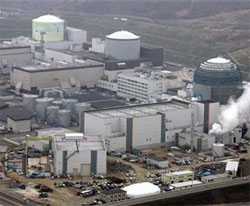
Japan nuclear power-free as last reactor shuts

May 5, 2012

japan

Tokyo, May 5: Japanese utility Hokkaido Electric Power Co began shutting the country's last active nuclear reactor on Saturday, leaving the world's third-biggest user of atomic energy with no nuclear-derived electricity for the first time since 1970.

A crisis at Tokyo Electric Power's Fukushima Daiichi nuclear plant, where an earthquake and tsunami in March last year triggered radiation leaks, has hammered public faith in nuclear power and prevented the restart of reactors shut down for regular maintenance checks.

Hokkaido Electric said it started lowering output from the 912-megawatt No.3 unit at Tomari nuclear plant in northern Japan at 5 p. m. (0800 GMT).

The maintenance on the unit is set to begin at around 11 p.m. (1400 GMT) when power generation falls to zero, with the unit to be shut down completely by the early hours of Sunday.

The shutdown means all of Japan's 50 reactors have been taken off line, marking the country's first nuclear power-free day since May 1970.

Trade Minister Yukio Edano and three other ministers have been trying to win the support of communities to reactivate two idled reactors at Kansai Electric Power's Ohi nuclear plant to help ease expected power shortages of nearly 20 percent in coming hot-weather months.

The two Ohi reactors are the first to be considered for reactivation by the central government, but it faces an uphill battle of winning public support.

Kansai Electric's expected deficit for this summer was the highest among four Japanese nuclear plant operators that forecast shortfalls when demand peaks in the summer.

The last time Japan was nuclear power-free was for five days to May 4, 1970, when the two reactors then existing were shut for maintenance, according to the Federation of Electric Power Companies of Japan.


Comments

Add new comment

  • Coastaldigest.com reserves the right to delete or block any comments.
  • Coastaldigset.com is not responsible for its readers’ comments.
  • Comments that are abusive, incendiary or irrelevant are strictly prohibited.
  • Please use a genuine email ID and provide your name to avoid reject.
News Network
April 12,2020

Washington, Apr 12: The US has overtaken Italy as the country with the highest number of deaths due to COVID-19 pandemic with the fatalities crossing 20,000, according to Johns Hopkins University data, as the novel coronavirus continues to wreak havoc across the globe.

The deadly coronavirus, that originated in China in December last year, has so far killed more than one lakh people across the globe. The United States on Saturday became the country with the highest number of deaths at 20,597, surpassing Italy's 19,468 fatalities.

More than 5.3 lakh Americans have tested positive for coronavirus, which is about the same for the next four countries put together: Spain (163,027), Italy (152,271), Germany (125,452) and France (93,790). In terms of fatalities, the US and Italy are followed by Spain (16,606), France (13832) and United Kingdom (9,875), the varsity data showed.

New York City, the financial capital of the world, has emerged as the epicenter of coronavirus in the world. A city of 8.3 million, which is one of the most densely populated cities in the US, by Saturday night had as many as 8,627 deaths and more than 180,000 people had tested positive for COVID-19.

President Donald Trump has declared a national emergency and all the 50 States have been notified with major disaster declaration. More than 95 per cent of the country's 330 million population are under stay-at-home order. Trump has deployed more than 50,000 personnel from the armed forces in fight against COVID-19.

After an initial two-week social mitigation measures, that includes social distancing, the measures have been extended till April 30. Initially, members of the White House Task Force on Coronavirus had projected between one and two lakhs deaths. Now, they have dropped the projection to 60,000 deaths, mainly due to the successful implementation of these measures.

"The people of our country have gone through a lot. But we did it the right way. And we look like we'll be coming in on the very, very low side, really below the lowest, the lowest side of the curve of death," Trump told Fox News on Saturday night.

Trump asserted that situation was improving in places like New York, where there is a drop in new patients. Responding to a question, he said he wanted the country to open up as soon as possible.

However, he has not taken a decision so far, even as some media reports said that he the President was looking for early May.

"I think it's going to be the toughest decision that I've ever made. I really, hopefully that I ever will have to make. But it's certainly the toughest decision that I've ever made. I hope that I'm going to make the right decision," Trump said, adding that he will be making a decision reasonably soon.

"We're setting up a council now of some of the most distinguished leaders in virtually every field including politics and business and medical. We'll be making that decision fairly soon," Trump said.

Meanwhile, The New York Times reported that its investigations have revealed that the president was warned about a potential pandemic but that internal divisions, lack of planning and his faith in his own instincts led to a halting response.

According to The Washington Post, coronavirus is killing about one in 10 hospitalised middle-aged patients and four in 10 older than 85 in the United States. It is particularly lethal to men even when taking into account common chronic diseases that exacerbate risk.

Globally, the novel coronavirus has killed 108,862 people and infected over 1.7 million people globally. The US has the highest number of infections at 529,887, according to Johns Hopkins University data.

Comments

Add new comment

  • Coastaldigest.com reserves the right to delete or block any comments.
  • Coastaldigset.com is not responsible for its readers’ comments.
  • Comments that are abusive, incendiary or irrelevant are strictly prohibited.
  • Please use a genuine email ID and provide your name to avoid reject.
News Network
May 9,2020

Beijing, May 9: Mounting a strong defence of the ruling Communist Party of China, President Xi Jinping has said the COVID-19 fight has once again shown that the CPC leadership and the country's socialist political system can overcome any challenge.

Xi's comments came as China faced global criticism for its initial inaction to act against the novel coronavirus, which according to Chinese officials emerged in the central Chinese city of Wuhan in December last year.

Pressure is also mounting on Beijing to agree for an international probe on the origins of the vicious virus, including from the Wuhan Institute of Virology (WIV), as claimed by the US leadership.

China curbed the spread of the coronavirus in over a month and brought COVID-19 under control at its first epicentre in Wuhan in about three months, Xi, also the General Secretary of the CPC, said at a symposium held on Friday to get suggestions from non-ruling Communist Party of China (CPC) parties on COVID-19 prevention and control.

He termed the curbing of the COVID-19 pandemic as "hard-won achievements" for the world's most populous country and the second-biggest economy.

The COVID-19 fight has once again shown that the CPC leadership, China's socialist system and its governance system can overcome any challenge and make big contributions to the progress of human civilisation, he said.

Xi said China had basically curbed the spread of the virus in over one month, managed to bring the daily number of new domestically-transmitted cases down to single digits in about two months, and secured decisive achievements in protecting epicentres Wuhan and Hubei province in about three months.

"For a huge country with 1.4 billion people, these are hard-won achievements," he said

Besides the top CPC officials, the symposium was attended by members of the central committees of non-CPC parties in China, the All-China Federation of Industry and Commerce, and persons without party affiliation.

The speakers at the symposium praised the Chinese leadership in handling the crisis, saying it fully demonstrated the political advantage of China's socialist system and showed that China was a major responsible country.

Xi, who is also the head of the People's Liberation Army, praised China's one-party political system governed by the CPC.

His comments on the country's political system came as Beijing is also defending the role of the CPC as US President Donald Trump and Secretary of State Mike Pompeo have blamed the ruling party for not being transparent in the fight against the pandemic.

Both Trump and Pompeo have been pressing Beijing to allow American experts for a probe on whether the virus emerged from the WIV, China's premier research lab where viruses of different types are reportedly researched.

At the symposium attended by the top CPC officials, Xi's leadership came for praise for successfully handling the situation, the state-run Xinhua news agency reported.

"Attendees noted the major strategic achievements in the COVID-19 fight under the strong leadership of the CPC Central Committee with Comrade Xi Jinping at the core," the report said.

The meeting was held amid reports of murmurs of internal criticism within the CPC about Xi's handling of the coronavirus crisis.

While China's move of handling the coronavirus from January 23 by locking down Hubei province and its capital Wuhan to prevent the spread of the virus and curbing it by deploying 42000 medical personnel has been praised, Beijing is criticised for its slow reaction after it emerged in December last year.

China used less than a week to identify the full genome sequence of the novel coronavirus and isolate the virus strain, produced various testing kits and swiftly selected a number of effective drugs and treatments. Different types of vaccines have also entered clinical trials.

President Xi said during the COVID-19 fight, China upheld the centralised and unified leadership of the CPC and concentrated the nation's best doctors, the most advanced equipment and the most needed resources to treat patients, with all treatment expenses covered by the state.

It managed to maximise the testing and cure rates while minimising the infection and fatality rates.

As of Friday, the COVID-19 death toll in China remained at 4,633 with no new fatalities reported for several days while the total number of cases stood at 82,887. In contrast, Chinese officials point out the death toll in the US which has crossed 75,000 with over 1.2 million cases, besides the mounting global toll.

Almost all countries in the world have been under lockdown for weeks to control the spread of the virus.

Xi called for mobilising the whole society, leveraging the institutional strength of concentrating resources to get things done and tapping the composite national strength as well as closely relying on science and technology.

On international cooperation, Xi said China had helped countries and international organisations to the best of its ability, demonstrating the nation's sense of responsibility as a major and responsible country.

Xi also stressed fixing the shortcomings in the country's major epidemic prevention and control mechanism and for the national public health system to raise the ability to deal with major public health emergencies.

He emphasised on targeted and effective measures to guard against the importation of cases and prevent a resurgence of the epidemic.

Comments

Add new comment

  • Coastaldigest.com reserves the right to delete or block any comments.
  • Coastaldigset.com is not responsible for its readers’ comments.
  • Comments that are abusive, incendiary or irrelevant are strictly prohibited.
  • Please use a genuine email ID and provide your name to avoid reject.
News Network
March 28,2020

Berlin, Mar 28: The number of confirmed coronavirus infections worldwide topped 600,000 on Saturday as new cases stacked up quickly in Europe and the United States and officials dug in for a long fight against the pandemic.

The latest landmark came only two days after the world passed half a million infections, according to a tally by John Hopkins University, showing that much work remains to be done to slow the spread of the virus. It showed more than 602,000 cases and a total of over 27,000 deaths.

While the U.S. now leads the world in reported infections — with more than 104,000 cases — five countries exceed its roughly 1,700 deaths: Italy, Spain, China, Iran and France.

“We cannot completely prevent infections at this stage, but we can and must in the immediate future achieve fewer new infections per day, a slower spread,” German Chancellor Angela Merkel, who is in quarantine at home after her doctor tested positive for the virus, told her compatriots in an audio message. “That will decide whether our health system can stand up to the virus.”

The virus already has put health systems in Italy, Spain and France under extreme strain. Lockdowns of varying severity have been introduced across Europe. Merkel's chief of staff, Helge Braun, said that Germany — where authorities closed nonessential shops and banned gatherings of more than two in public — won't relax its restrictions before April 20.

As the epicenter has shifted westward, the situation has calmed in China, where some restrictions on people's lives have now been lifted. Six subway lines restored limited service in Wuhan, where the virus first emerged in December, after the city had its official coronavirus risk evaluation downgraded from high to medium on Friday. Five districts of the city of 11 million people had other restrictions on travel loosened after their risk factor was downgraded to low.

For most people, the coronavirus causes mild or moderate symptoms, such as fever and cough that clear up in two to three weeks. But for others, especially older adults and people with existing health problems, the virus can cause more severe illness, including pneumonia, and lead to death.

More than 130,000 people have recovered, according to Johns Hopkins' tally.

In one way or another, the effects of the COVID-19 outbreak have been felt by the powerful and the poor alike.

On Friday, British Prime Minister Boris Johnson became the first leader of a major country to test positive for the virus. He said he would continue to work from self-quarantine.

Countries are still scrambling bring home some citizens stranded abroad by border closures and a near-shutdown of flights. On Saturday, 174 foreign tourists and four Nepali nationals on the foothills of Mount Everest were flown out days after being stranded on the only airstrip serving the world's highest mountain.

In neighboring India, authorities sent a fleet of buses to the outskirts of the capital to meet an exodus of migrant workers desperately trying to reach their home villages during the world's largest lockdown.

Thousands of people, mostly young male day laborers but also families, had fled their New Delhi homes after Prime Minister Narendra Modi announced a 21-day lockdown that began on Wednesday and effectively put millions of Indians who live off daily earnings out of work.

In a possibly hopeful sign, the U.S. Food and Drug Administration cleared a new rapid test from Abbott Laboratories, which the company says can detect the coronavirus in about 5 minutes. Medical device maker Abbott announced the emergency clearance of its cartridge-based test Friday night, saying the test delivers a negative result in 13 minutes when the virus is not detected.

While New York remained the worst-hit city in the U.S., Americans braced for worsening conditions elsewhere, with worrisome infection numbers being reported in New Orleans, Chicago and Detroit.

New Orleans’ sprawling Ernest N. Morial Convention Center, along the Mississippi River, was being converted into a massive hospital as officials prepared for thousands more patients than they could accommodate.

In New York, where there are more than 44,000 cases statewide, the number of people hospitalized with COVID-19 passed 6,000 on Friday, double what it had been three days earlier.

Gov. Andrew Cuomo called for 4,000 more temporary beds across New York City, where the Jacob K. Javits Convention Center has already been converted into a hospital.

The struggle to defeat the virus will take “weeks and weeks and weeks,” Cuomo told members of the National Guard working at the Javits Center.

President Donald Trump invoked the Defense Production Act on Friday, ordering General Motors to begin manufacturing ventilators. Trump had previously rejected Cuomo's pleas for tens of thousands more of the machines and the governor's calls to implement the Korean War-era production law.

Trump signed a $2.2 trillion stimulus package, after the House approved the sweeping measure by voice vote. Lawmakers in both parties lined up behind the law to send checks to millions of Americans, boost unemployment benefits, help businesses and toss a life preserver to an overwhelmed health care system.

Dr. John Brooks of the U.S. Centers for Disease Control and Prevention warned Americans remained “in the acceleration phase” of the pandemic and that all corners of the country were at risk.

"There is no geographic part of the United States that is spared from this," he said.

Comments

Add new comment

  • Coastaldigest.com reserves the right to delete or block any comments.
  • Coastaldigset.com is not responsible for its readers’ comments.
  • Comments that are abusive, incendiary or irrelevant are strictly prohibited.
  • Please use a genuine email ID and provide your name to avoid reject.