



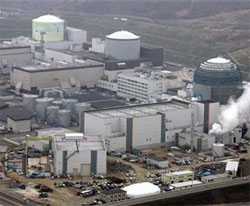
Japan nuclear power-free as last reactor shuts

May 5, 2012

japan

Tokyo, May 5: Japanese utility Hokkaido Electric Power Co began shutting the country's last active nuclear reactor on Saturday, leaving the world's third-biggest user of atomic energy with no nuclear-derived electricity for the first time since 1970.

A crisis at Tokyo Electric Power's Fukushima Daiichi nuclear plant, where an earthquake and tsunami in March last year triggered radiation leaks, has hammered public faith in nuclear power and prevented the restart of reactors shut down for regular maintenance checks.

Hokkaido Electric said it started lowering output from the 912-megawatt No.3 unit at Tomari nuclear plant in northern Japan at 5 p. m. (0800 GMT).

The maintenance on the unit is set to begin at around 11 p.m. (1400 GMT) when power generation falls to zero, with the unit to be shut down completely by the early hours of Sunday.

The shutdown means all of Japan's 50 reactors have been taken off line, marking the country's first nuclear power-free day since May 1970.

Trade Minister Yukio Edano and three other ministers have been trying to win the support of communities to reactivate two idled reactors at Kansai Electric Power's Ohi nuclear plant to help ease expected power shortages of nearly 20 percent in coming hot-weather months.

The two Ohi reactors are the first to be considered for reactivation by the central government, but it faces an uphill battle of winning public support.

Kansai Electric's expected deficit for this summer was the highest among four Japanese nuclear plant operators that forecast shortfalls when demand peaks in the summer.

The last time Japan was nuclear power-free was for five days to May 4, 1970, when the two reactors then existing were shut for maintenance, according to the Federation of Electric Power Companies of Japan.


Comments

Add new comment

  • Coastaldigest.com reserves the right to delete or block any comments.
  • Coastaldigset.com is not responsible for its readers’ comments.
  • Comments that are abusive, incendiary or irrelevant are strictly prohibited.
  • Please use a genuine email ID and provide your name to avoid reject.
News Network
March 24,2020

New Delhi, Mar 24: Reports of a person in China dying due to a virus called hantavirus have spread panic at a time when the world is battling the pandemic of novel coronavirus, which began in China.

The novel coronavirus has killed over 16,000 people around the world and the outbreak is yet to be brought under control.

This morning, hantavirus became one of the top trends on Twitter after the Chinese state media tweeted about one person in the country dying due the virus. However, it turns out, hantavirus is not a new virus and has been infecting humans for decades.

Global Times, a state-run English-language newspaper, wrote on Twitter on Tuesday, "A person from Yunnan Province died while on his way back to Shandong Province for work on a chartered bus on Monday. He was tested positive for hantavirus. Other 32 people on bus were tested."

Global Times's hantavirus report on Twitter has been shared over 6,000 times.

On Tuesday, hantavirus was one of the top trends on Twitter.

WHAT IS HANTAVIRUS?

Some people are calling it a new virus but so is not the case. United States's National Center for Biotechnology Information (NCBI) in a journal writes that currently, the hantavirus genus includes more than 21 species.

"Hantaviruses in the Americas are known as 'New World' hantaviruses and may cause hantavirus pulmonary syndrome [HPS]," CDC says. "Other hantaviruses, known as 'Old World' hantaviruses, are found mostly in Europe and Asia and may cause hemorrhagic fever with renal syndrome [HFRS]."

Any man, woman, or child who is around mice or rats that carry harmful hantaviruses can get HPS.

People get HPS when they breath in hantaviruses. This can happen when rodent urine and droppings that contain a hantavirus are stirred up into the air. People can also become infected when they touch mouse or rat urine, droppings, or nesting materials that contain the virus and then touch their eyes, nose, or mouth. They can also get HPS from a mouse or rat bite.

In the US, 10 confirmed cases of hantavirus infection in people who visited Yosemite National Park in California, US, in November 2012, were reported. Similarly, in 2017, CDC assisted health officials in investigating an outbreak of Seoul virus infection that infected 17 people in seven states.

WHAT ARE THE SYMPTOMS OF HANTAVIRUS?

If people get HPS, they will feel sick one to five weeks after they were around mice or rats that carried a hantavirus.

At first people with HPS will have:

Fever
Severe muscle aches
Fatigue

After a few days, they will have a hard time breathing. Sometimes people will have headaches, dizziness, chills, nausea, vomiting, diarrhoea, and stomach pain.

Usually, people do not have a runny nose, sore throat, or a rash.

Comments

Add new comment

  • Coastaldigest.com reserves the right to delete or block any comments.
  • Coastaldigset.com is not responsible for its readers’ comments.
  • Comments that are abusive, incendiary or irrelevant are strictly prohibited.
  • Please use a genuine email ID and provide your name to avoid reject.
Agencies
May 6,2020

Italian researchers have claimed that they have successfully developed a vaccine to contain coronavirus (COVID-19) which is likely to work on humans, a report said.

Luigi Aurisicchio, CEO of Takis, the firm developing the medication, said that a coronavirus candidate vaccine has neutralised the virus in human cells for the first time, the Arab News reported.

"This is the most advanced stage of testing of a candidate vaccine created in Italy. Human tests are expected after this summer," Aurisicchio was quoted as saying to Italian news agency ANSA.

"According to the Spallanzani Hospital, as far as we know we are the first in the world so far to have demonstrated neutralisation of the coronavirus by a vaccine. We expect this to happen in humans too," he added.

The researchers experimented with the vaccine on mice that had successfully developed antibodies that blocked the virus from infecting the cells. They further observed that the five vaccine candidates generated a large number of antibodies, and selected two with the best results.

All of the vaccine candidates currently being developed are based on the genetic material of DNA protein "spike", the molecular tip used by the coronavirus to enter human cells.

They are injected with the so-called "electroporation" technique, which consists of an intramuscular injection followed by a brief electrical impulse, helping the vaccine break into the cells and activating the immune system, the report said.

Researchers believe that this makes their vaccine particularly effective for generating functional antibodies against the "spike" protein, in particular in the lung cells, which are the most vulnerable to coronavirus.

"We are working hard for a vaccine coming from Italian research, with an all-Italian and innovative technology, tested in Italy and made available to everyone," Aurisicchio was quoted by the Arab News report.

"In order to reach this goal, we need the support of national and international institutions and partners who may help us speed up the process," he noted.

The total number of COVID-19 infections, fatalities and recoveries since the pandemic began has risen to 213,013 in the country.

Comments

Add new comment

  • Coastaldigest.com reserves the right to delete or block any comments.
  • Coastaldigset.com is not responsible for its readers’ comments.
  • Comments that are abusive, incendiary or irrelevant are strictly prohibited.
  • Please use a genuine email ID and provide your name to avoid reject.
News Network
February 3,2020

Beijing, Feb 3: The first batch of patients arrived on Monday at a specialised hospital built in just 10 days as part of China's intensive efforts to fight a new virus.

Huoshenshan Hospital and a second facility with 1,500 beds that's due to open this week were built by construction crews who are working around the clock in Wuhan, the city in central China where the outbreak was first detected in December.

The Wuhan treatment centres mark the second time Chinese leaders have responded to a new disease by building specialised hospitals almost overnight. As severe acute respiratory syndrome, or SARS, spread in 2003, a facility in Beijing for patients with that viral disease was constructed in a week.

The first batch of patients arrived at the Huoshenshan Hospital at 10 am on Monday, according to state media. The reports gave no details of the patients' identities or conditions.

The ruling Communist Party's military wing, the People's Liberation Army, sent 1,400 doctors, nurses and other personnel to staff the Wuhan hospital, the official Xinhua News Agency said. The government said earlier some have experience fighting SARS and other outbreaks.

Authorities have cut most road, rail and air access to Wuhan and surrounding cities, isolating some 50 million people, in efforts to contain the viral outbreak that has sickened more than 17,000 and killed more than 360 people.

The Huoshenshan Hospital was built by a 7,000-member crew of carpenters, plumbers, electricians and other specialists, according to the Xinhua News Agency.               Photos in state media showed workers in winter clothing, safety helmets and the surgical-style masks worn by millions of Chinese in an attempt to avoid contracting the virus.

About half of the two-storey, 600,000-square-foot building is isolation wards, according to the government newspaper Yangtze Daily. It has 30 intensive care units.

Doctors can talk with outside experts over a video system that links them to Beijing's PLA General Hospital, according to the Yangtze Daily. It said the system was installed in less than 12 hours by a 20-member "commando team" from Wuhan Telecom Ltd.

The building has specialised ventilation systems and double-sided cabinets that connect patient rooms to hallways and allow hospital staff to deliver supplies without entering the rooms.

The hospital received a donation of "medical robots" from a Chinese company for use in delivering medicines and carrying test samples, according to the Shanghai newspaper The Paper.

In other cities, the government has designated hospitals to handle cases of the new virus.

In Beijing, the Xiaotangshan Hospital built in 2003 for SARS is being renovated by construction workers. The government has yet to say whether it might be used for patients with the new disease.

Comments

Add new comment

  • Coastaldigest.com reserves the right to delete or block any comments.
  • Coastaldigset.com is not responsible for its readers’ comments.
  • Comments that are abusive, incendiary or irrelevant are strictly prohibited.
  • Please use a genuine email ID and provide your name to avoid reject.