


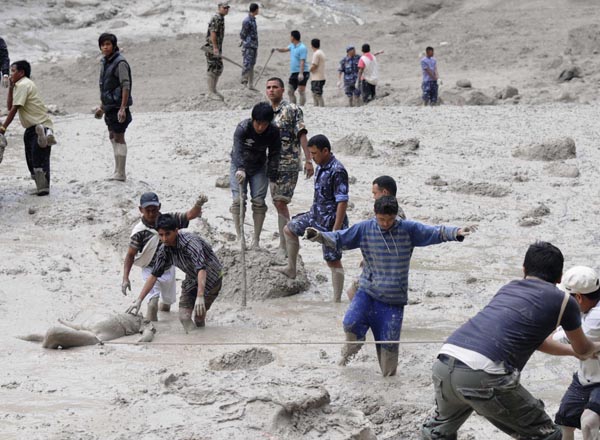
13 killed, 60 missing in glacial lake burst in Nepal

May 6, 2012

NEPAL

Kathmandu, May 6 : A glacial lake burst on Saturday in the high Himalayan region in northwestern Nepal sweeping away houses, farms, cattles near the tourist resort of Pokhara, killing at least 13 people and leaving 60 missing, including three foreign trekkers.

The lake waters flooded the Seti river in the remote Kaski district, 300-km away from capital Kathmandu, sweeping away parts of Sardikhola village located on the foothills of the famous Machapuchare peak.

The army and police officials said so far 13 bodies have been recovered from the banks of the swollen river. “The waters have risen so high that they are touching bridges,” they said.

Official said though the bodies were badly scarred and swollen, most of them appeared to be of local villages.

Army spokesman Ramindra Chhetri said army helicopters and rescue teams had been rushed to the spot and five people buried under deluge were rescued. He said the fury of the river waters had also swept away trucks and buses.

Fast-flowing floodwaters from the swollen Seti River smashed into two buildings and a number of shacks in Kharapani village, in the shadow of Mt Annapurna.

Though incidents of glacial Himalayan lake burst have been reported from parts of Tibet in China, this is the first such major tragedy in Nepal.

Nepalese experts have warned of such catastrophic happenings triggered by climatic change and melting glaciers.

Chhetri said sixty people were still missing, including three Russian tourists who were part of a trekking team. The names of the Russians were immediately known.

The flooded region is a major draw for foreign trekkers as the area has three more than 8,000 metre peaks, including Annapurna, Dhaulagiri and Nilgiri, but as the trekking season is yet pick up, the number of mountaineering teams is less in number.

Prime Minister Baburam Bhattarai has ordered the authorities to conduct the rescue operation without any delay.

He is monitoring the incident and is in touch with the authorities in Pokhara.


Comments

Add new comment

  • Coastaldigest.com reserves the right to delete or block any comments.
  • Coastaldigset.com is not responsible for its readers’ comments.
  • Comments that are abusive, incendiary or irrelevant are strictly prohibited.
  • Please use a genuine email ID and provide your name to avoid reject.
Agencies
March 31,2020

Months after the outbreak of COVID-19 in Wuhan city of central China, families of those deceased, who contracted the contagious infection, stood in long queues at funeral homes demanding to receive the cremated ashes of their loved ones.

Now this has spurred questions about the actual tally of COVID-19 related casualties in Wuhan, in a renewed pressure on the Chinese government that is already struggling to control its containment narrative of the pandemic spread.

Chinese media outlet Caixin showed how trucks carrying 2,500 urns with the ashes of the deceased COVID-19 cases were being shipped in a funeral home last week. Another picture published revealed how 3,500 urns were stacked within these funeral homes. It is therefore unclear how many urns have been filled in.

According to media reports, workers at several funeral parlors declined to provide any details as to how many urns were waiting to be collected, saying they either did not know or were not authorised to share the number.

Some families said they had been forced to wait for several hours to pick up the ashes. The photos circulated as mass deaths from the virus spiked in cities across the west, including Milan, Madrid and New York, where hospitals were erecting tents to handle the overflow as global infections soar past 500,000, with 24,000 dead.

According to Chinese government figures, 2,535 people in Wuhan have died of the virus. The announcement that a lockdown in place since January would be lifted came after the country said its tally of new cases had hit zero and stepped up diplomatic outreach to other countries hard hit by the virus, sending some of them medical supplies.

But some in China have been skeptical of the accuracy of the official tally, particularly given Wuhan's overwhelmed medical system, authorities' attempts to cover up the outbreak in its initial stages, and multiple revisions to the way official cases are counted.

Residents on social media have demanded disciplinary action against top Wuhan officials.

Many people who died had Covid-19 symptoms, but weren't tested and excluded from the official case tally, Caixin said. There were also patients who died of other diseases due to a lack of proper treatment when hospitals were overwhelmed dealing with those who had the coronavirus.

There were 56,007 cremations in Wuhan in the fourth quarter of 2019, according to data from the city's civil affairs agency. The number of cremations was 1,583 higher than those in the fourth quarter of 2018 and 2,231 higher than the fourth quarter of 2017.

Two locals in Wuhan who have lost family members to the virus said online that they were informed they had to be accompanied by their employers or officials from neighborhood committees when picking up the urns, likely as a measure against public gatherings.

COVID-19 is affecting 199 countries and territories around the world. Over 664,000 coronavirus cases have been registered globally out of which 30,890 have succumbed to the infection.

Comments

Add new comment

  • Coastaldigest.com reserves the right to delete or block any comments.
  • Coastaldigset.com is not responsible for its readers’ comments.
  • Comments that are abusive, incendiary or irrelevant are strictly prohibited.
  • Please use a genuine email ID and provide your name to avoid reject.
News Network
February 12,2020

Saint Martin's Island, Feb 12: At least 15 women and children drowned and more than 50 others were missing after a boat overloaded with Rohingya refugees sank off southern Bangladesh as it tried to reach Malaysia Tuesday, officials said.

Some 138 people -- mainly women and children -- were packed on a trawler barely 13 metres (40 feet) long, trying to cross the Bay of Bengal, a coast guard spokesman told news agency.

"It sank because of overloading. The boat was meant to carry maximum 50 people. The boat was also loaded with some cargo," another coast guard spokesman, Hamidul Islam, added.

Nearly one million Rohingya live in squalid camps near Bangladesh's border with Myanmar, many fleeing the neighbouring country after a 2017 brutal military crackdown.

With few opportunities for jobs and education in the camps, thousands have tried to reach other countries like Malaysia and Thailand by attempting the hazardous 2,000-kilometre journey.

In the latest incident, 71 people have been rescued including 46 women. Among the dead, 11 were women and the rest children.

Anwara Begum said two of her sons, aged six and seven, drowned in the tragedy.

"We were four of us in the boat... Another child (son, aged 10) is very sick," the 40-year-old told news agency.

Fishermen tipped off the coast guard after they saw survivors swimming and crying for help in the sea.

The boat's keel hit undersea coral in shallow water off Saint Martin's Island, Bangladesh's southernmost territory, before it sank, survivors said.

"We swam in the sea before boats came and rescued us," said survivor Mohammad Hossain, 20.

Coast guard commander Sohel Rana said three survivors, including a Bangladeshi, were detained over human trafficking allegations.

An estimated 25,000 Rohingya left Bangladesh and Myanmar on boats in 2015 trying to get to Thailand, Malaysia and Indonesia. Hundreds drowned when overloaded boats sank.

Begum said her family paid a Bangladeshi trafficker $450 per head to be taken to Malaysia.

"We're first taken to a hill where we stayed for five days. Then they used three small trawlers to take us to a large trawler, which sank," she said.

Shakirul Islam, a migration expert whose group works with Rohingya to raise awareness against trafficking, said desperation in the camps was making refugees want to leave.

"It was a tragedy waiting to happen," he said.

"They just want to get out, and fall victim to traffickers who are very active in the camps."

Islam said in the past two months dozens of Rohingya reported approaches from traffickers to his OKUP migration rights group.

"Human smuggling and trafficking in the Bay of Bengal is particularly difficult to address as it requires concerted effort from multiple states," the Bangladesh head of UN agency the International Organization for Migration, Giorgi Gigauri, told news agency.

"The gaps in coordination are easily exploited by criminal networks."

Since last year, Bangladeshi authorities have picked up over 500 Rohingya from rickety fishing trawlers or coastal villages as they waited to board boats.

Trafficking often increases during the November-March period when the sea is safest for the small trawlers used by traffickers.

Bangladesh and Myanmar signed a repatriation deal to send back some Rohingya to their homeland, but none have agreed to return because of safety fears.

The charity Save the Children called on Myanmar to "take all necessary steps to ensure the Rohingya community can return to their homes in a safe and dignified manner".

"The tragic drowning of women and children... should be a wake-up call for us all," the group's Athena Rayburn said in a statement.

Comments

Add new comment

  • Coastaldigest.com reserves the right to delete or block any comments.
  • Coastaldigset.com is not responsible for its readers’ comments.
  • Comments that are abusive, incendiary or irrelevant are strictly prohibited.
  • Please use a genuine email ID and provide your name to avoid reject.
News Network
May 25,2020

Karachi, May 25: The pilot of the Pakistan International Airlines (PIA)'s crashed plane ignored three warnings from the air traffic controllers about the aircraft's altitude and speed before the landing, saying he was satisfied and would handle the situation, according to a report on Monday.

The national flag carrier's PK-8303 tragedy on Friday, in which 97 people were killed and two miraculously survived, is one of the most catastrophic aviation disasters in the country's history.

The Airbus A-320 from Lahore to Karachi was 15 nautical miles from the Jinnah International Airport, flying at an altitude of 10,000 feet above the ground instead of 7,000 when the Air Traffic Control (ATC) issued its first warning to lower the plane's altitude, Geo News quoted an ATC report as saying.

Instead of lowering the altitude, the pilot responded by saying that he was satisfied. When only 10 nautical miles were left till the airport, the plane was at an altitude of 7,000 feet instead of 3,000 feet, it said.

The ATC issued a second warning to the pilot to lower the plane's altitude. However, the pilot responded again by stating that he was satisfied and would handle the situation, saying he was ready for landing, the report said.

The report said that the plane had enough fuel to fly for two hours and 34 minutes, while its total flying time was recorded at one hour and 33 minutes.

Pakistani investigators are trying to find out if the crash is attributable to a pilot error or a technical glitch.

According to a report prepared by the country's Civil Aviation Authority (CAA), the plane's engines had scraped the runway thrice on the pilot's first attempt to land, causing friction and sparks recorded by the experts.

When the aircraft scraped the ground on the first failed attempt at landing, the engine's oil tank and fuel pump may have been damaged and started to leak, preventing the pilot from achieving the required thrust and speed to raise the aircraft to safety, the report said.

The pilot made a decision "on his own" to undertake a "go-around" after he failed to land the first time. It was only during the go-around that the ATC was informed that landing gear was not deploying, it said.

"The pilot was directed by the air traffic controller to take the aircraft to 3,000 feet, but he managed only 1,800. When the cockpit was reminded to go for the 3,000 feet level, the first officer said 'we are trying'," the report said.

Experts said that the failure to achieve the directed height indicates that the engines were not responding. The aircraft, thereafter, tilted and crashed suddenly.

The flight crashed at the Jinnah Garden area near Model Colony in Malir on Friday afternoon, minutes before its landing in Karachi's Jinnah International Airport. Eleven people on the ground were injured.

The probe team, headed by Air Commodore Muhammad Usman Ghani, President of the Aircraft Accident and Investigation Board, is expected to submit a full report in about three months.

According to the PIA's engineering and maintenance department, the last check of the plane was done on March 21 this year and it had flown from Muscat to Lahore a day before the crash.

In the wake of the COVID-19 pandemic, the Pakistan government had allowed the limited domestic flight operations from five major airports - Islamabad, Karachi, Lahore, Peshawar and Quetta - from May 16.

After the plane tragedy, the PIA has called off its domestic operation.

Comments

Add new comment

  • Coastaldigest.com reserves the right to delete or block any comments.
  • Coastaldigset.com is not responsible for its readers’ comments.
  • Comments that are abusive, incendiary or irrelevant are strictly prohibited.
  • Please use a genuine email ID and provide your name to avoid reject.