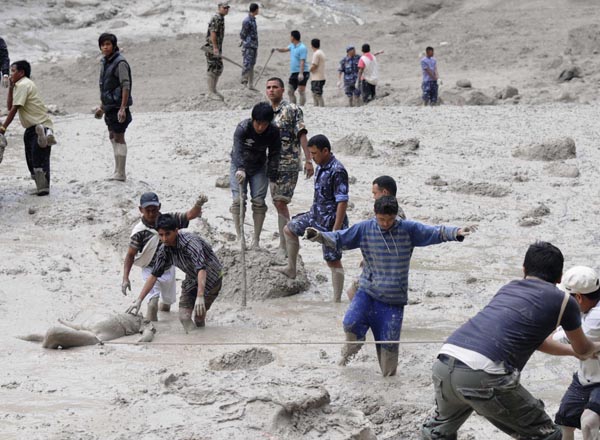
13 killed, 60 missing in glacial lake burst in Nepal

May 6, 2012

NEPAL

Kathmandu, May 6 : A glacial lake burst on Saturday in the high Himalayan region in northwestern Nepal sweeping away houses, farms, cattles near the tourist resort of Pokhara, killing at least 13 people and leaving 60 missing, including three foreign trekkers.

The lake waters flooded the Seti river in the remote Kaski district, 300-km away from capital Kathmandu, sweeping away parts of Sardikhola village located on the foothills of the famous Machapuchare peak.

The army and police officials said so far 13 bodies have been recovered from the banks of the swollen river. “The waters have risen so high that they are touching bridges,” they said.

Official said though the bodies were badly scarred and swollen, most of them appeared to be of local villages.

Army spokesman Ramindra Chhetri said army helicopters and rescue teams had been rushed to the spot and five people buried under deluge were rescued. He said the fury of the river waters had also swept away trucks and buses.

Fast-flowing floodwaters from the swollen Seti River smashed into two buildings and a number of shacks in Kharapani village, in the shadow of Mt Annapurna.

Though incidents of glacial Himalayan lake burst have been reported from parts of Tibet in China, this is the first such major tragedy in Nepal.

Nepalese experts have warned of such catastrophic happenings triggered by climatic change and melting glaciers.

Chhetri said sixty people were still missing, including three Russian tourists who were part of a trekking team. The names of the Russians were immediately known.

The flooded region is a major draw for foreign trekkers as the area has three more than 8,000 metre peaks, including Annapurna, Dhaulagiri and Nilgiri, but as the trekking season is yet pick up, the number of mountaineering teams is less in number.

Prime Minister Baburam Bhattarai has ordered the authorities to conduct the rescue operation without any delay.

He is monitoring the incident and is in touch with the authorities in Pokhara.


Comments

Add new comment

  • Coastaldigest.com reserves the right to delete or block any comments.
  • Coastaldigset.com is not responsible for its readers’ comments.
  • Comments that are abusive, incendiary or irrelevant are strictly prohibited.
  • Please use a genuine email ID and provide your name to avoid reject.
News Network
June 6,2020

United Nations, Jun 6: US President Donald Trump’s response to protests against the killing of African-American George Floyd has included language “directly associated with racial segregationists” from America's past, a group of UN human rights experts have said.

There have been widespread protests across the United States as Floyd, 46, was killed by a white police officer in Minneapolis. People from diverse backgrounds have called for justice and have voiced their support to the protests.

In the wake of protests over the killing of Floyd, Trump had tweeted that “when the looting starts, the shooting starts.”

“The response of the President of the United States to the protests at different junctures has included threatening more state violence using language directly associated with racial segregationists from the nation’s past, who worked hard to deny black people fundamental human rights," a statement issued on Friday by over 60 independent experts of the Special Procedures of the United Nations Human Rights Council said.

"We are deeply concerned that the nation is on the brink of a militarised response that reenacts the injustices that have driven people to the streets to protest,” it said.

A report in The New York Times had said that the phrase "When the looting starts, the shooting starts” was used by Miami’s former police chief Walter Headley in 1967. Headley had been “long accused of using racist tactics in his force’s patrols of black neighbourhoods,” the NYT had said.

They said the recent killing of Floyd has shocked many in the world, “but it is the lived reality of black people across the United States. The uprising nationally is a protest against systemic racism that produces state-sponsored racial violence, and licenses impunity for this violence.”

They noted that following the recent spate of killings of African-Americans, many in the United States and abroad are finally acknowledging that “the problem is not a few bad apples” but instead the problem is the very way that economic, political and social life are structured in a country that prides itself in liberal democracy, and with the largest economy in the world.

Separately, 28 UN experts called on the US Government to take decisive action to address systemic racism and racial bias in the country's criminal justice system by launching independent investigations and ensuring accountability in all cases of excessive use of force by police.

“Exactly 99 years after the massacre in Tulsa, involving the killing of people of African descent and the massive loss of life, destruction of property and loss of wealth on ‘Black Wall Street’, African Americans continue to experience racial terror in state-sponsored and privately organised violence,” the experts said.

Strongly condemning the killings of Ahmaud Arbery, Breonna Taylor and George Floyd, the experts called for systemic reform and justice. “Given the track record of impunity for racial violence of this nature in the United States, Black people have good reason to fear for their lives.”

Taylor, a 25-year-old emergency medical technician was shot in her bed when police raided the wrong house; Arbery, 25, was fatally shot while jogging near his home by three white men who chased and cornered him; and Floyd was accused of using counterfeit currency in a store and died in the street while a white officer knelt on his neck and three others participated and observed.

“The origin story of policing in the United States of America starts with slave patrols and social control, where human property of enslavers was ‘protected’ with violence and impunity against people of African descent. In the US, this legacy of racial terror remains evident in modern-day policing,” the experts said.

The experts also raised concern about the police response to demonstrations in several US cities, termed by some the ‘Fed Up-rising’, that have been marked by violence, arbitrary arrest, militarisation and the detention of thousands of protesters. Reporters of colour have been targeted and detained, and some journalists have faced violence and harassment.

“Statements from the US Government inciting and threatening violence against protesters stand in stark contrast to calls for leniency and understanding which the Government had issued in the wake of largely white protests against COVID-19 restrictions on services like barbershops, salons, and spas,” the experts said.


Comments

Add new comment

  • Coastaldigest.com reserves the right to delete or block any comments.
  • Coastaldigset.com is not responsible for its readers’ comments.
  • Comments that are abusive, incendiary or irrelevant are strictly prohibited.
  • Please use a genuine email ID and provide your name to avoid reject.
Agencies
January 9,2020

Washington, Jan 9: The U.S. and Iran stepped back from the brink of possible war Wednesday as President Donald Trump signaled he would not retaliate militarily for Iran's missile strikes on Iraqi bases housing U.S. troops. No one was harmed in the strikes, but U.S. forces in the region remained on high alert.

Speaking from the White House, Trump seemed intent on deescalating the crisis, which spiralled after he authorized the assassination of Iran's top general, Qassem Soleimani. Iran responded overnight by firing more than a dozen missiles at two installations in Iraq, its most direct assault on America since the 1979 seizure of the U.S. Embassy in Tehran.

Trump's takeaway was that “Iran appears to be standing down, which is a good thing for all parties concerned and a very good thing for the world.”

The region remained on edge, however, and American troops including a quick-reaction force dispatched over the weekend were on high alert. Hours after Trump spoke, an ‘incoming’ siren went off in Baghdad's Green Zone after what seemed to be small rockets “impacted” the diplomatic area, a Western official said. There were no reports of casualties.

Iran's Supreme Leader Ayatollah Ali Khamenei said the overnight strike was not necessarily the totality of Iran's response. “Last night they received a slap,” Khamenei said. “These military actions are not sufficient (for revenge). What is important is that the corrupt presence of America in this region comes to an end.”

The strikes had pushed Tehran and Washington perilously close to all-out conflict and left the world waiting to see whether the American president would respond with more military force. Trump, in his nine-minute, televised address, spoke of a robust U.S. military with missiles that are “big, powerful, accurate, lethal and fast.'' But then he added: “We do not want to use it."

Iran for days had been promising to respond forcefully to Soleimani's killing, but its limited strike on two bases--one in the northern Iraqi city of Irbil and the other at Ain al-Asad in western Iraq--appeared to signal that it too was uninterested in a wider clash with the U.S. Foreign minister Mohammad Javad Zarif tweeted that the country had “concluded proportionate measures in self-defence.”

Trump said the U.S. was “ready to embrace peace with all who seek it.” That marked a sharp change in tone from his warning a day earlier that “if Iran does anything that they shouldn't be doing, they're going to be suffering the consequences, and very strongly.”

Trump opened his remarks at the White House by reiterating his promise that “Iran will never be allowed to have a nuclear weapon.” Iran had announced in the wake of Soleimani's killing that it would no longer comply with any of the limits on uranium enrichment in the 2015 nuclear deal crafted to keep it from building a nuclear device.

The president, who had earlier pulled the U.S. out of the deal, seized on the moment of calm to call for negotiations toward a new agreement that would do more to limit Iran's ballistic missile programmes and constrain regional proxy campaigns like those led by Soleimani.

Trump spoke of new sanctions on Iran, but it was not immediately clear what those would be.

Comments

Add new comment

  • Coastaldigest.com reserves the right to delete or block any comments.
  • Coastaldigset.com is not responsible for its readers’ comments.
  • Comments that are abusive, incendiary or irrelevant are strictly prohibited.
  • Please use a genuine email ID and provide your name to avoid reject.
News Network
April 18,2020

Washington, Apr 18: The United States on Friday passed 700,000 confirmed coronavirus cases, according to a tally maintained by Johns Hopkins University.

With the highest number of cases and deaths of any country in the world, the US had recorded 700,282 cases of COVID-19 and 36,773 deaths as of 8:30 pm (0030 GMT Friday), according to the Baltimore-based university.

That marked an increase of 3,856 deaths in the past 24 hours, but that figure likely includes "probable" virus-linked deaths, which had not previously been counted.

This week, New York City said it would add 3,778 "probable" virus deaths to its official count.

The US Centers for Disease Control and Prevention gave a toll Friday night of 33,049 dead, including 4,226 probable virus-linked deaths.

The United States has seen the highest death toll in the world in the coronavirus pandemic, ahead of Italy (22,745 deaths) although its population is just a fifth of that of the US.

Spain has recorded 19,478 deaths, followed by France with 18,681.

Trump announces $19 billion relief for farmers amid COVID-19 epidemic

President Donald Trump on Friday announced a $19 billion financial rescue package to help the agriculture industry weather the staggering economic downturn sparked by measures to defeat the coronavirus.

Trump told a press conference the government "will be implementing a $19 billion relief program for our great farmers and ranchers as they cope with the fallout of the global pandemic."

The program will include direct payments to farmers, ranchers and producers who Trump said have experienced "unprecedented losses during this pandemic."

Agriculture Secretary Sonny Perdue said US farmers have been hit hard by a sharp shift in demand, as schools and restaurants close and more Americans eat at home.

That has disrupted the food supply chain, forcing farmers in many places to destroy dairy output and plow under crops that no longer have buyers.

"Having to dump milk and plow under vegetables ready to market is not only financially distressing, but it's heartbreaking as well to those who produce them," Perdue said.

Perdue said some $3 billion of the money would go to buying produce and milk from such farmers, and redistribute it to community food banks.

Millions of Americans have recently turned to food pantries for meals and groceries after losing their jobs.

Comments

Add new comment

  • Coastaldigest.com reserves the right to delete or block any comments.
  • Coastaldigset.com is not responsible for its readers’ comments.
  • Comments that are abusive, incendiary or irrelevant are strictly prohibited.
  • Please use a genuine email ID and provide your name to avoid reject.