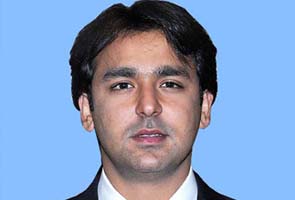
Gilani's son involved in brawl on board PIA flight: Report

May 19, 2012
Ali_Musa_gilani_295

Islamabad, May 19: The son of the Pakistani prime minister Yousuf Raza Gilani allegedly caused a scene on board a flight from Lahore to Karachi, according to a local newspaper.

Ali Musa, Mr Gilani's son and an MP, allegedly demanded that his security guard, who had an economy class ticket, be allowed to sit next to him in the business class of the Pakistan International Airlines plane.

According to the Express Tribune, the matter was resolved when the captain of the flight intervened and told the premier's son that he would turn the aircraft back to Lahore if he persisted with his demand.

The flight then continued and landed at Karachi, the report said.

The report did not say when the incident had occurred.


Comments

Add new comment

  • Coastaldigest.com reserves the right to delete or block any comments.
  • Coastaldigset.com is not responsible for its readers’ comments.
  • Comments that are abusive, incendiary or irrelevant are strictly prohibited.
  • Please use a genuine email ID and provide your name to avoid reject.
News Network
June 18,2020

Washington, Jun 18: US Defence officials are concerned over China's use of COVID-19 situation to gain stakes in strategically important companies of United States as the impact of novel coronavirus has left several companies in dire need of capital.

Amid the pandemic, it getting hard for the defence department to keep an eye on national security and help protect smaller companies down the chain, CNN reported.

"We are paying close attention to any indicators that China is leveraging Covid-19 to take advantage of a situation where defence companies need capital more than ever," a defence official told CNN.

In April, Ellen Lord, undersecretary of defence for acquisition and sustainment said it is paying close attention to 'adversaries' against the 'economic warfare' with the United States.

"We have to be very, very careful about the focused efforts some of our adversaries have to really undergo sort of economic warfare with us, which has been going on for some time," Ellen Lord, undersecretary of defence for acquisition and sustainment was quoted as saying by CNN.

US Committee on Foreign Investment protects its interest against hostile countries gaining ownership in strategically important companies. But the pandemic is changing the definition of national security concerns to include drugs, protective gear and medical supplies.

"These are now national security needs and we probably should have been thinking about it a long time ago in terms of biowarfare that we should have a trusted industrial base or a set of trusted allies -- the UK, or NATO allies or Japan or Korea -- who are trusted in that regard," Bill Greenwalt, a former Pentagon official.

Give the threat posed by foreign acquisition, Pentagon has been offering tools to help small US businesses defend themselves against adversarial investment and conducting background checks with other government agencies to ensure transparency.

US President Donald Trump's trade adviser Peter Navarro recently told CNN if Trump wins reelection, Washington DC will likely take offshore supply chains as national security priorities.

"If we fail to do that in the face of this crisis, we will have failed this country and all future generations of Americans," Navarro said.

The US State Department has also warned US allies to "avoid economic overreliance on China" and "guard their critical infrastructure" from China's influence.

Chad P Bown, a senior fellow at the Peterson Institute for International Economics, pointed to recent China's economic coercion of Australia on the political matter saying, "this is how China operates and everybody knows it."

Comments

Add new comment

  • Coastaldigest.com reserves the right to delete or block any comments.
  • Coastaldigset.com is not responsible for its readers’ comments.
  • Comments that are abusive, incendiary or irrelevant are strictly prohibited.
  • Please use a genuine email ID and provide your name to avoid reject.
News Network
June 4,2020

Jun 4: A malaria drug President Donald Trump took to try to prevent COVID-19 proved ineffective for that in the first large, high-quality study to test it in people in close contact with someone with the disease.

Results published Wednesday by the New England Journal of Medicine show that hydroxychloroquine was no better than placebo pills at preventing illness from the coronavirus.

The drug did not seem to cause serious harm, though -- about 40% on it had side effects, mostly mild stomach problems.

 “We were disappointed. We would have liked for this to work,” said the study leader, Dr. David Boulware, an infectious disease specialist at the University of Minnesota.

“But our objective was to answer the question and to conduct a high-quality study,” because the evidence on the drug so far has been inconclusive, he said.

Hydroxychloroquine and a similar drug, chloroquine, have been the subject of much debate since Trump started promoting them in March.

Hydroxychloroquine has long been used for malaria, lupus, and rheumatoid arthritis, but no large studies have shown it or chloroquine to be safe or effective for much sicker patients with coronavirus, and some studies have suggested the drugs may do harm.

Trump took a two-week course of hydroxychloroquine, along with zinc and Vitamin D, after two staffers tested positive for COVID-19, and had no ill effects, according to results of his latest physical released by his doctor Wednesday.

Federal regulators have warned against hydroxychloroquine's use except in hospitals and formal studies because of the risk of side effects, especially heart rhythm problems.

Boulware's study involved 821 people in the United States and Canada living with someone diagnosed with COVID-19 or at high risk of getting it because of their job -- doctors, nurses, ambulance workers who had significant exposure to a sick patient while not wearing full protective gear.

They were randomly assigned to get either the nutrient folate as a placebo or hydroxychloroquine for five days, starting within four days of their exposure. Neither they nor others involved in the research knew who was getting which pills.

After 14 days in the study, 12 per cent on the drug developed COVID-19 symptoms versus 14 per cent in the placebo group, but the difference is so small it could have occurred by chance, Boulware said.

“There's basically no effect. It does not prevent infection,” he said of the drug. Even if it were to give some slim advantage, “we'd want a much larger effect” to justify its use and risk of side effects for preventing illness, he said.

Results were no different among a subgroup of participants who were taking zinc or vitamin C, which some people believe might help make hydroxychloroquine more effective or fight the coronavirus.

There are some big caveats: The study enrolled people through the Internet and social media, relying on them to report their own symptoms rather than having them tracked in a formal way by doctors.

Participants were not all tested for the coronavirus but were diagnosed as COVID-19 cases based on symptoms in many cases. And not all took their medicines as directed.

The results “are more provocative than definitive,” and the drug may yet have prevention benefits if tried sooner or in a different way, Dr. Myron Cohen of the University of North Carolina at Chapel Hill wrote in a commentary in the journal.

Others were glad to see a study that had a comparison group and good scientific methods after so many weaker reports on hydroxychloroquine.

“This fits with everything else we've seen so far which suggests that it's not beneficial," said Dr. Peter Bach, director of a health policy center at Memorial Sloan Kettering Cancer Center in New York.

This study was in younger relatively healthy people, but the results “would make me very discouraged about trying to use this in older people” who are most vulnerable to serious illness from the coronavirus, Bach said.

“If it does work, it doesn't work very well.” Dr. Dan Culver, a lung specialist at the Cleveland Clinic, said there's still a chance that giving the drug sooner than four days after someone's exposure to the virus may help prevent illness.

But the study “takes 'home run' off the table” as far as hopes for the drug, he said.

The study was mostly funded by David Baszucki, founder of Roblox, a California-based game software company, and other private donors and the Minnesota university.

Boulware also is leading a study testing hydroxychloroquine for treating COVID-19. The study is finished and results are being analyzed now.

On Tuesday, the journal Lancet posted an “expression of concern” about a study it published earlier this month of nearly 15,000 COVID-19 patients on the malaria drugs that tied their use to a higher risk of dying in the hospital or developing a heartbeat problem.

Scientists have raised serious questions about the database used for that study, and its authors have launched an independent audit.

That work had a big impact: the World Health Organization suspended use of hydroxychloroquine in a study it is leading, and French officials stopped the drug's use in hospitals. On Wednesday, the WHO said experts who reviewed safety information decided that its study could resume.


Comments

Add new comment

  • Coastaldigest.com reserves the right to delete or block any comments.
  • Coastaldigset.com is not responsible for its readers’ comments.
  • Comments that are abusive, incendiary or irrelevant are strictly prohibited.
  • Please use a genuine email ID and provide your name to avoid reject.
News Network
March 11,2020

Rome, Mar 11: Italy has recorded its deadliest day of the coronavirus crisis despite locking down the entire country, as New York deployed the National Guard to contain a disease that has sown worldwide panic.

The hardest-hit country in Europe said its death toll from the COVID-19 virus had risen Tuesday by a third to 631, with the surging epidemic taking its toll on global sporting, cultural and political events.

While authorities in China, where the outbreak began, have declared it "basically curbed", cases are multiplying around the world, sparking panic buying in shops, and wild swings on financial markets.

China remains the hardest-hit overall with more than 80,000 cases and over 3,000 deaths, out of a global total of 117,339 cases and 4,251 deaths across 107 countries and territories, according to an AFP tally.

The virus is infecting all walks of life, including politics, with US Democratic presidential hopefuls Bernie Sanders and Joe Biden both cancelling campaign rallies and British health minister Nadine Dorries saying she had tested positive.

And amid criticism of the US authorities' response, New York deployed the National Guard for the first time during the crisis to help contain the spread of the disease from an infection-hit suburb.

There have been 173 confirmed cases in New York state, including 108 in Westchester County, home to New Rochelle where the majority of infections have been detected.

"It is a dramatic action, but it is the largest cluster in the country. This is literally a matter of life and death," said state governor Andrew Cuomo.

"People are scared, it's an unusual situation to be in," Miles Goldberg, who runs a New Rochelle bar, told AFP.

"It makes people nervous to be around others, it makes people nervous to get inside into businesses and such," he said.

In an unprecedented move, Italian Prime Minister Giuseppe Conte has told the 60 million residents of his country they should travel only for the most urgent work or health reasons.

And while squares in Milan and Rome were emptied of their usual bustle and traffic, some residents appeared uncertain if they were even allowed to leave their homes for everyday tasks like shopping.

The virus has battered tourism around the world, as people scrap travel plans, and a restaurant owner in Florence in northern Italy said that the impact on business had been catastrophic.

"We hope that we will see the end of it, because from around 140 covers a day, this afternoon, we've gone down to 20-25," Agostino Ferrara told AFP.

Pope Francis also seemed to muddy the waters, holding a mass in which he urged priests to go out and visit the sick -- something Conte has specifically discouraged.

Sporting events continued to fall victim to the virus as authorities urge people to avoid large gatherings.

Arsenal's game at Manchester City was postponed after players from the London club were put into quarantine, making it the first Premier League fixture to be called off because of the virus.

The virus has sparked doubts about the Olympics due to open in Tokyo on July 24 and the traditional flame lighting ceremony in Greece is set to be held without spectators.

In the United States, organisers rescheduled the two-week Coachella music festival for October.

The virus and the response to the crisis has prompted pandemonium on global markets with volatility not seen since the world financial crisis in 2008.

After suffering its worst session in more than 11 years at the beginning of the week, the Dow Jones Index in New York bounced back significantly, rising five percent on Tuesday.

Politicians around the world have scrambled to put together emergency packages to ease the significant financial hardships the virus is expected to cause for households and businesses.

US President Donald Trump, who is relying on a strong economy to boost his re-election hopes, promised to announce "major" economic measures on Tuesday.

The biggest item on his wish list is a cut in payroll taxes. But even allies in Congress and reportedly some aides in the White House are sceptical, questioning the cost.

Italy prepared Tuesday to let families skip mortgage and some tax payments while Japan unveiled a second emergency package to tackle economic woes stemming from the outbreak, including $15 billion in loan programmes to support small businesses.

Analysts warned of further volatility ahead however.

"It's like winding up a rubber band. The more you wind it, when you let go, the more it pops," said LBBW's Karl Haeling.

"A lot of the uncertainty goes to the root of the virus itself."

Comments

Add new comment

  • Coastaldigest.com reserves the right to delete or block any comments.
  • Coastaldigset.com is not responsible for its readers’ comments.
  • Comments that are abusive, incendiary or irrelevant are strictly prohibited.
  • Please use a genuine email ID and provide your name to avoid reject.