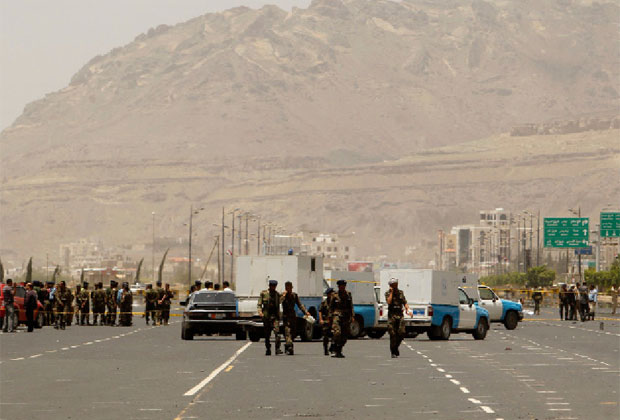
Suicide bomber kills 96 Yemen soldiers in Sanaa

May 21, 2012

yemen1_21052012


Sanaa (Yemen), May 21: A Yemeni soldier packing powerful explosives under his uniform blew himself up in the middle of an army battalion in Sanaa on Monday, killing 96 troops and wounding around 300, a military official and medics said.


Medics, speaking on condition of anonymity, said the casualties were being treated in seven hospitals across Sanaa. All the dead and injured were soldiers, they added.


There was no immediate claim of responsibility for the massive blast which according to witnesses echoed loudly across the city, causing panic among residents.


The unidentified bomber detonated his explosives as soldiers from the government's central security forces, commanded by a nephew of former president Ali Abdullah Saleh, rehearsed for an army parade to mark the 22nd anniversary of the unification of north and south Yemen, according to the military official.


Yemen's defence minister, Mohammed Nasser Ahmed, was present at the time of the explosion but escaped unharmed, the official added.


Witnesses said human remains were scattered across the site of the blast at Sanaa's Sabeen Square, where the Yemeni government often holds large military parades.


It remains unclear if the parade will take place as planned.


Comments

Add new comment

  • Coastaldigest.com reserves the right to delete or block any comments.
  • Coastaldigset.com is not responsible for its readers’ comments.
  • Comments that are abusive, incendiary or irrelevant are strictly prohibited.
  • Please use a genuine email ID and provide your name to avoid reject.
News Network
April 13,2020

Manila, Apr 13: The Asian Development Bank (ADB) on Monday tripled the size of its response to novel coronavirus disease (COVID-19) pandemic to 20 billion dollars and approved measures to streamline its operations for quicker and more flexible delivery of assistance.

The package expands ADB's 6.5 billion dollars initial response announced on March 18, adding 13.5 billion dollars in resources to help ADB's developing member countries counter the severe macroeconomic and health impacts caused by COVID-19.

The 20 billion dollar package includes about 2.5 billion dollars in concessional and grant resources.

"This pandemic threatens to severely set back economic, social, and development gains in Asia and the Pacific, reverse progress on poverty reduction and throw economies into recession," said ADB President Masatsugu Asakawa.

"Our expanded and comprehensive package of assistance, made possible with the strong support of our board, will be delivered more quickly, flexibly and forcefully to the governments and the private sector in our developing member countries to help them address the urgent challenges in tackling the pandemic and economic downturn," he said in a statement.

ADB's most recent assessment released on April 3 estimates the global impact of the pandemic at between 2.3 and 4.8 per cent of gross domestic product. Regional growth is forecast to decline from 5.2 per cent last year to 2.2 per cent in 2020.

The new package includes the establishment of a COVID-19 pandemic response option under ADB's countercyclical support facility.

Up to 13 billion dollars will be provided through this new option to help governments of developing member countries implement effective countercyclical expenditure programs to mitigate impacts of the COVID-19 pandemic, with a particular focus on the poor and the vulnerable.

Grant resources will continue to be deployed quickly for providing medical and personal protective equipment and supplies from expanded procurement sources.

Some 2 billion dollars from the 20 billion dollar package will be made available for the private sector. Loans and guarantees will be provided to financial institutions to rejuvenate trade and supply chains.

Enhanced microfinance loan and guarantee support and a facility to help liquidity-starved small and medium-sized enterprises, including those run by female entrepreneurs, will be implemented alongside direct financing of companies responding to or impacted by COVID-19.

The response package includes a number of adjustments to policies and business processes that will allow ADB to respond more rapidly and flexibly to the crisis. These include measures to streamline internal business processes, widen the eligibility and scope of various support facilities and make the terms and conditions of lending more tailored.

All support under the expanded package will be provided in close collaboration with international organisations, including the International Monetary Fund, World Bank Group, World Health Organisation, UNICEF, other UN agencies and the broader global community.

Comments

Add new comment

  • Coastaldigest.com reserves the right to delete or block any comments.
  • Coastaldigset.com is not responsible for its readers’ comments.
  • Comments that are abusive, incendiary or irrelevant are strictly prohibited.
  • Please use a genuine email ID and provide your name to avoid reject.
News Network
May 11,2020

Kabul, May 11: Four back-to-back roadside bombs exploded in a northern district of Afghanistan's capital Kabul on Monday, wounding four civilians including a child, police said. Kabul police spokesman Ferdaws Faramarz said a clearance team was at the site of the attacks.

Militants have carried out several roadside bombings and rocket attacks in Kabul and other parts of the country in recent weeks, but Monday's four consecutive explosions appeared to be the first coordinated effort for some months.

The Taliban has not carried out any large attacks in the city since they signed a landmark withdrawal deal with the US in February, meant to pave the way for peace in the country. No group has claimed the attacks. The explosions come as authorities are trying to impose a lockdown in the capital to curb the spread of coronavirus in the country.

Comments

Add new comment

  • Coastaldigest.com reserves the right to delete or block any comments.
  • Coastaldigset.com is not responsible for its readers’ comments.
  • Comments that are abusive, incendiary or irrelevant are strictly prohibited.
  • Please use a genuine email ID and provide your name to avoid reject.
Agencies
May 10,2020

Paris, May 10: The number of coronavirus cases worldwide topped four million as some of the hardest-hit countries readied Sunday to lift lockdown restrictions despite concern about a second wave of infections.

Governments around the world are trying to stop the spread of the deadly disease while scrambling for ways to relieve pressure on their economies, which are facing a historic downturn with millions pushed into unemployment.

Despite the intense political pressure to reopen, nations are also keen to avoid second waves of infections that could overwhelm healthcare systems, with reminders over the weekend of the threat posed by the virus.

In the United States, media reported Saturday that the nation's top infectious disease expert, Anthony Fauci, was among three members of the White House coronavirus task force who will self-isolate after potential exposure.

And in South Korea, the capital Seoul shut all bars and clubs on Saturday as more than 50 cases were linked to a man who tested positive after spending time in one of the city's busiest nightlife districts.

Despite the risks, some governments in hard-hit Europe have said are signs of progress that justify cautious steps towards normality.

Officials in France on Saturday said the day's death toll of 80 was the lowest since early April, while nursing home fatalities also fell sharply as the nation prepared to relax curbs on public movement imposed eight weeks ago.

The easing, to begin Monday, has brought mixed reactions.

"I've been scared to death" about the reopening, said Maya Flandin, a bookshop manager from Lyon. "It's a big responsibility to have to protect my staff and my customers."

French health officials have warned that social distancing must be kept up even as restrictions are eased.

In Spain, about half the population will be allowed out on Monday for limited socialisation, and restaurants will be able to offer some outdoor service as the country begins a phased transition set to last through June.

With lingering fears of a resurgence, authorities excluded Madrid and Barcelona -- two COVID-19 hotspots -- from the first phase.

Belgium is also easing some restrictions on Monday, and in some parts of Germany, bars and restaurants reopened on Saturday with further easing set for Monday.

In Britain, Prime Minister Boris Johnson is expected Sunday to lay out a plan for the nation to emerge out of its current lockdown.

Media reports have suggested that Britain may introduce a mandatory 14-day quarantine for international arrivals to stop the spread of the virus.

Global economic figures are pointing to the most acute downturn in nearly a century, with businesses forced to shut and supply lines badly disrupted, and pressure is growing on leaders around the world to find a way out as the worldwide death toll topped 277,000 and infections crossed four million.

In the United States, the country with the highest death toll and where more than 20 million people have lost their jobs, President Donald Trump has insisted that next year would be "phenomenal" for the economy, urging reopening despite the virus still claiming well over 1,000 lives daily in the country.

The scale of the challenge was brought in sharp focus over the weekend as US media reported that top disease expert Anthony Fauci, who has become the trusted face of the government response to the pandemic, is going to self-isolate after possible exposure to an infected White House staffer.

Fauci told CNN that he will undergo a "modified quarantine" as he had not been in close proximity to the staffer, the network reported. He will remain at home teleworking, and will wear a mask for two weeks.

Robert Redfield, the director of the Centers for Disease Control and Prevention, and Stephen Hahn, the commissioner of the Food and Drug Administration, will also self-isolate, CNN added.

All three will still testify at Tuesday's Senate coronavirus hearing, with Redfield and Hahn participating via video link, according to Senator Lamar Alexander, chairman of the chamber's health committee.

It is believed Fauci will attend wearing a mask, CNN reported.

President Trump has faced sharp criticism from his predecessor Barack Obama, who said on a leaked tape that Trump's handling of the crisis was an "absolute chaotic disaster".

With people wearying of being indoors and under economic pressure, anti-lockdown protests have been held in a number of countries in recent weeks, with some demonstrators arguing that such restrictions violate their rights and others promoting conspiracy theories about the pandemic.

Ten people were arrested and a police officer injured in Melbourne, Australia, on Sunday in the latest such protest, where around 150 people gathered to demand an end to the shutdown.

Participants were promoting a number of conspiracy theories, such as linking 5G cellular communications to the disease.

Australian chief medical officer Brendan Murphy said there was "a lot of very silly misinformation out there", including the 5G allegation.

"I have unfortunately received a lot of communication from these conspiracy theorists myself," he said.

"It is complete nonsense. 5G has got nothing at all to do with coronavirus."

Comments

Add new comment

  • Coastaldigest.com reserves the right to delete or block any comments.
  • Coastaldigset.com is not responsible for its readers’ comments.
  • Comments that are abusive, incendiary or irrelevant are strictly prohibited.
  • Please use a genuine email ID and provide your name to avoid reject.