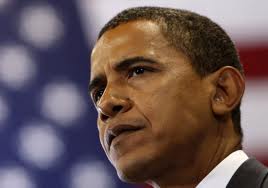
Obama refuses to meet Zardari in Chicago

May 22, 2012

obama_refuses

Washington, May 22: In a rebuff to Pakistan president Asif Ali Zardari, US president Barack Obama did not meet him on the margins of the NATO Summit in Chicago as the two countries failed to strike a deal on reopening the NATO supply lines to Afghanistan.

Zardari, who flew to Chicago with hopes of lifting his stature with a meeting with Obama, was preparing to leave empty-handed as the two countries continued to feel the repercussions of a NATO air strike last November that killed 24 Pakistani soldiers, an incident for which the US President has offered condolences but no apology.

As the two-day NATO summit opened in Chicago last evening, Obama remained at loggerheads with Zardari, refusing even to meet him without a deal on the supply routes, which officials in both sides acknowledged would not be coming soon, US media reported on Monday.


But White House deputy national security advisor Ben Rhodes said that Obama could not meet Zardari as he had a "full slate of summit meetings to attend."


"The two bilateral meetings, really, that he did, or President (Hamid) Karzai for obvious reasons given the focus on Afghanistan here, and the Secretary General of NATO given that it's traditional for the host to make sure that we're aligned with the secretary general heading into the summit.


"But we don't anticipate any other bilateral meetings so we didn't draw that linkage. We're going to continue to work through the issue with the Pakistanis," he said.


However, a deal to reopen the supply lines fell apart as Obama began talks on ending the NATO alliance's combat role in Afghanistan in 2013, The New York Times said. The failure to strike a deal ahead of the summit injects new tension into the relationship, it said.


Comments

Add new comment

  • Coastaldigest.com reserves the right to delete or block any comments.
  • Coastaldigset.com is not responsible for its readers’ comments.
  • Comments that are abusive, incendiary or irrelevant are strictly prohibited.
  • Please use a genuine email ID and provide your name to avoid reject.
News Network
March 4,2020

Tokyo, Mar 4: Takeda Pharmaceutical Co said on Wednesday it was developing a drug to treat COVID-19, the flu-like illness that has struck more than 90,000 people worldwide and killed over 3,000.

The Japanese drugmaker is working on a plasma-derived therapy to treat high-risk individuals infected with the new coronavirus and will share its plans with members of the U.S. Congress on Wednesday, it said in a statement.

Takeda is also studying whether its currently marketed and pipeline products may be effective treatments for infected patients.

"We will do all that we can to address the novel coronavirus threat...(and) are hopeful that we can expand the treatment options," Rajeev Venkayya, president of Takeda's vaccine business, said in the statement.

Takeda said it was in talks with various health and regulatory agencies and healthcare partners in the United States, Asia and Europe to move forward its research into the drug.

Its research requires access to the blood of people who have recovered from the respiratory disease or who have been vaccinated, once a vaccine is developed, Takeda said.

Comments

Add new comment

  • Coastaldigest.com reserves the right to delete or block any comments.
  • Coastaldigset.com is not responsible for its readers’ comments.
  • Comments that are abusive, incendiary or irrelevant are strictly prohibited.
  • Please use a genuine email ID and provide your name to avoid reject.
News Network
March 28,2020

Berlin, Mar 28: The number of confirmed coronavirus infections worldwide topped 600,000 on Saturday as new cases stacked up quickly in Europe and the United States and officials dug in for a long fight against the pandemic.

The latest landmark came only two days after the world passed half a million infections, according to a tally by John Hopkins University, showing that much work remains to be done to slow the spread of the virus. It showed more than 602,000 cases and a total of over 27,000 deaths.

While the U.S. now leads the world in reported infections — with more than 104,000 cases — five countries exceed its roughly 1,700 deaths: Italy, Spain, China, Iran and France.

“We cannot completely prevent infections at this stage, but we can and must in the immediate future achieve fewer new infections per day, a slower spread,” German Chancellor Angela Merkel, who is in quarantine at home after her doctor tested positive for the virus, told her compatriots in an audio message. “That will decide whether our health system can stand up to the virus.”

The virus already has put health systems in Italy, Spain and France under extreme strain. Lockdowns of varying severity have been introduced across Europe. Merkel's chief of staff, Helge Braun, said that Germany — where authorities closed nonessential shops and banned gatherings of more than two in public — won't relax its restrictions before April 20.

As the epicenter has shifted westward, the situation has calmed in China, where some restrictions on people's lives have now been lifted. Six subway lines restored limited service in Wuhan, where the virus first emerged in December, after the city had its official coronavirus risk evaluation downgraded from high to medium on Friday. Five districts of the city of 11 million people had other restrictions on travel loosened after their risk factor was downgraded to low.

For most people, the coronavirus causes mild or moderate symptoms, such as fever and cough that clear up in two to three weeks. But for others, especially older adults and people with existing health problems, the virus can cause more severe illness, including pneumonia, and lead to death.

More than 130,000 people have recovered, according to Johns Hopkins' tally.

In one way or another, the effects of the COVID-19 outbreak have been felt by the powerful and the poor alike.

On Friday, British Prime Minister Boris Johnson became the first leader of a major country to test positive for the virus. He said he would continue to work from self-quarantine.

Countries are still scrambling bring home some citizens stranded abroad by border closures and a near-shutdown of flights. On Saturday, 174 foreign tourists and four Nepali nationals on the foothills of Mount Everest were flown out days after being stranded on the only airstrip serving the world's highest mountain.

In neighboring India, authorities sent a fleet of buses to the outskirts of the capital to meet an exodus of migrant workers desperately trying to reach their home villages during the world's largest lockdown.

Thousands of people, mostly young male day laborers but also families, had fled their New Delhi homes after Prime Minister Narendra Modi announced a 21-day lockdown that began on Wednesday and effectively put millions of Indians who live off daily earnings out of work.

In a possibly hopeful sign, the U.S. Food and Drug Administration cleared a new rapid test from Abbott Laboratories, which the company says can detect the coronavirus in about 5 minutes. Medical device maker Abbott announced the emergency clearance of its cartridge-based test Friday night, saying the test delivers a negative result in 13 minutes when the virus is not detected.

While New York remained the worst-hit city in the U.S., Americans braced for worsening conditions elsewhere, with worrisome infection numbers being reported in New Orleans, Chicago and Detroit.

New Orleans’ sprawling Ernest N. Morial Convention Center, along the Mississippi River, was being converted into a massive hospital as officials prepared for thousands more patients than they could accommodate.

In New York, where there are more than 44,000 cases statewide, the number of people hospitalized with COVID-19 passed 6,000 on Friday, double what it had been three days earlier.

Gov. Andrew Cuomo called for 4,000 more temporary beds across New York City, where the Jacob K. Javits Convention Center has already been converted into a hospital.

The struggle to defeat the virus will take “weeks and weeks and weeks,” Cuomo told members of the National Guard working at the Javits Center.

President Donald Trump invoked the Defense Production Act on Friday, ordering General Motors to begin manufacturing ventilators. Trump had previously rejected Cuomo's pleas for tens of thousands more of the machines and the governor's calls to implement the Korean War-era production law.

Trump signed a $2.2 trillion stimulus package, after the House approved the sweeping measure by voice vote. Lawmakers in both parties lined up behind the law to send checks to millions of Americans, boost unemployment benefits, help businesses and toss a life preserver to an overwhelmed health care system.

Dr. John Brooks of the U.S. Centers for Disease Control and Prevention warned Americans remained “in the acceleration phase” of the pandemic and that all corners of the country were at risk.

"There is no geographic part of the United States that is spared from this," he said.

Comments

Add new comment

  • Coastaldigest.com reserves the right to delete or block any comments.
  • Coastaldigset.com is not responsible for its readers’ comments.
  • Comments that are abusive, incendiary or irrelevant are strictly prohibited.
  • Please use a genuine email ID and provide your name to avoid reject.
News Network
February 5,2020

Feb 5: Pakistan will buy more palm oil from Malaysia, Prime Minister Imran Khan said on Tuesday, aiming to help offset lost sales after top buyer India put curbs on Malaysian imports last month amid a diplomatic row.

India imposed restrictions on refined palm oil imports and informally asked traders to stop buying from Malaysia, the world's biggest producer of the edible oil. Sources said the move was in retaliation for Malaysia's criticism of India's policy on Kashmir.

Malaysian Prime Minister Mahathir Mohamad said on Tuesday that he discussed palm oil with Khan who was on a visit to Malaysia and that Pakistan had indicated it would import more from Malaysia.

"That's right, especially since we noticed India threatened Malaysia for supporting the Kashmir cause, threatened to cut palm oil imports," Khan told a joint news conference, referring to India's Muslim-majority region of Kashmir.

"Pakistan will do its best to compensate for that."

India is a Hindu-majority country while Malaysia and Pakistan are mainly Muslim. India and Pakistan have been mostly hostile to each other since the partition of British India in 1947, and have fought two of their three wars over competing territorial claims in Kashmir.

Pakistan may have bought around 135,000 tonnes of Malaysian palm oil last month, a record high, India-based dealers who track such shipments told Reuters on condition of anonymity.

The figure is close to estimates of 141,500 tonnes from Refinitiv, which show sales to India in January may have plunged 80% from a year earlier to 40,400 tonnes.

Malaysia will release official export data on Monday.

Pakistan bought 1.1 million tonnes of palm oil from Malaysia last year, while India bought 4.4 million tonnes, according to the Malaysian Palm Oil Council.

Malaysian palm oil futures rose on Tuesday after Khan's comments and on expectations of a steep drop in production in January.

STRONG TIES

India has repeatedly objected to Mahathir speaking out against its move last year to strip Kashmir's autonomy and make it easier for non-Muslims from neighbouring Muslim-majority Bangladesh, Pakistan and Afghanistan to gain citizenship.

At the news conference, Mahathir did not refer to Kashmir but Khan did.

"The way you, PM, have stood with us and spoken about this injustice going on, on behalf of Pakistan I really want to thank you," Khan said.

He also said he was sad he had been unable to attend a summit of Muslim leaders in Malaysia in December. Saudi Arabia did not attend the summit, saying it was the wrong forum to discuss matters affecting the world's Muslims and Khan belatedly pulled out.

Some Pakistani officials, unnamed because they were not authorised to speak to the media, said at the time that Khan pulled out under pressure from Saudi Arabia, a close ally, although local media reported his officials denied that was the reason for his absence.

"Unfortunately our friends, who are very close to Pakistan as well, felt that somehow the conference was going to divide the ummah," Khan said, using the Arabic word for the Muslim community but not mentioning Saudi Arabia by name.

"It is clearly a misconception, as that was not the purpose of the conference."

Comments

Add new comment

  • Coastaldigest.com reserves the right to delete or block any comments.
  • Coastaldigset.com is not responsible for its readers’ comments.
  • Comments that are abusive, incendiary or irrelevant are strictly prohibited.
  • Please use a genuine email ID and provide your name to avoid reject.