



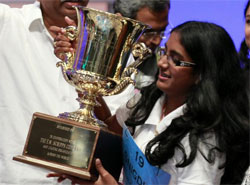
Snigdha Nandipati wins fifth Spelling Bee crown for Indian-Americans

June 1, 2012

spelling-bee


Washington, June 1: Snigdha Nandipati, a 14-year-old Indian American girl, correctly spelled ''guetapens'', French for ambush, to win the 2012 Scripps National Spelling Bee crown and retain the coveted honour for the community for the fifth year in a row.

"It's a miracle," said Nandipati from San Diego, California, as she pipped fellow Indian American Stuti Mishra, 14, of West Melbourne, Florida who stumbled over "schwarmerei", German for extravagant enthusiasm, in the last round of the final at a convention centre outside Washington Thursday night.

Nandipati, an avid reader and coin collector who aspires to become a psychiatrist or neurosurgeon, gets $30,000 in cash, a trophy, a $2,500 savings bond, a $5,000 scholarship, $2,600 in reference works from the Encyclopedia Britannica and an online language course.

Nandipati plays violin and is fluent in Telugu. She is the fifth consecutive Indian-American winner and 10th in the last 14 years.

The Indian-American community's victory run began in 1999 when Nupur Lala captured the crown and was later featured in the documentary "Spellbound".

Anamika Veeramani scored a hat-trick for Indian-Americans by taking the crown in 2010.

With Arvind Mahankali, 12, of Bayside Hills, New York, a finalist for the last two years, the three Indian American kids were the top spellers left in the last round from among the nine who made the finals Thursday.

Forty-one spellers, meanwhile, heard the dreaded bell that signals an incorrect spelling in the semi-finals. Those included one of the favorites, 10-year-old Vanya Shivashankar of Olathe, Kansas. The younger sister of the 2009 champion got the only perfect score in the preliminary rounds.

Breezily confident through the first two semifinal rounds, Shivashankar was flummoxed by "pejerrey", a small fish. She went with "perjere".

Another Indian American fifth-time competitor, Rahul Malayappan, also did not make the finals.

The finals did not include the youngest speller in bee history, six-year-old Lori Anne Madison of Lake Ridge, Virginia, who was eliminated during the preliminary rounds when she misspelled one of her two words -- "ingulvies" (the crop, or craw, of birds) -- and then fell short on her written test.



Comments

Add new comment

  • Coastaldigest.com reserves the right to delete or block any comments.
  • Coastaldigset.com is not responsible for its readers’ comments.
  • Comments that are abusive, incendiary or irrelevant are strictly prohibited.
  • Please use a genuine email ID and provide your name to avoid reject.
News Network
March 25,2020

Beijing, Mar 25: Around 5,000 people have signed up for the phase I clinical trial of recombinant novel coronavirus vaccine in Chinese city Wuhan where the virus first emerged late last year.

The recruitment for participants ended this week with nearly 5,000 volunteers signing up for the trial, state-run Beijing News reported on Wednesday.

A single-centre, open and dose-escalation phase I clinical trial for recombinant novel coronavirus vaccine (adenoviral vector) will be tested in healthy adults aged between 18 and 60 years, according to the ChiCTR (China Clinical Trial Register).

The trial, led by experts from the Academy of Military Medical Sciences, gained its approval on March 16 and the research is expected to last half a year.

Requiring at least 108 participants, the trial will be conducted in Wuhan, capital of Hubei province, the region worst-affected by the virus in the country, state-run China Daily reported.

Participants will experience 14-day quarantine restrictions after being vaccinated and their health condition will be recorded every day.

Chinese scientists are hastening the development of COVID-19 vaccines through five approaches --- inactivated vaccines, genetic engineering subunit vaccines, adenovirus vector vaccines, nucleic acid vaccines and vaccines using attenuated influenza virus as vectors.

So far, most teams are expected to complete preclinical research in April and some are moving forward faster, Wang Junzhi, an academician with the Chinese Academy of Engineering said.

Wang noted that research and development of COVID-19 vaccines in China is not slower than foreign counterparts and has been carried out in a scientific, standardised and orderly way.

China has stepped up the process to finalise vaccines to counter COVID-19 after Kaiser Permanente research facility in Seattle and Washington stole the march and began human trials.

China lifted tough restrictions on the Hubei province on Wednesday after a months-long lockdown as the country reported no new domestic cases.

But there were another 47 imported infections from overseas, the National Health Commission said. In total, 474 imported infections have been diagnosed in China -- mostly Chinese nationals returning home.

Comments

Y UDAYA CHANDAR
 - 
Monday, 13 Apr 2020

Dear Sir,


I am 77 but a very healthy person with remarkable immunity. I contracted Malaria fever in 1994 because of mosquito biting and I have not been sick anytime there after, not even for ordinary fever in the last 26 years.


I am sure you would like to conduct the trials on persons of varying criteria. I am sure you don't want to carry out the trials on perfectly healthy young individuals only. 


I am certain that  you want to try the vaccine on a 'common man' from 'general public.' I am ready for the trial and you can take me. I will be delighted. 


If you are not handling this matter kindly forward this mail to the correct agency.


I look forward to hearing from you.


Best regards.


If you are not moving forward, you are really moving backward.

Y Udaya Chandar


Add new comment

  • Coastaldigest.com reserves the right to delete or block any comments.
  • Coastaldigset.com is not responsible for its readers’ comments.
  • Comments that are abusive, incendiary or irrelevant are strictly prohibited.
  • Please use a genuine email ID and provide your name to avoid reject.
News Network
February 24,2020

Kuala Lumpur, Feb 24: Malaysian Prime Minister Mahathir Mohamad has submitted his resignation to the king, two sources with direct knowledge of the matter told Reuters on Monday, amid talks of forming a new coalition to govern the country.

Mahathir, 94, assumed office in May 2018 for his second stint as prime minister.

A spokesman from the prime minister's office declined to comment, saying only that a statement will be issued soon.

The sources declined to be named as they were not authorised to talk to the media.

Comments

Add new comment

  • Coastaldigest.com reserves the right to delete or block any comments.
  • Coastaldigset.com is not responsible for its readers’ comments.
  • Comments that are abusive, incendiary or irrelevant are strictly prohibited.
  • Please use a genuine email ID and provide your name to avoid reject.
News Network
May 19,2020

May 19: A Chinese laboratory has been developing a drug it believes has the power to bring the coronavirus pandemic to a halt.

The outbreak first emerged in China late last year before spreading across the world, prompting an international race to find treatments and vaccines.

A drug being tested by scientists at China's prestigious Peking University could not only shorten the recovery time for those infected, but even offer short-term immunity from the virus, researchers say.

Sunney Xie, director of the university's Beijing Advanced Innovation Center for Genomics, told AFP that the drug has been successful at the animal testing stage.

"When we injected neutralising antibodies into infected mice, after five days the viral load was reduced by a factor of 2,500," said Xie.

"That means this potential drug has (a) therapeutic effect."

The drug uses neutralising antibodies -- produced by the human immune system to prevent the virus infecting cells -- which Xie's team isolated from the blood of 60 recovered patients.

A study on the team's research, published Sunday in the scientific journal Cell, suggests that using the antibodies provides a potential "cure" for the disease and shortens recovery time.

Xie said his team had been working "day and night" searching for the antibody.

"Our expertise is single-cell genomics rather than immunology or virology. When we realised that the single-cell genomic approach can effectively find the neutralising antibody we were thrilled."

He added that the drug should be ready for use later this year and in time for any potential winter outbreak of the virus, which has infected 4.8 million people around the world and killed more than 315,000.

"Planning for the clinical trial is underway," said Xie, adding it will be carried out in Australia and other countries since cases have dwindled in China, offering fewer human guinea pigs for testing.

"The hope is these neutralised antibodies can become a specialised drug that would stop the pandemic," he said.

China already has five potential coronavirus vaccines at the human trial stage, a health official said last week.

But the World Health Organization has warned that developing a vaccine could take 12 to 18 months.

Scientists have also pointed to the potential benefits of plasma -- a blood fluid -- from recovered individuals who have developed antibodies to the virus enabling the body's defences to attack it.

More than 700 patients have received plasma therapy in China, a process which authorities said showed "very good therapeutic effects".

"However, it (plasma) is limited in supply," Xie said, noting that the 14 neutralising antibodies used in their drug could be put into mass production quickly.

Using antibodies in drug treatments is not a new approach, and it has been successful in treating several other viruses such as HIV, Ebola and Middle East Respiratory Syndrome (MERS).

Xie said his researchers had "an early start" since the outbreak started in China before spreading to other countries.

Ebola drug Remdesivir was considered a hopeful early treatment for COVID-19 -- clinical trials in the US showed it shortened the recovery time in some patients by a third -- but the difference in mortality rate was not significant.

The new drug could even offer short-term protection against the virus.

The study showed that if the neutralising antibody was injected before the mice were infected with the virus, the mice stayed free of infection and no virus was detected.

This may offer temporary protection for medical workers for a few weeks, which Xie said they are hoping to "extend to a few months".

More than 100 vaccines for COVID-19 are in the works globally, but as the process of vaccine development is more demanding, Xie is hoping that the new drug could be a faster and more efficient way to stop the global march of the coronavirus.

"We would be able to stop the pandemic with an effective drug, even without a vaccine," he said.

Comments

Add new comment

  • Coastaldigest.com reserves the right to delete or block any comments.
  • Coastaldigset.com is not responsible for its readers’ comments.
  • Comments that are abusive, incendiary or irrelevant are strictly prohibited.
  • Please use a genuine email ID and provide your name to avoid reject.