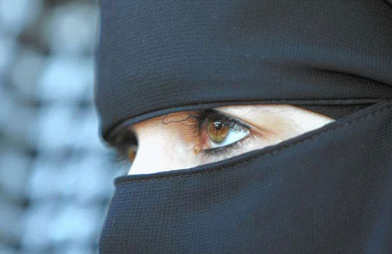
3 veiled women banned from entering France

June 13, 2012

Veiled_Women

Paris, June 13: A police union says three Saudi women who refused to remove their face veils at Paris' Charles de Gaulle airport have been barred entry to France.

A 2011 French law bans people from wearing Islamic face-covering veils anywhere in public.

An official with the SGP-FO police union said Tuesday that border police asked the women to remove their veils after they arrived Monday on a flight from Doha, Qatar. The official says the women refused, border police refused them entry in France, and they returned to Doha Monday night. The official spoke on condition of anonymity because he was not authorized to speak publicly for the police.

Supporters of the ban say the veil contradicts France's principles of secularism and women's rights. Some Muslim groups say it stigmatizes moderate Muslims.


Comments

Add new comment

  • Coastaldigest.com reserves the right to delete or block any comments.
  • Coastaldigset.com is not responsible for its readers’ comments.
  • Comments that are abusive, incendiary or irrelevant are strictly prohibited.
  • Please use a genuine email ID and provide your name to avoid reject.
News Network
May 12,2020

May 12: Gunmen stormed a hospital on Tuesday in an ongoing attack in the Afghan capital Kabul, as a suicide blast killed 15 people at a funeral in the country's restive east.

Special forces rescued 80 people including mothers and babies from the Kabul hospital after three gunmen launched a morning assault, killing at least four people, the interior ministry said in a statement.

Heavily armed forces were seen carrying babies wrapped in blankets away from the scene, as the clearance operation continued.

The facility, which has a large maternity ward, is located in the west of the city, home to the capital's minority Shiite Hazara community -- a frequent target of Sunni militants from the Islamic State group.

The flare-up in violence comes as Afghanistan grapples with myriad crises including a rise in militant operations across the country and a surge in coronavirus infections.

A paediatrician who fled the hospital told AFP he heard a loud explosion at the entrance of the building.

"The hospital was full of patients and doctors, there was total panic inside," he said, asking not to be named.

The maternity services at the hospital are supported by humanitarian organisation Doctors Without Borders (MSF).

"Hospitals and health workers must not be attacked. We call on all sides to stop attacking hospitals and health workers," said deputy health minister in the city, Waheed Majroh.

Around an hour later, a suicide bomber killed at least 15 people at the funeral of a local police commander in the country's eastern Nangarhar province, according to provincial spokesman Ataullah Khogyani.

The attacker detonated his explosives in the middle of the ceremony.

Zaher Adel, spokesman for the government hospital in Jalalabad, earlier said 12 bodies had arrived from the blast site and more than 50 people were being treated for injuries.

Amir Mohammad, who was wounded in the blast, said thousands of people had gathered for the funeral, an event which often draws huge crowds in Afghanistan.

The violence comes just a day after four roadside bombs exploded in a northern district of Kabul, wounding four civilians including a child.

The bombings were later claimed by the Islamic State group, according to the SITE intelligence group.

They were just the latest in a string of IS attacks on the capital.

In March, at least 25 people were killed by a gunman at a Sikh temple in Kabul, which was later claimed by the group.

IS is also responsible for an infamous attack in March 2017 on one of the country's largest hospitals, when gunmen disguised as doctors stormed the Kabul building and killed dozens.

In recent months, the jihadist group has suffered mounting setbacks after being hunted by US and Afghan forces as well as Taliban offensives targeting their fighters, but it still retains the ability to launch major assaults on urban centres.

The Taliban have largely refrained from launching large attacks on Afghan cities since February when they signed a landmark withdrawal deal with the US meant to pave the way for peace talks with the Kabul government.

Under the agreement, the Taliban promised not to target forces from the US-led coalition, but made no such pledge toward Afghan troops and have stepped up attacks in the provinces.

The Taliban have denied involvement in both of Tuesday's attacks.

Comments

Add new comment

  • Coastaldigest.com reserves the right to delete or block any comments.
  • Coastaldigset.com is not responsible for its readers’ comments.
  • Comments that are abusive, incendiary or irrelevant are strictly prohibited.
  • Please use a genuine email ID and provide your name to avoid reject.
News Network
February 21,2020

New Delhi, Feb 21: Global terror financing watchdog FATF on Friday decided continuation of Pakistan in the "Grey List" and warned the country that stern action will be taken if it fails to check flow of money to terror groups like the LeT and the JeM, sources said.

The decision has been taken at the Financial Action Task Force's plenary in Paris.

The FATF decided to continue Pakistani in the "Grey List". The FATF also warned Pakistan that if it doesn't complete a full action plan by June, it could lead to consequences on its businesses, a source said.

Comments

Add new comment

  • Coastaldigest.com reserves the right to delete or block any comments.
  • Coastaldigset.com is not responsible for its readers’ comments.
  • Comments that are abusive, incendiary or irrelevant are strictly prohibited.
  • Please use a genuine email ID and provide your name to avoid reject.
News Network
June 15,2020

Stockholm, Jun 15: Nuclear powers continue to modernise their arsenals, researchers said Monday, warning that tensions were rising and the outlook for arms control was "bleak".

"The loss of key channels of communication between Russia and the USA... could potentially lead to a new nuclear arms race," said Shannon Kile, director of the nuclear arms control programme at the Stockholm International Peace Research Institute (SIPRI) and co-author of the report.

Russia and the US account for more than 90 percent of the world's nuclear weapons.

Kile was referring to the future of the New START treaty between the US and Russia, which is set to expire in February 2021.

It is the final nuclear deal still in force between the two superpowers, aimed at maintaining their nuclear arsenals below Cold War levels.

"Discussions to extend New START or to negotiate a new treaty made no progress in 2019," the SIPRI researchers noted.

At the same time, nuclear powers continue to modernise their weapons while China and India are increasing the size of their arsenals.

"China is in the middle of a significant modernisation of its nuclear arsenal. It is developing a so-called nuclear triad for the first time, made up of new land- and sea-based missiles and nuclear-capable aircraft," SIPRI said.

The country has repeatedly rejected Washington's insistence that it join any future nuclear arms reduction talks.

The number of nuclear warheads declined in the past year.

At the start of 2020, the United States, Russia, Britain, China, India, Pakistan, Israel and North Korea together had 13,400 nuclear arms, according to SIPRI's estimates, 465 fewer than at the start of 2019.

The decline was attributed mainly to the United States and Russia.

While the future of the New START treaty remains uncertain, Washington and Moscow have continued to respect their obligations under the accord.

"In 2019, the forces of both countries remained below the limits specified by the treaty," the report said. But both nations "have extensive and expensive programmes underway to replace and modernise their nuclear warheads, missile and aircraft delivery systems, and nuclear weapon production facilities," it added.

"Both countries have also given new or expanded roles to nuclear weapons in their military plans and doctrines, which marks a significant reversal of the post-Cold War trend towards the gradual marginalisation of nuclear weapons."

The Treaty on the Non-Proliferation of Nuclear Weapons (NPT), a cornerstone of the global nuclear non-proliferation regime, celebrates its 50th anniversary this year.

The number of nuclear arms worldwide has declined since hitting a peak of almost 70,000 in the mid-1980s.

The five original nuclear powers -- Washington, Beijing, Moscow, Paris and London -- in March reiterated their commitment to the treaty.

Comments

Add new comment

  • Coastaldigest.com reserves the right to delete or block any comments.
  • Coastaldigset.com is not responsible for its readers’ comments.
  • Comments that are abusive, incendiary or irrelevant are strictly prohibited.
  • Please use a genuine email ID and provide your name to avoid reject.