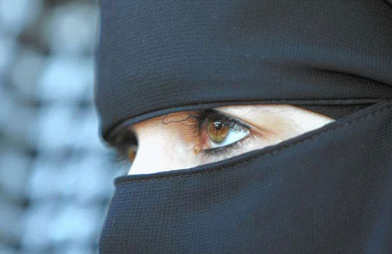
3 veiled women banned from entering France

June 13, 2012

Veiled_Women

Paris, June 13: A police union says three Saudi women who refused to remove their face veils at Paris' Charles de Gaulle airport have been barred entry to France.

A 2011 French law bans people from wearing Islamic face-covering veils anywhere in public.

An official with the SGP-FO police union said Tuesday that border police asked the women to remove their veils after they arrived Monday on a flight from Doha, Qatar. The official says the women refused, border police refused them entry in France, and they returned to Doha Monday night. The official spoke on condition of anonymity because he was not authorized to speak publicly for the police.

Supporters of the ban say the veil contradicts France's principles of secularism and women's rights. Some Muslim groups say it stigmatizes moderate Muslims.


Comments

Add new comment

  • Coastaldigest.com reserves the right to delete or block any comments.
  • Coastaldigset.com is not responsible for its readers’ comments.
  • Comments that are abusive, incendiary or irrelevant are strictly prohibited.
  • Please use a genuine email ID and provide your name to avoid reject.
Agencies
June 7,2020

Moscow, Jun 7: OPEC, Russia and allies agreed on Saturday to extend record oil production cuts until the end of July, prolonging a deal that has helped crude prices double in the past two months by withdrawing almost 10% of global supplies from the market.

The group, known as OPEC+, also demanded countries such as Nigeria and Iraq, which exceeded production quotas in May and June, compensate with extra cuts in July to September.

OPEC+ had initially agreed in April that it would cut supply by 9.7 million barrels per day (bpd) during May-June to prop up prices that collapsed due to the coronavirus crisis. Those cuts were due to taper to 7.7 million bpd from July to December.

“Demand is returning as big oil-consuming economies emerge from pandemic lockdown. But we are not out of the woods yet and challenges ahead remain,” Saudi Energy Minister Prince Abdulaziz bin Salman told the video conference of OPEC+ ministers.

Benchmark Brent crude climbed to a three-month high on Friday above $42 a barrel, after diving below $20 in April. Prices still remain a third lower than at the end of 2019.

“Prices can be expected to be strong from Monday, keeping their $40 plus levels,” said Bjornar Tonhaugen from Rystad Energy.

Saudi Arabia, OPEC’s de facto leader, and Russia have to perform a balancing act of pushing up oil prices to meet their budget needs while not driving them much above $50 a barrel to avoid encouraging a resurgence of rival U.S. shale production.

It was not immediately clear whether Saudi Arabia, the United Arab Emirates and Kuwait would extend beyond June their additional, voluntary cuts of 1.18 million bpd, which are not part of the deal.

BULGING INVENTORIES

The April deal was agreed under pressure from U.S. President Donald Trump, who wants to avoid U.S. oil industry bankruptcies.

Trump, who previously threatened to pull U.S. troops out of Saudi Arabia if Riyadh did not act, spoke to the Russian and Saudi leaders before Saturday’s talks, saying he was happy with the price recovery.

While oil prices have partially recovered, they are still well below the costs of most U.S. shale producers. Shutdowns, layoffs and cost cutting continue across the United States.

“I applaud OPEC-plus for reaching an important agreement today which comes at a pivotal time as oil demand continues to recover and economies reopen around the world,” U.S. Energy Secretary Dan Brouillette wrote on Twitter after the extension.

As global lockdowns ease, oil demand is expected to exceed supply sometime in July but OPEC has yet to clear 1 billion barrels of excess oil inventories accumulated since March.

Rystad’s Tonhaugen said Saturday’s decisions would help OPEC reduce inventories at a rate of 3 million to 4 million bpd in July-August. “The quicker stocks fall, the higher prices will get,” he said.

Nigeria’s petroleum ministry said Abuja backed the idea of compensating for its excessive output in May and June.

Iraq, with one of the worst compliance rates in May, agreed to extra cuts although it was not clear how Baghdad would reach agreement with oil majors on curbing Iraqi output.

Iraq produced 520,000 bpd above its quota in May, while overproduction by Nigeria was 120,000 bpd, Angola’s was 130,000 bpd, Kazakhstan’s was 180,000 bpd and Russia’s was 100,000 bpd, OPEC+ data showed.

OPEC+’s joint ministerial monitoring committee, known as the JMMC, will meet monthly until December to review the market, compliance and recommend levels of cuts. JMMC’s next meeting is scheduled for June 18.

OPEC and OPEC+ will hold their next scheduled meetings on Nov. 30-Dec. 1.

Comments

Add new comment

  • Coastaldigest.com reserves the right to delete or block any comments.
  • Coastaldigset.com is not responsible for its readers’ comments.
  • Comments that are abusive, incendiary or irrelevant are strictly prohibited.
  • Please use a genuine email ID and provide your name to avoid reject.
News Network
June 11,2020

Jun 11: The total death toll in the US from the novel coronavirus pandemic could hit the grim figure of 200,000 by September and expecting a dramatic decrease in COVID-19 cases in the country will be a "wishful thinking , an eminent Indian-American professor has warned.

Ashish Jha, the head of Harvard's Global Health Institute, told CNN on Wednesday that he is not trying to scare people to stay at home rather urged everyone to wear masks, adhere to the social distancing rules and called for ramping up testing and tracing infrastructure.

Anybody who's expecting a dramatic decrease in cases is almost surely engaging in wishful thinking. And if it (COVID numbers) stays just flat for the next three months, we're going to hit 200,000 deaths sometime in September and that is just awful, Jha said.

Jha said the 200,000 death toll is not just a guess . Currently 800-1000 people are dying daily in America from the virus and all data suggest that the situation is going to get worse.

We're gonna have increases, but even if we assume that it's going to be flat all summer, that nothing is going to get worse... even if we pick that low number of 800 a day, that is 25,000 (deaths) a month in three and a half months. We're going to add another 88,000 people and we will hit 200,000 sometime in September, Jha said.

The United States is by far the hardest-hit country in the global pandemic, in terms of both confirmed infections and deaths.

According to data by the Johns Hopkins University, the number of coronavirus cases in the US currently is nearly two million and about 112,900 people have died in the country, the most in the world.

When asked about an improvement in states like New York, which had been the epicenter of the COVID19 pandemic in the US, Jha said while coronavirus cases are declining in New York, New Jersey, Connecticut and Massachusetts, the numbers are increasing in states such as Arizona, Florida, Texas, North and South Carolina while the country as a whole is pretty flat.

He said, people should take measures as that will help suppress the virus and ensure people could get back outside safely but he voiced concern that this was not the situation in reality.

We're not doing that and so we're going to unfortunately have another 25,000 deaths a month until September, and then it'll keep going. It's not going to magically disappear. We've got a turn around. This is not the future I want, he said.

Jha said he had expected the situation to improve in the summer months but on the contrary the numbers have continued to rise even in the warm weather.

Summer was supposed to be our better months - warmer weather, people outside, a little less transmission. This is not the time (summer) I was expecting a lot more cases. We're seeing a lot more cases, especially in states like Arizona where the numbers look really scary, he said.

Jha added that he was hopeful that maybe the summer months would give us more of a break. I think I may have been too optimistic on that.

Comments

Add new comment

  • Coastaldigest.com reserves the right to delete or block any comments.
  • Coastaldigset.com is not responsible for its readers’ comments.
  • Comments that are abusive, incendiary or irrelevant are strictly prohibited.
  • Please use a genuine email ID and provide your name to avoid reject.
Agencies
May 8,2020

United Nations, May 8: UN Secretary-General Antonio Guterres said Friday the coronavirus pandemic keeps unleashing a tsunami of hate and xenophobia, scapegoating and scare-mongering. 

The UN chief said anti-foreigner sentiment has surged online and in the streets, anti-Semitic conspiracy theories have spread, and COVID-19-related anti-Muslim attacks have occurred. 

Guterres said migrants and refugees have been vilified as a source of the virus -- and then denied access to medical treatment. 

With older persons among the most vulnerable, contemptible memes have emerged suggesting they are also the most expendable, he said. 

And journalists, whistleblowers, health professionals, aid workers and human rights defenders are being targeted simply for doing their jobs. 

Guterres appealed for an all-out effort to end hate speech globally. The secretary-general called on political leaders to show solidarity with all people, on educational institutions to focus on digital literacy at a time when extremists are seeking to prey on captive and potentially despairing audiences. 

He called on the media, especially social media, to remove racist, misogynist and other harmful content, on civil society to strengthen their outreach to vulnerable people, and on religious figures to serve as models of mutual respect. 

And I ask everyone, everywhere, to stand up against hate, treat each other with dignity and take every opportunity to spread kindness, Guterres said.

The secretary-general stressed that COVID-19 does not care who we are, where we live, what we believe or about any other distinction. His global appeal to address and counter COVID-19-related hate speech follows his April 23 message calling the coronarivus pandemic a human crisis that is fast becoming a human rights crisis. 

Guterres said then that the pandemic has seen disproportionate effects on certain communities, the rise of hate speech, the targeting of vulnerable groups, and the risks of heavy-handed security responses undermining the health response. 

With rising ethno-nationalism, populism, authoritarianism and a push back against human rights in some countries, the crisis can provide a pretext to adopt repressive measures for purposes unrelated to the pandemic, he warned.

In February, Guterres issued a call to action to countries, businesses and people to help renew and revive human rights across the globe, laying out a seven-point plan amid concerns about climate change, conflict and repression.

Comments

Add new comment

  • Coastaldigest.com reserves the right to delete or block any comments.
  • Coastaldigset.com is not responsible for its readers’ comments.
  • Comments that are abusive, incendiary or irrelevant are strictly prohibited.
  • Please use a genuine email ID and provide your name to avoid reject.