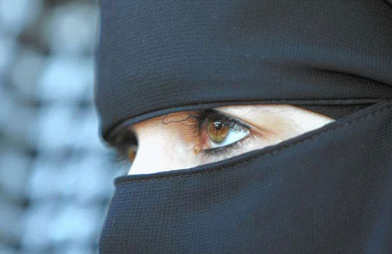
3 veiled women banned from entering France

June 13, 2012

Veiled_Women

Paris, June 13: A police union says three Saudi women who refused to remove their face veils at Paris' Charles de Gaulle airport have been barred entry to France.

A 2011 French law bans people from wearing Islamic face-covering veils anywhere in public.

An official with the SGP-FO police union said Tuesday that border police asked the women to remove their veils after they arrived Monday on a flight from Doha, Qatar. The official says the women refused, border police refused them entry in France, and they returned to Doha Monday night. The official spoke on condition of anonymity because he was not authorized to speak publicly for the police.

Supporters of the ban say the veil contradicts France's principles of secularism and women's rights. Some Muslim groups say it stigmatizes moderate Muslims.


Comments

Add new comment

  • Coastaldigest.com reserves the right to delete or block any comments.
  • Coastaldigset.com is not responsible for its readers’ comments.
  • Comments that are abusive, incendiary or irrelevant are strictly prohibited.
  • Please use a genuine email ID and provide your name to avoid reject.
News Network
May 27,2020

Washington, May 27: Most viruses and other germs do not spread easily on flights, the US Center for Disease Control and Prevention has said in its COVID-19 guidelines which do not recommend following social distancing between two passengers inside a plane or keeping the middle seat unoccupied.

As a result of coronavirus pandemic, air traffic inside the US has come to a near halt. Air traffic is said to be down to about 90 per cent. For all travellers coming from overseas, the Center for Disease Control and Prevention (CDC) has recommended 14 days quarantine.

"Most viruses and other germs do not spread easily on flights because of how air circulates and is filtered on aeroplanes," the CDC has said in its set of COVID-19 guidelines for air travellers.

However, it noted that the air travellers were not risk-free especially in the time of the coronavirus pandemic and recommended Americans to avoid travel as far as possible.

"Air travel requires spending time in security lines and airport terminals, which can bring you in close contact with other people and frequently touched surfaces," it said.

"Social distancing is difficult on crowded flights, and you may have to sit near others (within six feet), sometimes for hours. This may increase your risk for exposure to the virus that causes COVID-19," the CDC said.

But instead of recommended social distancing inside commercial planes, the CDC has advised a series of preventive and hygienic measures to be taken by the airlines pilot and crew to prevent the spread of coronavirus.

The US Department of Transportation and Federal Aviation Administration in its latest safety alerts for operators on May 11 said that air carriers and crews conducting flight operations having a nexus to the US, including both domestic and foreign air carriers, should follow CDC's occupational health and safety guidance.

The CDC issued its guidelines in first guidelines for the airlines and airline crew on March and again in May.

The CDC, which has issued an exhaustive social guideline measures in various sections, is silent on keeping the middle seat of a plane unoccupied so as to maintain the six feet distance between two passengers.

It calls for the plane crew to report to the CDC a traveller with specific COVID-19 symptoms like fever, persistent cough, difficulty in breathing and appearing unwell.

Asking the airlines and cabin crew to review infection control guidelines for cabin crew, the CDC recommends several measures for cabin crew to protect themselves and others, manage a sick traveller, clean contaminated areas, and take actions after a flight.

Prominent among them include washing hands often with soap and water for at least 20 seconds, particularly after assisting sick travellers or touching potentially contaminated body fluids or surfaces and use of alcohol-based hand sanitizer (containing at least 60 per cent alcohol) if soap and water are not available.

Airlines should consider providing alcohol-based hand sanitizer to cabin and flight crews for their personal use, it said.

The CDC guidelines do not recommend following social distancing inside a plane between two passengers or keeping the middle seat unoccupied. But it asks to minimise contact between passengers and cabin crew and the sick person.

"If possible, separate the sick person from others (by a distance of 2 meters or 6 feet, ideally) and designate one crew member to serve the sick person. Offer a facemask, if available and if the sick person can tolerate it. If a facemask is not available or cannot be tolerated, ask the sick person to cover their mouth and nose with tissues when coughing or sneezing," said the CDC guidelines.

If no symptomatic passengers were identified during or immediately after the flight, the CDC recommends airlines to follow routine operating procedures for cleaning aircraft, managing solid waste, and wearing PPE.

"If symptomatic passengers are identified during or immediately after the flight, routine cleaning procedures should be followed, and enhanced cleaning procedures should also be used," it said.

Clean porous (soft) surfaces (e.g, cloth seats, cloth seat belts) at the seat of the symptomatic passengers and within 6 feet of the symptomatic passengers in all directions, it added.


Comments

Add new comment

  • Coastaldigest.com reserves the right to delete or block any comments.
  • Coastaldigset.com is not responsible for its readers’ comments.
  • Comments that are abusive, incendiary or irrelevant are strictly prohibited.
  • Please use a genuine email ID and provide your name to avoid reject.
News Network
June 6,2020

United Nations, Jun 6: US President Donald Trump’s response to protests against the killing of African-American George Floyd has included language “directly associated with racial segregationists” from America's past, a group of UN human rights experts have said.

There have been widespread protests across the United States as Floyd, 46, was killed by a white police officer in Minneapolis. People from diverse backgrounds have called for justice and have voiced their support to the protests.

In the wake of protests over the killing of Floyd, Trump had tweeted that “when the looting starts, the shooting starts.”

“The response of the President of the United States to the protests at different junctures has included threatening more state violence using language directly associated with racial segregationists from the nation’s past, who worked hard to deny black people fundamental human rights," a statement issued on Friday by over 60 independent experts of the Special Procedures of the United Nations Human Rights Council said.

"We are deeply concerned that the nation is on the brink of a militarised response that reenacts the injustices that have driven people to the streets to protest,” it said.

A report in The New York Times had said that the phrase "When the looting starts, the shooting starts” was used by Miami’s former police chief Walter Headley in 1967. Headley had been “long accused of using racist tactics in his force’s patrols of black neighbourhoods,” the NYT had said.

They said the recent killing of Floyd has shocked many in the world, “but it is the lived reality of black people across the United States. The uprising nationally is a protest against systemic racism that produces state-sponsored racial violence, and licenses impunity for this violence.”

They noted that following the recent spate of killings of African-Americans, many in the United States and abroad are finally acknowledging that “the problem is not a few bad apples” but instead the problem is the very way that economic, political and social life are structured in a country that prides itself in liberal democracy, and with the largest economy in the world.

Separately, 28 UN experts called on the US Government to take decisive action to address systemic racism and racial bias in the country's criminal justice system by launching independent investigations and ensuring accountability in all cases of excessive use of force by police.

“Exactly 99 years after the massacre in Tulsa, involving the killing of people of African descent and the massive loss of life, destruction of property and loss of wealth on ‘Black Wall Street’, African Americans continue to experience racial terror in state-sponsored and privately organised violence,” the experts said.

Strongly condemning the killings of Ahmaud Arbery, Breonna Taylor and George Floyd, the experts called for systemic reform and justice. “Given the track record of impunity for racial violence of this nature in the United States, Black people have good reason to fear for their lives.”

Taylor, a 25-year-old emergency medical technician was shot in her bed when police raided the wrong house; Arbery, 25, was fatally shot while jogging near his home by three white men who chased and cornered him; and Floyd was accused of using counterfeit currency in a store and died in the street while a white officer knelt on his neck and three others participated and observed.

“The origin story of policing in the United States of America starts with slave patrols and social control, where human property of enslavers was ‘protected’ with violence and impunity against people of African descent. In the US, this legacy of racial terror remains evident in modern-day policing,” the experts said.

The experts also raised concern about the police response to demonstrations in several US cities, termed by some the ‘Fed Up-rising’, that have been marked by violence, arbitrary arrest, militarisation and the detention of thousands of protesters. Reporters of colour have been targeted and detained, and some journalists have faced violence and harassment.

“Statements from the US Government inciting and threatening violence against protesters stand in stark contrast to calls for leniency and understanding which the Government had issued in the wake of largely white protests against COVID-19 restrictions on services like barbershops, salons, and spas,” the experts said.

Comments

Add new comment

  • Coastaldigest.com reserves the right to delete or block any comments.
  • Coastaldigset.com is not responsible for its readers’ comments.
  • Comments that are abusive, incendiary or irrelevant are strictly prohibited.
  • Please use a genuine email ID and provide your name to avoid reject.
News Network
June 22,2020

Karachi, Jun 22: India-born renowned Pakistani Shia scholar and author Talib Jauhari passed away here after a prolonged illness. He was 80.

Jauhari, who was born on August 27, 1939 in Patna, is survived by his three sons, Dawn News reported on Monday.

He migrated to Pakistan along with his father in 1949, two years after the Partition.

After obtaining early education from his father, he went to Iraq where he studied religion for 10 years under the renowned Shia scholars of that time.

Jauhari, who was on a ventilator in the intensive care unit of a private hospital for the past 15 days, breathed his last on Sunday night.

His son Riaz Jauhari confirmed his death and said that the body has been shifted to Ancholi Imambargah for the funeral prayers, The Express Tribune newspaper quoted his son as saying.

Jauhari was respected among his sect as he was a class fellow of the widely revered scholar Ayatollah Sayyid Ali al-Husayni al-Sistani.

He was also a poet, historian and philosopher and authored many books.

Pakistan Prime Minister Imran Khan has condoled Jauhari's death.

Comments

Add new comment

  • Coastaldigest.com reserves the right to delete or block any comments.
  • Coastaldigset.com is not responsible for its readers’ comments.
  • Comments that are abusive, incendiary or irrelevant are strictly prohibited.
  • Please use a genuine email ID and provide your name to avoid reject.