


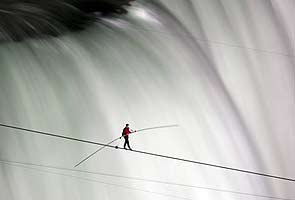
Nik Wallenda, first man to complete 1800-feet tightrope walk across Niagara Falls

June 16, 2012

niagara_falla_tightrope_walk.295

Ontario, Canada, June 16: Daredevil Nik Wallenda became the first person to walk on a tightrope across the Niagara Falls, taking steady, measured steps Friday night for 1,800 feet across the mist-fogged brink of the roaring falls separating the U.S. and Canada.

"I feel like I'm on cloud nine right now," an exuberant Wallenda told reporters after accomplishing what he said was his childhood dream before an estimated 112,000 people crowding the shores of both countries and millions more who watched a live television broadcast.

He described wind "coming from every which way," mist so powerful he had to blink it away to maintain his vision and a breathtaking view during the nighttime walk illuminated by spotlights that "compared to nothing."

"There was no way to focus on the movement of the cable," said Wallenda, 33. "If I looked down at the cable there was water moving everywhere. And if I looked up there was heavy mist blowing in front of my face. So it was a very unique, a weird sensation."

He said he accomplished the feat through "a lot of praying, that's for sure. But, you know, it's all about the concentration, the focus, and the training."

The seventh-generation member of the famed Flying Wallendas had long dreamed of pulling off the stunt, never before attempted. Other daredevils have wire-walked over the Niagara River but farther downstream and not since 1896.


"This is what dreams are made of, people," said Wallenda, who wore a microphone for the broadcast, shortly after he stepped off from a platform on the American shore.

Along the way, he calmly prayed aloud.

After passing the halfway mark, Wallenda expressed fatigue. "I'm strained, I'm drained," he said. "This is so physical, not only mental but physical."

Toward the end, as he neared the Canadian shore, Wallenda dropped to one knee and pumped his fist while the spectators cheered.


He broke into a playful run about 15 feet from the finish line, where his wife and three children waited.

"I am so blessed," he said later. "How blessed I am to have the life that I have."

ABC televised the walk and insisted Wallenda use a tether to keep him from falling in the river. Wallenda said he agreed because he wasn't willing to lose the chance to perform the walk it took him well over a year to win permission from two countries to do. Such stunts are normally illegal. ABC's sponsorship helped offset some of the $1.3 million cost of the spectacle.

Wallenda said he thought about the tether, which was secured at his waist and dragged behind him, at several points along the 30-minute walk but wasn't hindered by it as he'd feared.

"Awesome! The whole thing is awesome," 8-year-old William Clements of Dresden, Ontario, said after watching the walk with his family from the Canadian side, adding he wouldn't want to walk "even over something not high."

"He was meant to do it. The weather was perfect," said Glenda Rutherford of Ontario. "It was amazing."

For Wallenda, who has grown up on the high wire and holds six Guinness records for various stunts, the Niagara Falls walk was unlike anything he'd ever done. Because it was over water, the 2-inch wire didn't have the usual stabilizer cables to keep it from swinging. Pendulum anchors were designed to keep it from twisting under the elkskin-soled shoes designed by his mother.

The Wallendas trace their roots to 1780 Austria-Hungary, when ancestors traveled as a band of acrobats, aerialists, jugglers, animal trainers and trapeze artists. The clan has been touched by tragedy, notably in 1978 when patriarch Karl Wallenda, Nik's great-grandfather, fell to his death during a stunt in Puerto Rico.

Wallenda said that at one point in the middle of the walk, he thought about his great-grandfather and the walks he had taken:


"That's what this is all about, paying tribute to my ancestors, and my hero, Karl Wallenda."

About a dozen other tightrope artists have crossed the Niagara Gorge downstream, dating to Jean Francois Gravelet, aka The Great Blondin, in 1859. But no one had walked directly over the falls, and authorities hadn't allowed any tightrope acts in the area since 1896. It took Wallenda two years to persuade U.S. and Canadian authorities to allow it, and many civic leaders hoped to use the publicity to jumpstart the region's struggling economy, particularly on the U.S. side of the falls.



Comments

Add new comment

  • Coastaldigest.com reserves the right to delete or block any comments.
  • Coastaldigset.com is not responsible for its readers’ comments.
  • Comments that are abusive, incendiary or irrelevant are strictly prohibited.
  • Please use a genuine email ID and provide your name to avoid reject.
News Network
February 21,2020

Washington, Feb 21: US President Donald Trump has made yet another tall claim about the size of the crowd that will welcome him in Ahmedabad, saying Prime Minister Narendra Modi has told him that there will 10 million(1 crore) people to greet him on his arrival for his maiden visit to India.

President Trump and First Lady Melania are scheduled to travel to Ahmedabad, Agra and New Delhi on February 24 and 25.

Speaking to reporters at the Joint Base Andrews in Maryland on Tuesday, Trump said that Modi told him that "we'll have 7 million people between the airport and the event."

"So it's going to be very exciting. But he says between the stadium and the airport, we'll have about 7 million people. So it's going to be very exciting. I hope you all enjoy it," he said.

On Thursday, Trump upped the crowd size by three million at a 'Keep America Great' rally in Colorado.

"I hear, they are going to have 10 million people. They say anywhere from six to 10 million people are going to be showing up along the route to one of the largest stadiums in the world, the largest cricket stadium in the world, which is brand new and beautiful," said Trump, who is seeking reelection in the November presidential polls.

But according to a top civic official in Ahmedabad, the total population of the city is only around 70 lakh.

The authorities believe that between one to two lakh people are expected to line up along the 22-km route of the road show by Modi and Trump from the airport to the Motera cricket stadium, said to be the world's largest.

"We believe that around one to two lakh people will gather to welcome the dignitaries during the road show," Ahmedabad Municipal Commissioner Vijay Nehra said on Thursday, contradicting the claims made by the US President.

As per the road show route plan, Trump and Modi will first reach the Sabarmati Ashram, a place closely associated with Mahatma Gandhi, from Ahmedabad airport.

Addressing his supporters, Trump spoke about his India visit and said the "Namaste Trump" rally in Ahmedabad would spoil him.

"Prime Minister Modi said, we will have 10 million people greet you. Here's my problem. We have a packed house. We have a lot of people, thousands of people that couldn't get in. It's going to look like peanuts from now on," he said.

"I'll never be satisfied with the crowd. If we have 10 million people in India, how can I be satisfied when we fill up like a 60,000-seat stadium? I am getting spoiled," Trump said.

One of Trump's supporters from the audience then suggested that he build a bigger stadium.

Comments

Add new comment

  • Coastaldigest.com reserves the right to delete or block any comments.
  • Coastaldigset.com is not responsible for its readers’ comments.
  • Comments that are abusive, incendiary or irrelevant are strictly prohibited.
  • Please use a genuine email ID and provide your name to avoid reject.
News Network
July 24,2020

Kathmandu, Jul 24: At least 132 people lost their lives as a result of heavy rains triggering landslides, and flash floods in Nepal.

"132 people dead, 128 injured, 53 missing and 998 families affected due to rainfall, landslides and floods in the country as of 23rd July," Nepal Disaster Risk Reduction and Management Authority Within the last two weeks, the Myagdi district of western Nepal was the worst affected with 27 reported deaths.

Search and rescue operations are being conducted continuously with officials and police personnel who are looking through the debris to find missing people.

Monsoon-induced disasters are common in Nepal owing to the country's mountainous topography. Hundreds have been displaced as landslides have swept away their homes. They ended up taking refuge in local schools and community centers.

Nepal's Meteorological Forecasting Division earlier last week had predicted heavy downpour across the country. The Division had warned of monsoon winds being near the low-pressure line in the Terai belt, which would consequently cause more rainfall.

Comments

Add new comment

  • Coastaldigest.com reserves the right to delete or block any comments.
  • Coastaldigset.com is not responsible for its readers’ comments.
  • Comments that are abusive, incendiary or irrelevant are strictly prohibited.
  • Please use a genuine email ID and provide your name to avoid reject.
Agencies
April 25,2020

From loudspeakers on the roof of a Minnesota mosque, the Islamic call to prayer echoed for the first time ever throughout a Minneapolis neighbourhood late on Thursday as the Muslim community there prepared to begin the holy month of Ramadan.

It echoed again on Friday morning and will continue five times a day during the holy month. 

The simple, short call - known as the adhan - marked an historical moment for Minneapolis and major cities across the United States, community members said. While the adhan is commonly broadcast throughout the Middle East, North Africa and other places, for many Muslims in the US, it is only heard inside mosques or community centres.

"There's definitely a lot of excitement," said Imam Abdisalam Adam, who is on the board of the Dar al-Hijrah mosque, from where the adhan will be broadcast.
"Some people see it as historic," Adam told Al Jazeera. "To the point ... that they're not doing it, able to see it in their lifetime." 

Recited by different representatives from mosques around the city, the call to prayer is expected to reach thousands in the Cedar-Riverside neighbourhood in Minneapolis, according to Jaylani Hussein, the executive director of Minnesota's Council on American-Islamic Relations (CAIR).

While Hussein says the community had discussed broadcasting the call for years, it became even more pressing this year when the coronavirus pandemic forced mosques to shut their doors and residents to stay inside. The coronavirus has infected more than 870,000 people nationwide and killed at least 50,000.
"We wanted to touch those individuals who frequent this mosque and this community," Hussein said. "If we cannot be physically together, at least this echo, this voice, this call to prayer can be an extension of us being together at this difficult time. To give some people some solace."
Ramadan - Minnesota.

The Dar al-Hijrah mosque in the Cedar-Riverside neighbourhood of Minneapolis, Minnesota [Courtesy of Abdisalem Adam] 
Ramadan is traditionally a time when Muslims worldwide regularly attend mosques for daily prayers and break their fasts together. But this year, most have been told to pray at home and forgo community iftars in favour of staying safe from the COVID-19 crisis.

Adam, the imam, said while the Muslim community is experience loss this Ramadan, they hope the call to prayer broadcast will create a "semblance of normalcy".

"With the loss of Friday prayers and the regular congregational prayers, we are hoping that this will give a sense of solace and connection to the spiritual needs of community members," he added. 

An avenue to greater investment?

The Cedar-Riverside neighbourhood is a densely populated area of Minneapolis that has historically been an entry point for many immigrants and today is home to large Somali and Oromo communities.

Ramla Bile, a Somali American who lives in a neighbourhood adjacent to Cedar-Riverside, has been active in the community for years. She welcomed the broadcast of the call to prayer, saying it will help people "feel the spirit of Ramadan in a way that is meaningful".

But she also hopes the city of Minneapolis, which provided the noise permit for the broadcast, will make bigger strides to invest in the community in even more tangible ways.

"There's been a lot of need and a lot hurt in the community in light of the COVID-19 pandemic. And then there's the ongoing conversation you've been having," she said, pointing to deep-seated Islamophobia, systemic racism and the need for infrastructure projects like sprinkler systems in high-rise buildings. 

"We need to see greater investments to support the most vulnerable members of our community," Bile said referring to the neighbourhood's elders, undocumented individuals, low-income families and others.

"Right now, we're waiting for a bailout for our micro-businesses who comprise our Somali malls, or a rent freeze for neighbourhood residents," she added.

For CAIR's Hussein and Imam Adam, they hope this Ramadan's call to prayer helps encourage other communities around the US to take similar steps.

"This will hopefully inspire others … to think about what could happen in future Ramadans and beyond," Hussein said.

Adam added that while the virus has devastated communities and upended daily life, it has also shown that "we're in this together".

"It just shows the significance of the global village and how interconnected and interdependent we are as a world community," he said. "I think that there will be a lot of change in our way of life for the better. I hope so."


Comments

Add new comment

  • Coastaldigest.com reserves the right to delete or block any comments.
  • Coastaldigset.com is not responsible for its readers’ comments.
  • Comments that are abusive, incendiary or irrelevant are strictly prohibited.
  • Please use a genuine email ID and provide your name to avoid reject.