


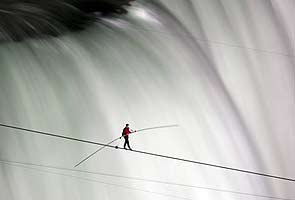
Nik Wallenda, first man to complete 1800-feet tightrope walk across Niagara Falls

June 16, 2012

niagara_falla_tightrope_walk.295

Ontario, Canada, June 16: Daredevil Nik Wallenda became the first person to walk on a tightrope across the Niagara Falls, taking steady, measured steps Friday night for 1,800 feet across the mist-fogged brink of the roaring falls separating the U.S. and Canada.

"I feel like I'm on cloud nine right now," an exuberant Wallenda told reporters after accomplishing what he said was his childhood dream before an estimated 112,000 people crowding the shores of both countries and millions more who watched a live television broadcast.

He described wind "coming from every which way," mist so powerful he had to blink it away to maintain his vision and a breathtaking view during the nighttime walk illuminated by spotlights that "compared to nothing."

"There was no way to focus on the movement of the cable," said Wallenda, 33. "If I looked down at the cable there was water moving everywhere. And if I looked up there was heavy mist blowing in front of my face. So it was a very unique, a weird sensation."

He said he accomplished the feat through "a lot of praying, that's for sure. But, you know, it's all about the concentration, the focus, and the training."

The seventh-generation member of the famed Flying Wallendas had long dreamed of pulling off the stunt, never before attempted. Other daredevils have wire-walked over the Niagara River but farther downstream and not since 1896.


"This is what dreams are made of, people," said Wallenda, who wore a microphone for the broadcast, shortly after he stepped off from a platform on the American shore.

Along the way, he calmly prayed aloud.

After passing the halfway mark, Wallenda expressed fatigue. "I'm strained, I'm drained," he said. "This is so physical, not only mental but physical."

Toward the end, as he neared the Canadian shore, Wallenda dropped to one knee and pumped his fist while the spectators cheered.


He broke into a playful run about 15 feet from the finish line, where his wife and three children waited.

"I am so blessed," he said later. "How blessed I am to have the life that I have."

ABC televised the walk and insisted Wallenda use a tether to keep him from falling in the river. Wallenda said he agreed because he wasn't willing to lose the chance to perform the walk it took him well over a year to win permission from two countries to do. Such stunts are normally illegal. ABC's sponsorship helped offset some of the $1.3 million cost of the spectacle.

Wallenda said he thought about the tether, which was secured at his waist and dragged behind him, at several points along the 30-minute walk but wasn't hindered by it as he'd feared.

"Awesome! The whole thing is awesome," 8-year-old William Clements of Dresden, Ontario, said after watching the walk with his family from the Canadian side, adding he wouldn't want to walk "even over something not high."

"He was meant to do it. The weather was perfect," said Glenda Rutherford of Ontario. "It was amazing."

For Wallenda, who has grown up on the high wire and holds six Guinness records for various stunts, the Niagara Falls walk was unlike anything he'd ever done. Because it was over water, the 2-inch wire didn't have the usual stabilizer cables to keep it from swinging. Pendulum anchors were designed to keep it from twisting under the elkskin-soled shoes designed by his mother.

The Wallendas trace their roots to 1780 Austria-Hungary, when ancestors traveled as a band of acrobats, aerialists, jugglers, animal trainers and trapeze artists. The clan has been touched by tragedy, notably in 1978 when patriarch Karl Wallenda, Nik's great-grandfather, fell to his death during a stunt in Puerto Rico.

Wallenda said that at one point in the middle of the walk, he thought about his great-grandfather and the walks he had taken:


"That's what this is all about, paying tribute to my ancestors, and my hero, Karl Wallenda."

About a dozen other tightrope artists have crossed the Niagara Gorge downstream, dating to Jean Francois Gravelet, aka The Great Blondin, in 1859. But no one had walked directly over the falls, and authorities hadn't allowed any tightrope acts in the area since 1896. It took Wallenda two years to persuade U.S. and Canadian authorities to allow it, and many civic leaders hoped to use the publicity to jumpstart the region's struggling economy, particularly on the U.S. side of the falls.



Comments

Add new comment

  • Coastaldigest.com reserves the right to delete or block any comments.
  • Coastaldigset.com is not responsible for its readers’ comments.
  • Comments that are abusive, incendiary or irrelevant are strictly prohibited.
  • Please use a genuine email ID and provide your name to avoid reject.
April 5,2020

Washington, Apr 5: US President Donald Trump on Saturday said that he has requested Prime Minister Narendra Modi to supply Hydroxychloroquine tablets that can be used to treat COVID-19 patients.

"After call today with Indian Prime Minister Narendra Modi, India is giving serious consideration to releasing the hold it put on a US order for hydroxychloroquine," Trump announced at the White House Coronavirus task force briefing that he requested PM Narendra Modi for more Hydroxychloroquine tablets.

President Trump did not shy away from saying he too will take a tablet of hydroxychloroquine after announcing that he has requested Prime Minister during his telephonic conversation earlier today to lift a hold on the US order of the medicine.

"I may take it too, will have to talk to my doctors," he added.

"India makes a lot of it. They need a lot too for their billion-plus people. 

The hydroxychloroquine, the anti-malaria drug will be released through the Strategic National Stockpile for treatment," he said.

"I said I would appreciate if they would release the amounts that we ordered" of hydroxychloroquine, he said.

The Indian government has put on hold the export of anti-malarial drug hydroxychloroquine and its formulations.

Prime Minister Narendra Modi said on Twitter, "Had an extensive telephone conversation with President @realDonaldTrump. 

We had a good discussion, and agreed to deploy the full strength of the India-US partnership to fight COVID-19."

Prime Minister conveyed deep condolences for the loss of lives in the United States and his prayers for the early recovery of those still suffering from the disease.

As on Sunday, the United States has at least 301,902 cases of coronavirus according to Johns Hopkins University's tally. 

At least 8,175 people have died in the US from coronavirus.

There was a steep rise in the number of cases in the last 24 hours. At least 23,949 new cases were reported, and at least 1,023 new deaths in the US have been reported in the last 24 hours.

US Secretary of State Michael Pompeo had discussions with External Affairs Minister S Jaishankar about the importance of continued close cooperation between the United States and India to combat coronavirus by strengthening global pharmaceutical supply chains.

Comments

Add new comment

  • Coastaldigest.com reserves the right to delete or block any comments.
  • Coastaldigset.com is not responsible for its readers’ comments.
  • Comments that are abusive, incendiary or irrelevant are strictly prohibited.
  • Please use a genuine email ID and provide your name to avoid reject.
News Network
March 16,2020

New Delhi, Mar 16: Due to the coronavirus pandemic, most airlines in the world will be bankrupt by the end of May and only a coordinated government and industry action right now can avoid the catastrophe, said global aviation consultancy firm CAPA in a note on Monday.

"As the impact of the coronavirus and multiple government travel reactions sweep through our world, many airlines have probably already been driven into technical bankruptcy, or are at least substantially in breach of debt covenants," it stated.

Across the world, airlines have announced drastic reduction in their operations in the wake of the coronavirus outbreak. For example, Atlanta-based Delta Air Lines stated on Sunday that it would be grounding 300 aircraft in its fleet and reduce flights by 40 per cent.

The US has suspended all tourist visas for people belonging to the European Union, the UK and Ireland. Similarly, the Indian government has suspended all tourist visas and e-visas granted on or before March 11.

CAPA, in its note on Monday, said, "By the end of May-2020, most airlines in the world will be bankrupt. Coordinated government and industry action is needed - now - if catastrophe is to be avoided."

Cash reserves are running down quickly as fleets are grounded and "what flights there are operate much less than half full", it added.

"Forward bookings are far outweighed by cancellations and each time there is a new government recommendation it is to discourage flying. Demand is drying up in ways that are completely unprecedented. Normality is not yet on the horizon," it said.

India's largest airline IndiGo -- which has around 260 planes in its fleet -- said on Thursday that it has seen a decline of 15-20 per cent in daily bookings in the last few days.

The low-cost carrier had stated that it expects its quarterly earnings to be materially impacted due to such decline.

CAPA said the failure to coordinate the future will result in protectionism and much less competition.

"The alternative does not bear thinking about. An unstructured and nationalistic outcome will not be survival of the fittest.

"It will mostly consist of airlines that are the biggest and the best-supported by their governments. The system will reek of nationalism. And it will not serve the needs of the 21st century world. That is not a prospect that any responsible government should be prepared to contemplate," the consultancy firm said.

Comments

Add new comment

  • Coastaldigest.com reserves the right to delete or block any comments.
  • Coastaldigset.com is not responsible for its readers’ comments.
  • Comments that are abusive, incendiary or irrelevant are strictly prohibited.
  • Please use a genuine email ID and provide your name to avoid reject.
News Network
February 9,2020

Beijing, Feb 9: After making sure everyone's face mask is on and sanitizer is to hand, the Qiao family heads out to Jingshan Park, a former royal sanctuary beside the Forbidden City in China's capital Beijing.

Snow has fallen for a second day, a rare event in the city of 21.5 million that would normally bring hundreds of thousands of people out to take photos and play. But the streets are empty and the parks are so quiet the only sound is of birds chirping.

It's not just Beijing. Shanghai, China's financial hub, and other cities in the world's most populous nation have turned into ghost towns after the government extended a holiday and asked residents not to go out because of the coronavirus.

"We know the situation of the coronavirus is severe. But the epicentre is far away, so we think it should be fine here ... It's a God-given chance to enjoy this family moment with snow and without work," said Mr Qiao, who has an 11-year-old daughter.

The epidemic has killed 722 people and infected nearly 32,000 in China as of February 8. More than three-quarters of the cases are in the central Hubei province where the virus originated - more than 1,000 km (620 miles) from Beijing.

Only a few people are brave enough to come out. A security guard at Jingshan Park said there were less than a third of the number of tourists than usual, even with the rare snowfall.

Even at one of the best spots for snapping photos of snowy Beijing just outside the Forbidden City, there's barely a crowd, while the usual tour buses and groups of people speaking different dialects are nowhere to be seen.

"Last year when it snowed, I took a few hours off work to come down here to take a picture and the crowd was several layers deep," said a man in his 30s who gave his surname as Yang. "But this year, I am not at all worried about finding a space to take a photo. The virus is keeping people indoors."

Security guards along Wangfujing street, a popular pedestrianised shopping area in downtown Beijing, said it was normally so crowded during the holiday period that it was hard to move around.

"Look at it now, there are more security guards and street cleaners than tourists!" said one of the guards.

Businesses, including shops, bars and restaurants, have been severely hit by the epidemic as the government has banned mass gatherings and even group meals in an effort to curb the spread of the coronavirus.

"You would have to wait outside for a table on a normal day," said a waitress at a restaurant with more than 50 tables. Just five were taken at the peak lunch hour.

Only a handful of the more than 100 restaurants along Beijing's famous food street, Guijie, were open, and the remaining outlets were wondering how long they can hold out.

Comments

Add new comment

  • Coastaldigest.com reserves the right to delete or block any comments.
  • Coastaldigset.com is not responsible for its readers’ comments.
  • Comments that are abusive, incendiary or irrelevant are strictly prohibited.
  • Please use a genuine email ID and provide your name to avoid reject.