


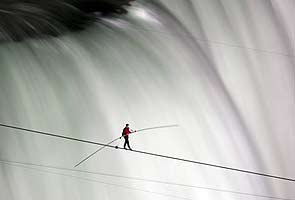
Nik Wallenda, first man to complete 1800-feet tightrope walk across Niagara Falls

June 16, 2012

niagara_falla_tightrope_walk.295

Ontario, Canada, June 16: Daredevil Nik Wallenda became the first person to walk on a tightrope across the Niagara Falls, taking steady, measured steps Friday night for 1,800 feet across the mist-fogged brink of the roaring falls separating the U.S. and Canada.

"I feel like I'm on cloud nine right now," an exuberant Wallenda told reporters after accomplishing what he said was his childhood dream before an estimated 112,000 people crowding the shores of both countries and millions more who watched a live television broadcast.

He described wind "coming from every which way," mist so powerful he had to blink it away to maintain his vision and a breathtaking view during the nighttime walk illuminated by spotlights that "compared to nothing."

"There was no way to focus on the movement of the cable," said Wallenda, 33. "If I looked down at the cable there was water moving everywhere. And if I looked up there was heavy mist blowing in front of my face. So it was a very unique, a weird sensation."

He said he accomplished the feat through "a lot of praying, that's for sure. But, you know, it's all about the concentration, the focus, and the training."

The seventh-generation member of the famed Flying Wallendas had long dreamed of pulling off the stunt, never before attempted. Other daredevils have wire-walked over the Niagara River but farther downstream and not since 1896.


"This is what dreams are made of, people," said Wallenda, who wore a microphone for the broadcast, shortly after he stepped off from a platform on the American shore.

Along the way, he calmly prayed aloud.

After passing the halfway mark, Wallenda expressed fatigue. "I'm strained, I'm drained," he said. "This is so physical, not only mental but physical."

Toward the end, as he neared the Canadian shore, Wallenda dropped to one knee and pumped his fist while the spectators cheered.


He broke into a playful run about 15 feet from the finish line, where his wife and three children waited.

"I am so blessed," he said later. "How blessed I am to have the life that I have."

ABC televised the walk and insisted Wallenda use a tether to keep him from falling in the river. Wallenda said he agreed because he wasn't willing to lose the chance to perform the walk it took him well over a year to win permission from two countries to do. Such stunts are normally illegal. ABC's sponsorship helped offset some of the $1.3 million cost of the spectacle.

Wallenda said he thought about the tether, which was secured at his waist and dragged behind him, at several points along the 30-minute walk but wasn't hindered by it as he'd feared.

"Awesome! The whole thing is awesome," 8-year-old William Clements of Dresden, Ontario, said after watching the walk with his family from the Canadian side, adding he wouldn't want to walk "even over something not high."

"He was meant to do it. The weather was perfect," said Glenda Rutherford of Ontario. "It was amazing."

For Wallenda, who has grown up on the high wire and holds six Guinness records for various stunts, the Niagara Falls walk was unlike anything he'd ever done. Because it was over water, the 2-inch wire didn't have the usual stabilizer cables to keep it from swinging. Pendulum anchors were designed to keep it from twisting under the elkskin-soled shoes designed by his mother.

The Wallendas trace their roots to 1780 Austria-Hungary, when ancestors traveled as a band of acrobats, aerialists, jugglers, animal trainers and trapeze artists. The clan has been touched by tragedy, notably in 1978 when patriarch Karl Wallenda, Nik's great-grandfather, fell to his death during a stunt in Puerto Rico.

Wallenda said that at one point in the middle of the walk, he thought about his great-grandfather and the walks he had taken:


"That's what this is all about, paying tribute to my ancestors, and my hero, Karl Wallenda."

About a dozen other tightrope artists have crossed the Niagara Gorge downstream, dating to Jean Francois Gravelet, aka The Great Blondin, in 1859. But no one had walked directly over the falls, and authorities hadn't allowed any tightrope acts in the area since 1896. It took Wallenda two years to persuade U.S. and Canadian authorities to allow it, and many civic leaders hoped to use the publicity to jumpstart the region's struggling economy, particularly on the U.S. side of the falls.



Comments

Add new comment

  • Coastaldigest.com reserves the right to delete or block any comments.
  • Coastaldigset.com is not responsible for its readers’ comments.
  • Comments that are abusive, incendiary or irrelevant are strictly prohibited.
  • Please use a genuine email ID and provide your name to avoid reject.
Agencies
August 1,2020

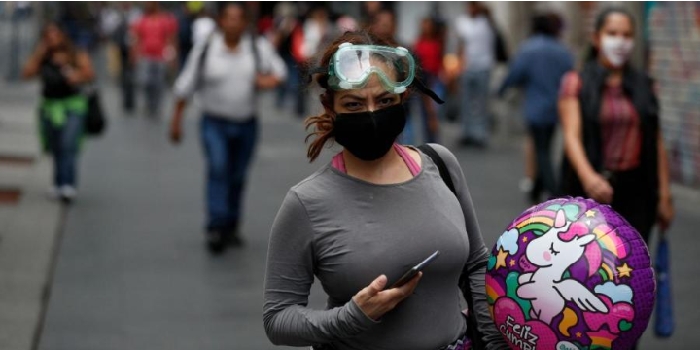
Mexico City, Aug 1: The number of people, who have died of COVID-19 in Mexico, has risen by 688 to 46,688 within the past 24 hours, Deputy Health Minister Hugo Lopez-Gatell said.

The number of victims in Mexico is now higher than in the United Kingdom, where 46,119 people have died of the disease. The largest number of fatalities - 153,311 - has been recorded in the United States, while Brazil comes second with 92,475 deaths.

Lopez-Gatell also said on late Friday that the number of confirmed coronavirus cases had increased by 8,458 to 424,637 over the past day.

A day earlier, the Latin American nation recorded 7,730 new cases of the coronavirus, with 639 fatalities.

The World Health Organisation (WHO) declared the COVID-19 outbreak a pandemic on March 11. To date, over 17.5 million people have been infected with the coronavirus worldwide, with over 677,000 fatalities, according to Johns Hopkins University.

Comments

Add new comment

  • Coastaldigest.com reserves the right to delete or block any comments.
  • Coastaldigset.com is not responsible for its readers’ comments.
  • Comments that are abusive, incendiary or irrelevant are strictly prohibited.
  • Please use a genuine email ID and provide your name to avoid reject.
News Network
January 3,2020

New Delhi, Jan 3: US aviation regulator Federal Aviation Administration on Thursday warned America's airlines and their pilots that there is risk involved in operating flights in Pakistan airspace due to "extremist or militant activity", according to an official document.

"Exercise caution during flight operations. There is a risk to US civil aviation operating in the territory and airspace of Pakistan due to extremist/militant activity," said the US Federal Aviation Administration (FAA) in a notice to airmen (NOTAM) dated December 30, 2019.

The NOTAM is applicable to all US-based airlines and US-based pilots.

The US regulator said in its NOTAM that there continues to be a risk to US civil aviation sector from attacks against airports and aircraft in Pakistan, particularly for aircraft on the ground and aircraft operating at low altitudes, including during the arrival and departure phases of flights.

"The ongoing presence of extremist/militant elements operating in Pakistan poses a continued risk to US civil aviation from small-arms fire, complex attacks against airports, indirect weapons fire, and anti-aircraft fire, any of which could occur with little or no warning," it said.

The FAA said that while, to date, there have been no reports of man-portable air defense systems or Manpads being used against the civil aviation sector in Pakistan, some extremist or terrorist groups operating there are suspected of having access to these Manpads.

"As a result, there is potential risk for extremists/militants to target civil aviation in Pakistan with Manpads," it said.

The regulator added that pilots or airlines must report safety or security incidents - which may happen in Pakistan - to the FAA.

Pakistan on July 16 last year opened its airspace for India after about five months of restrictions imposed in the wake of a standoff with New Delhi.

Following the Balakot airstrikes by the Indian Air Force, Pakistan had closed its airspace on February 26 last year.

Pakistan in October last year had denied India's request to allow Prime Minister Narendra Modi's VVIP flight to use its airspace for his visit to Saudi Arabia over the Jammu and Kashmir issue.

Comments

Add new comment

  • Coastaldigest.com reserves the right to delete or block any comments.
  • Coastaldigset.com is not responsible for its readers’ comments.
  • Comments that are abusive, incendiary or irrelevant are strictly prohibited.
  • Please use a genuine email ID and provide your name to avoid reject.
Agencies
June 7,2020

Moscow, Jun 7: OPEC, Russia and allies agreed on Saturday to extend record oil production cuts until the end of July, prolonging a deal that has helped crude prices double in the past two months by withdrawing almost 10% of global supplies from the market.

The group, known as OPEC+, also demanded countries such as Nigeria and Iraq, which exceeded production quotas in May and June, compensate with extra cuts in July to September.

OPEC+ had initially agreed in April that it would cut supply by 9.7 million barrels per day (bpd) during May-June to prop up prices that collapsed due to the coronavirus crisis. Those cuts were due to taper to 7.7 million bpd from July to December.

“Demand is returning as big oil-consuming economies emerge from pandemic lockdown. But we are not out of the woods yet and challenges ahead remain,” Saudi Energy Minister Prince Abdulaziz bin Salman told the video conference of OPEC+ ministers.

Benchmark Brent crude climbed to a three-month high on Friday above $42 a barrel, after diving below $20 in April. Prices still remain a third lower than at the end of 2019.

“Prices can be expected to be strong from Monday, keeping their $40 plus levels,” said Bjornar Tonhaugen from Rystad Energy.

Saudi Arabia, OPEC’s de facto leader, and Russia have to perform a balancing act of pushing up oil prices to meet their budget needs while not driving them much above $50 a barrel to avoid encouraging a resurgence of rival U.S. shale production.

It was not immediately clear whether Saudi Arabia, the United Arab Emirates and Kuwait would extend beyond June their additional, voluntary cuts of 1.18 million bpd, which are not part of the deal.

BULGING INVENTORIES

The April deal was agreed under pressure from U.S. President Donald Trump, who wants to avoid U.S. oil industry bankruptcies.

Trump, who previously threatened to pull U.S. troops out of Saudi Arabia if Riyadh did not act, spoke to the Russian and Saudi leaders before Saturday’s talks, saying he was happy with the price recovery.

While oil prices have partially recovered, they are still well below the costs of most U.S. shale producers. Shutdowns, layoffs and cost cutting continue across the United States.

“I applaud OPEC-plus for reaching an important agreement today which comes at a pivotal time as oil demand continues to recover and economies reopen around the world,” U.S. Energy Secretary Dan Brouillette wrote on Twitter after the extension.

As global lockdowns ease, oil demand is expected to exceed supply sometime in July but OPEC has yet to clear 1 billion barrels of excess oil inventories accumulated since March.

Rystad’s Tonhaugen said Saturday’s decisions would help OPEC reduce inventories at a rate of 3 million to 4 million bpd in July-August. “The quicker stocks fall, the higher prices will get,” he said.

Nigeria’s petroleum ministry said Abuja backed the idea of compensating for its excessive output in May and June.

Iraq, with one of the worst compliance rates in May, agreed to extra cuts although it was not clear how Baghdad would reach agreement with oil majors on curbing Iraqi output.

Iraq produced 520,000 bpd above its quota in May, while overproduction by Nigeria was 120,000 bpd, Angola’s was 130,000 bpd, Kazakhstan’s was 180,000 bpd and Russia’s was 100,000 bpd, OPEC+ data showed.

OPEC+’s joint ministerial monitoring committee, known as the JMMC, will meet monthly until December to review the market, compliance and recommend levels of cuts. JMMC’s next meeting is scheduled for June 18.

OPEC and OPEC+ will hold their next scheduled meetings on Nov. 30-Dec. 1.

Comments

Add new comment

  • Coastaldigest.com reserves the right to delete or block any comments.
  • Coastaldigset.com is not responsible for its readers’ comments.
  • Comments that are abusive, incendiary or irrelevant are strictly prohibited.
  • Please use a genuine email ID and provide your name to avoid reject.