


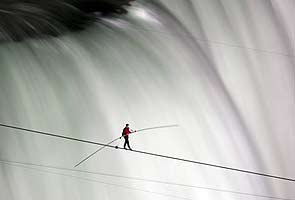
Nik Wallenda, first man to complete 1800-feet tightrope walk across Niagara Falls

June 16, 2012

niagara_falla_tightrope_walk.295

Ontario, Canada, June 16: Daredevil Nik Wallenda became the first person to walk on a tightrope across the Niagara Falls, taking steady, measured steps Friday night for 1,800 feet across the mist-fogged brink of the roaring falls separating the U.S. and Canada.

"I feel like I'm on cloud nine right now," an exuberant Wallenda told reporters after accomplishing what he said was his childhood dream before an estimated 112,000 people crowding the shores of both countries and millions more who watched a live television broadcast.

He described wind "coming from every which way," mist so powerful he had to blink it away to maintain his vision and a breathtaking view during the nighttime walk illuminated by spotlights that "compared to nothing."

"There was no way to focus on the movement of the cable," said Wallenda, 33. "If I looked down at the cable there was water moving everywhere. And if I looked up there was heavy mist blowing in front of my face. So it was a very unique, a weird sensation."

He said he accomplished the feat through "a lot of praying, that's for sure. But, you know, it's all about the concentration, the focus, and the training."

The seventh-generation member of the famed Flying Wallendas had long dreamed of pulling off the stunt, never before attempted. Other daredevils have wire-walked over the Niagara River but farther downstream and not since 1896.


"This is what dreams are made of, people," said Wallenda, who wore a microphone for the broadcast, shortly after he stepped off from a platform on the American shore.

Along the way, he calmly prayed aloud.

After passing the halfway mark, Wallenda expressed fatigue. "I'm strained, I'm drained," he said. "This is so physical, not only mental but physical."

Toward the end, as he neared the Canadian shore, Wallenda dropped to one knee and pumped his fist while the spectators cheered.


He broke into a playful run about 15 feet from the finish line, where his wife and three children waited.

"I am so blessed," he said later. "How blessed I am to have the life that I have."

ABC televised the walk and insisted Wallenda use a tether to keep him from falling in the river. Wallenda said he agreed because he wasn't willing to lose the chance to perform the walk it took him well over a year to win permission from two countries to do. Such stunts are normally illegal. ABC's sponsorship helped offset some of the $1.3 million cost of the spectacle.

Wallenda said he thought about the tether, which was secured at his waist and dragged behind him, at several points along the 30-minute walk but wasn't hindered by it as he'd feared.

"Awesome! The whole thing is awesome," 8-year-old William Clements of Dresden, Ontario, said after watching the walk with his family from the Canadian side, adding he wouldn't want to walk "even over something not high."

"He was meant to do it. The weather was perfect," said Glenda Rutherford of Ontario. "It was amazing."

For Wallenda, who has grown up on the high wire and holds six Guinness records for various stunts, the Niagara Falls walk was unlike anything he'd ever done. Because it was over water, the 2-inch wire didn't have the usual stabilizer cables to keep it from swinging. Pendulum anchors were designed to keep it from twisting under the elkskin-soled shoes designed by his mother.

The Wallendas trace their roots to 1780 Austria-Hungary, when ancestors traveled as a band of acrobats, aerialists, jugglers, animal trainers and trapeze artists. The clan has been touched by tragedy, notably in 1978 when patriarch Karl Wallenda, Nik's great-grandfather, fell to his death during a stunt in Puerto Rico.

Wallenda said that at one point in the middle of the walk, he thought about his great-grandfather and the walks he had taken:


"That's what this is all about, paying tribute to my ancestors, and my hero, Karl Wallenda."

About a dozen other tightrope artists have crossed the Niagara Gorge downstream, dating to Jean Francois Gravelet, aka The Great Blondin, in 1859. But no one had walked directly over the falls, and authorities hadn't allowed any tightrope acts in the area since 1896. It took Wallenda two years to persuade U.S. and Canadian authorities to allow it, and many civic leaders hoped to use the publicity to jumpstart the region's struggling economy, particularly on the U.S. side of the falls.



Comments

Add new comment

  • Coastaldigest.com reserves the right to delete or block any comments.
  • Coastaldigset.com is not responsible for its readers’ comments.
  • Comments that are abusive, incendiary or irrelevant are strictly prohibited.
  • Please use a genuine email ID and provide your name to avoid reject.
News Network
January 27,2020

Kabul, Jan 27: A passenger plane crashed on Monday in a Taliban-held area of Afghanistan's Ghazni province, local officials said.

Arif Noori, spokesman for the provincial governor, said the plane went down around 1:10 p.m. local time in Deh Yak district, which is held by the Taliban. Two provincial council members also confirmed the crash.

The number of people on board and their fate was not immediately known, nor was the cause of the crash.

Ariana Airlines, Afghanistan's national carrier, dismissed the claim that one of their planes had crashed in a statement on their website, saying all their aircraft were operational and safe.

The mountainous Ghazni province sits in the foothills of the Hindu Kush mountains and is bitterly cold in winter.

The last major commercial air crash in Afghanistan occurred in 2005 when a Kam Air flight from western Herat to the capital Kabul crashed into the mountains as it tried to land in snowy weather.

The war however has seen a number of deadly crashes of military aircraft. One of the most spectacular occurred in 2013 when an American Boeing 747 cargo jet crashed shortly after takeoff from Bagram air base north of Kabul en route to Dubai in the United Arab Emirates. All seven crew member were killed.

Afghanistan's aviation industry suffered desperately during the rule of the Taliban when its only airline Ariana was subject to punishing sanctions and allowed to fly only to Saudi Arabia for Hajj flights.

Since the overthrow of the religious regime smaller private airlines have emerged but the industry is still a nascent one.

Comments

Add new comment

  • Coastaldigest.com reserves the right to delete or block any comments.
  • Coastaldigset.com is not responsible for its readers’ comments.
  • Comments that are abusive, incendiary or irrelevant are strictly prohibited.
  • Please use a genuine email ID and provide your name to avoid reject.
Agencies
March 15,2020

Tehran, Mar 15: Two hundred and thirty-four Indians stranded in coronavirus-hit Iran have arrived in India, External Affairs Minister S Jaishankar said on Sunday.

The batch comprises 131 students and 103 pilgrims, he said.

“234 Indians stranded in Iran have arrived in India; including 131 students and 103 pilgrims. Thank you Ambassador Dhamu Gaddam and @India_in_Iran team for your efforts. Thank Iranian authorities,” Jaishankar tweeted.

The third batch of Indians from Iran arrived early Sunday. A second batch of 44 Indian pilgrims had arrived from Iran on Friday.

Iran is one of the worst-affected countries by the coronavirus outbreak and the government has been working on plans to bring back Indians stranded there.

The first batch of 58 Indian pilgrims were brought back from Iran on Tuesday.

Comments

Add new comment

  • Coastaldigest.com reserves the right to delete or block any comments.
  • Coastaldigset.com is not responsible for its readers’ comments.
  • Comments that are abusive, incendiary or irrelevant are strictly prohibited.
  • Please use a genuine email ID and provide your name to avoid reject.
News Network
July 3,2020

Islamabad, Jul 3: The US embassy here in a statement on Friday said the Trump administration through the US Agency for International Development (USAID) “donated a shipment of 100 brand-new, state-of-the-art ventilators” to Pakistan.

The ventilators arrived in Karachi on July 2 and will be sent to hospitals across Pakistan.

“This donation delivers on President Donald Trump’s generous offer of these critically-needed supplies and supports Pakistan’s urgent response to the pandemic,” the embassy said.

Made in America, the ventilators are valued at about $3 million and reflect the latest in cutting-edge medical design and technology, it said.

They are compact, easily deployable, and will enable Pakistan to more effectively treat patients suffering from Covid-19.

The US-Pakistan health partnership to curb the spread of the novel coronavirus is helping to improve and expand laboratory testing, disease monitoring, case tracking, infection prevention and control and patient care, the embassy said.

The US has contributed nearly $27 million in new funding so far to this vital partnership that is growing every day. "We are also thankful for Pakistan's contribution of medical supplies to help fight coronavirus in the US," the embassy said in the statement.

Ambassador Paul Jones said, “The US stands with Pakistan in its fight against the coronavirus. These American-made ventilators will help Pakistani patients in the most acute need of medical care."

The announcement comes days after Pakistan said it had started producing locally designed ventilators.

Pakistan reported 78 more deaths from the coronavirus in the past 24 hours, raising virus-related fatalities to 4,551 while the total number of confirmed cases has increased to 221,896.

On Friday, the health authorities said 1,13,623 persons have recovered from the coronavirus, surpassing the number of active Covid-19 infections in the country for the first time.

Comments

Add new comment

  • Coastaldigest.com reserves the right to delete or block any comments.
  • Coastaldigset.com is not responsible for its readers’ comments.
  • Comments that are abusive, incendiary or irrelevant are strictly prohibited.
  • Please use a genuine email ID and provide your name to avoid reject.